
Welcome to Synagogue Stories: The Pale of Settlement
This collaborative project functions as a resource supplementing the Montreal Jewish Museum’s Official Collateral Event at La Biennale di Venezia: Nabatele, an open-air installation by Anna Kamyshan.
In these stories, which highlight synagogues past and present in Montreal, Italy, and the former Pale of Settlement, readers will recognize aspects of Nabatele through architectural references and the life it could sustain within. Spanning geography, tradition, and time, these synagogues reveal themselves to be more than houses of worship; they are also sites of collective memory, resilience, and belonging. For the synagogues that no longer stand, the legacy of their congregants becomes their ultimate Ner Tamid: the enduring light.
Here, we bring our attention to The Pale, featuring synagogues such as The Wołpa Synagogue, The Great Synagogue of Luboml, the Synagogue of Piaski (Synagoga Piaskower), the Synagogue of Zelwa (Synagogue w Zelva), and the Synagogue of Gwoździec (Synagogue w Gwoźdźcu).
The Wołpa Synagogue
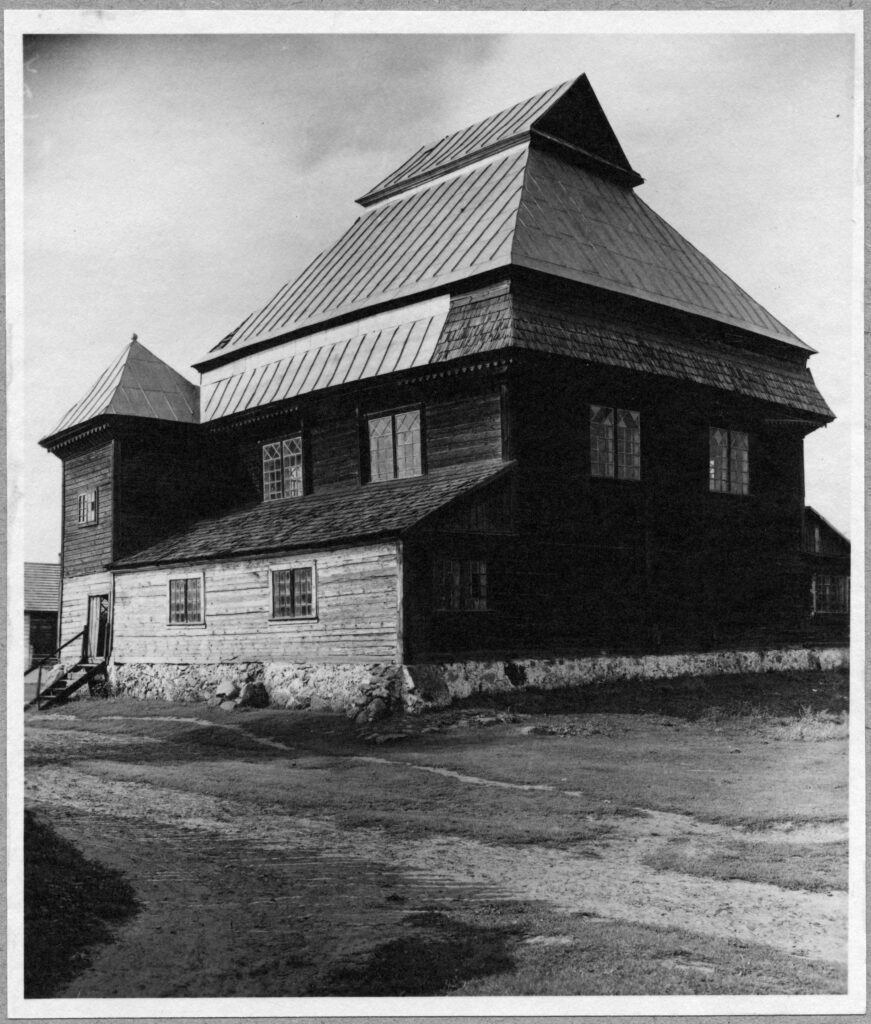
Wołpa, situated on the route between Grodno and Volkovysk (present-day Belarus) was once regarded for its grand wooden synagogue. The town itself was one of many in the former Polish-Lithuanian Commonwealth in which the Jewish community played a significant role in economic and social life.
Likely constructed in the first half of the 17th century, the synagogue was not only a place of worship but also a symbol of local identity and pride for the Jewish community of Wolpa. It occupied a central place in the life of the town, both literally and symbolically, and it was a testament to the skill of its craftsmen and the richness of Jewish culture. Although everyday religious life also unfolded in smaller houses of prayer, it was here that the local Jewish population gathered to celebrate major holidays, mark important occasions, and respond to significant events affecting the community.
The synagogue’s interior impressed visitors with its grand scale and remarkable richness of decoration. At its centre stood the elaborately carved bimah—the raised platform from which the Torah was read—surrounded by a lofty prayer hall whose walls and ceiling were covered with polychrome paintings depicting floral and animal motifs, as well as symbols associated with Jewish tradition. Its multi-tiered, broken roof, represented a masterpiece of wooden architecture. In 1903, the art historian Matthias Bersohn described it as follows: “At first glance, we immediately notice in this larch-wood structure those rising roofs, each smaller than the one below, those exterior galleries surrounding the front towers with their light, pointed roofs, which, as we have already seen, are characteristic features of the older wooden architecture of Polish Jews.”
The synagogue of Wołpa was destroyed during the Second World War. Its memory has survived through photographs, architectural surveys, and eyewitness accounts. To this day, it remains a powerful symbol of the lost wooden synagogues of the former Polish-Lithuanian Commonwealth—a world that helped shape the cultural landscape of Central and Eastern Europe as we know it today.
-
Institute of Art of the Polish Academy of Sciences
Exterior, Wołpa Synagogue (Date Unknown)
-
Institute of Art of the Polish Academy of Sciences
Interior, Wołpa Synagogue (Date Unknown)
Wołpa Synagogue bimah.
-
Institute of Art of the Polish Academy of Sciences
Interior, Wołpa Synagogue (Date Unknown)
Wołpa Synagogue aron ha-kodesh
The Great Synagogue of Luboml
The earliest references to Jews in Luboml date back to the late fourteenth century. In the subsequent years, first in 1510, and then again at the end of the seventeenth century, the Jewish community would build (and then rebuild) a synagogue in the centre of the town’s Jewish quarter. Historical records indicate how for the new synagogue, with its impressive masonry, the Jewish community of Luboml had to borrow money from the Latin Bishop of Chełm to finance its construction.
The seventeenth century synagogue in Luboml was a massive stone building with defensive features, built on a rectangular plan and crowned with a Renaissance attic parapet. The interior of the synagogue was adorned with rich sculptural decoration, including an elaborately carved Torah ark (aron ha-kodesh), and walls covered in paintings depicting floral and animal motifs, as well as musical instruments. The main prayer stood within the principal structure, while a lower adjoining section accommodated the women’s gallery.
The synagogue survived the great fire that devastated the town in 1729 and remained standing until the Second World War. While Luboml’s Jews prayed in smaller houses of prayer and Hasidic shtiblekh in their daily lives, the memorial book (Yizkor Book) explains that “The synagogue remained a symbol of the greatness of the town’s Jewish community and the place where people gathered in times of hardship and mourning, as well as celebration and joy. On festivals and holy days… people instinctively made their way to the Great Synagogue.” Its image even appeared on postage stamps issued in 1918.
The synagogue building was destroyed during the German occupation, and in 1947 its final demolition was carried out– a shop subsequently built in its place. The only surviving traces of this magnificent building are its foundations, hidden beneath the ground.
-
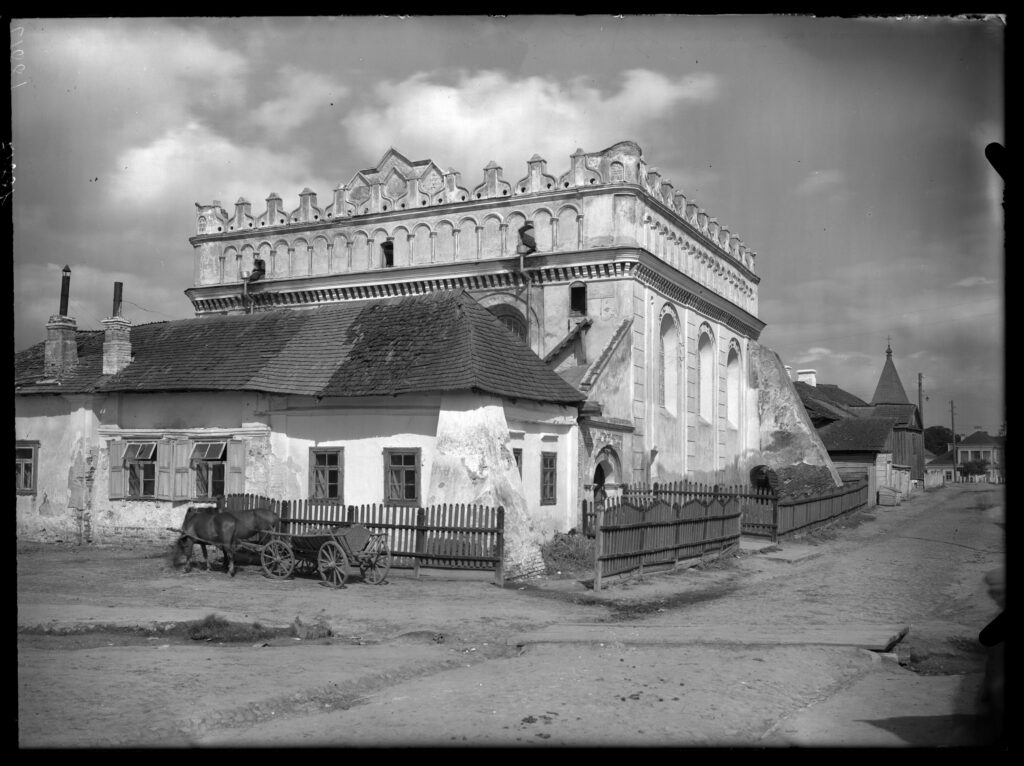
Institute of Art of the Polish Academy of Sciences
Exterior, The Great Synagogue of Luboml (1939)
-
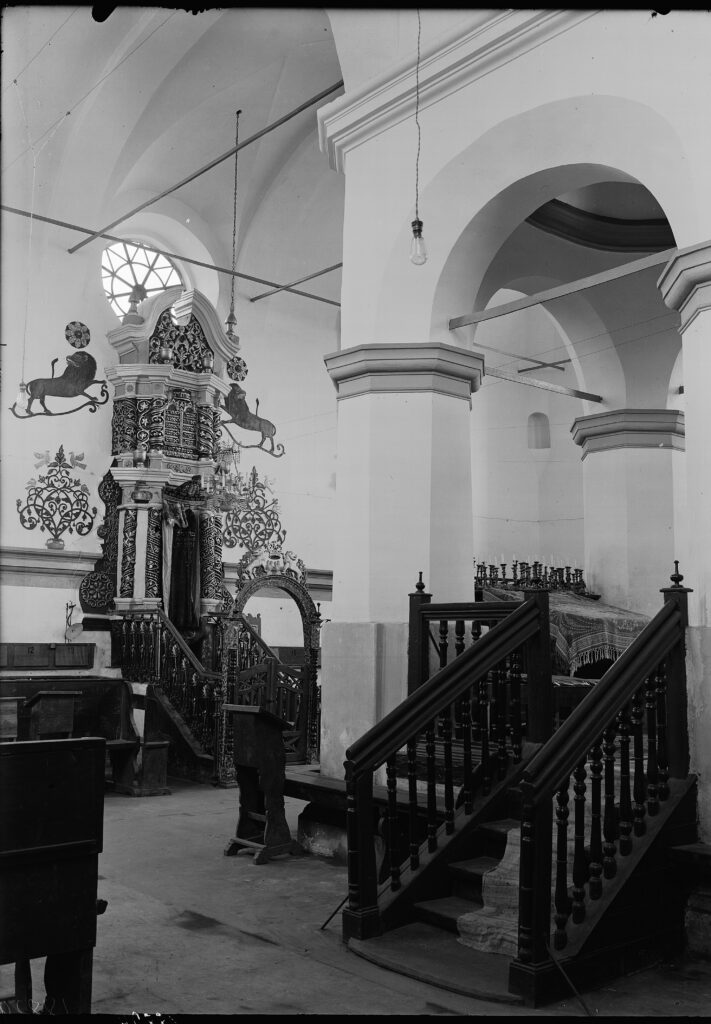
Institute of Art of the Polish Academy of Sciences
Interior, The Great Synagogue of Luboml (1939)
The Great Synagogue of Luboml's aron ha-kodesh and bimah. Documentation by Sz. Zajczyk.
-
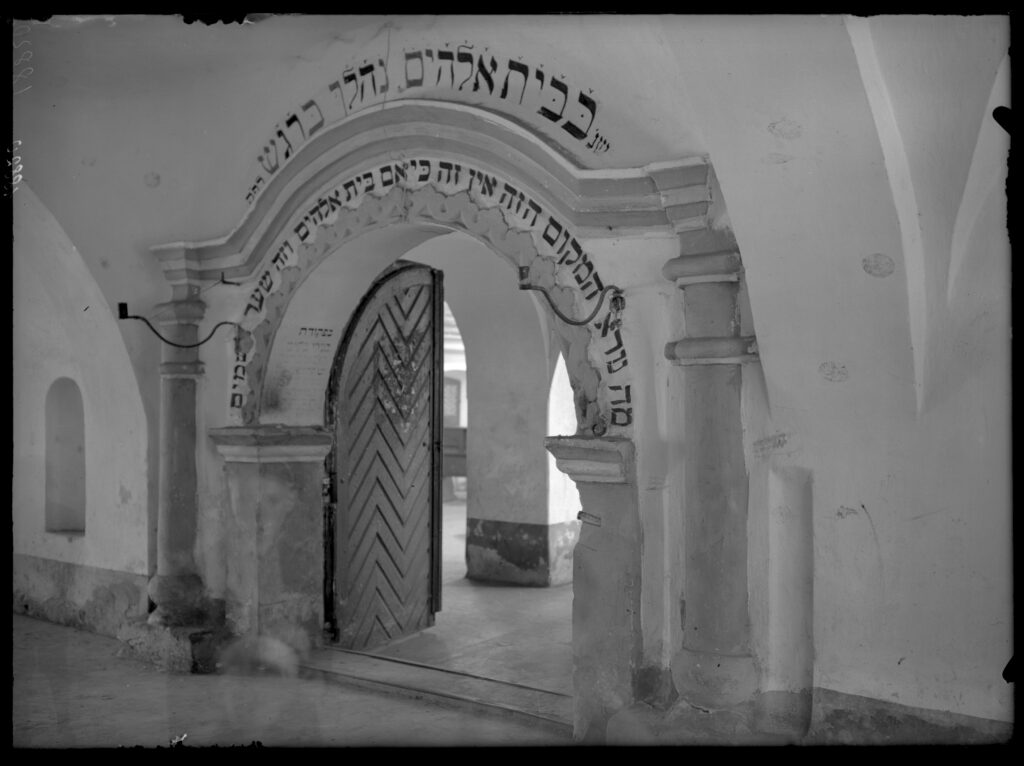
Institute of Art of the Polish Academy of Sciences
Interior, The Great Synagogue of Luboml (1939)
Documentation by Sz.Zajczyk.
-
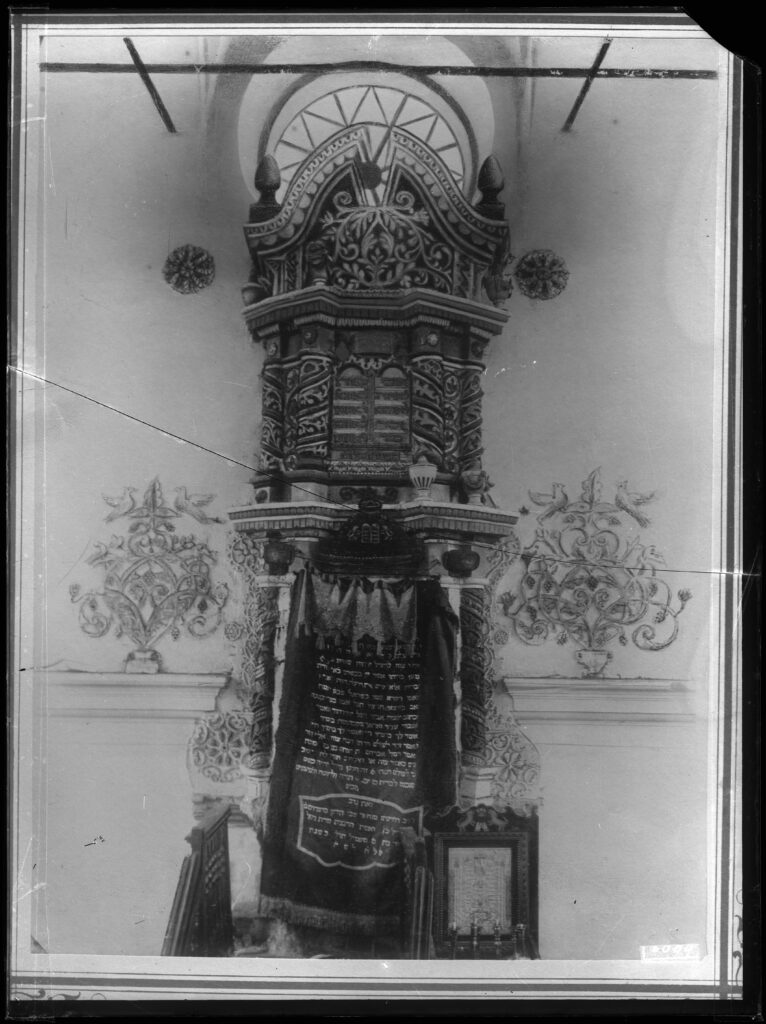
Institute of Art of the Polish Academy of Sciences
Interior, The Great Synagogue of Luboml (1939)
Close up image of The Great Synagogue of Luboml's aron ha-kodesh.
-
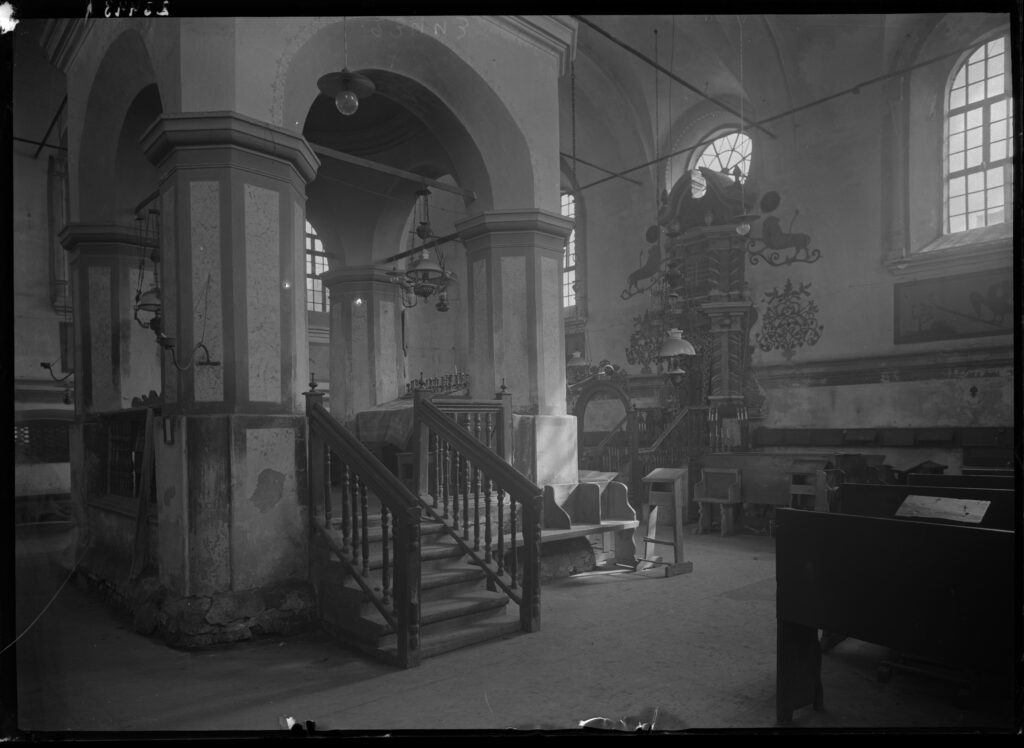
Institute of Art of the Polish Academy of Sciences
Interior, The Great Synagogue of Luboml (1939)
The Great Synagogue of Luboml's bimah.
The Synagogue of Piaski
Jewish presence in Piaski dates back to the early 16th century, and in the second half of the 18th century the community erected a wooden synagogue– becoming a key landmark of the area Set among forests and meadows, and cut through by a network of streams and rivers, Piaski is a small town where for centuries important communication routes intersected, Vilnius – Warsaw and Grodno – Minsk (today Belarus). At the end of the 19th century, Piaski had around 2,400 inhabitants, the majority of whom were Jews – approximately 1,600 people – forming a significant part of the local social and economic life.
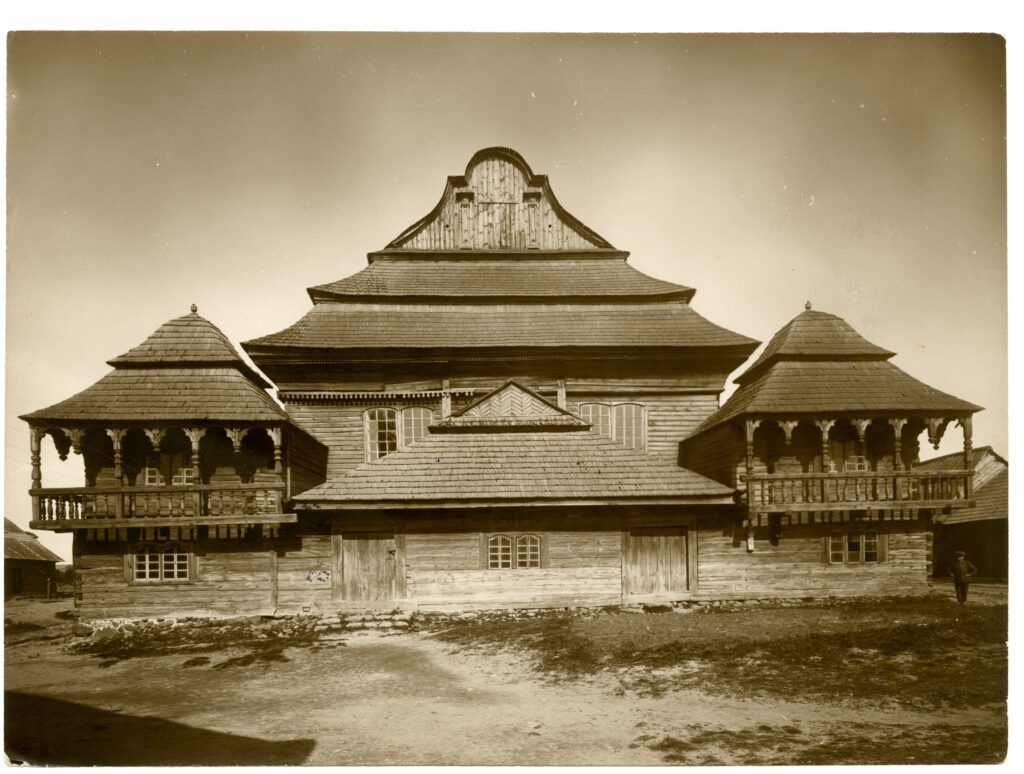
Piaski’s synagogue was typical of the synagogues found in the small towns of Eastern Europe – simple in form, yet rich in structural solutions shaped by local craftsmanship. Attached to the main prayer hall were annexes, as for the women’s section (babiniec), and two-storey corner structures flanking the facade. The syangogue was crowned by a three-tiered roof, giving the building a distinctive and recognizable silhouette within the townscape. The whole was crowned by a tall, three-tiered broken roof,
The interior of the synagogue featured whitewashed walls and a natural wooden ceiling, with its bimah – enclosed by a wooden balustrade – as its main focal point. On the eastern wall of the synagogue was an elaborately decorated ark (aron ha-kodesh), carved with animal motifs like the elephant. Congregants were particularly moved by the synagogue’s acoustics, and its impact on their prayer.
The synagogue in Piaski, like the entire Jewish community of the town, was destroyed during the Second World War. Its loss is one part of the larger interrupted world of Eastern European small towns, where wooden synagogues symbolized the presence and rootedness of Jewish communities in the local landscape.
-
Institute of Art of the Polish Academy of Sciences
Exterior, The Synagogue of Piaski (Synagoga Piaskower, Date Unknown).
The Synagogue of Zelwa
Located halfway between Słonim and Wołkowysk (today in Belarus), Zelwa’s Jewish population first settled in the 16th century– its first synagogue likely built during the second half of the 18th century. Around this time Zelwa became known for its fair, where rabbis from the most important communities of the Grand Duchy of Lithuania (now parts of Lithuania, Belarus, Latvia, Poland, Moldova, Russia, and most of Ukraine) would gather and deliberate.
Constructed of brick and stone, Zelwa’s now legendary synagogue formed the heart of the town. Here, the local Jewish community experienced the most important moments of its daily life – births, funeral ceremonies, bar and bat mitzvahs, and weddings held under the canopy in the synagogue’s courtyard.At night, according to local mythology, spirits and souls of the righteous would watch over the synagogue. The main prayer hall, with its separate women’s section, had low irregular adjoining structures on three of its sides built at different points during the synagogue’s life. The main structure was covered with a gabled roof, while the surrounding spaces had lean-to roofs.
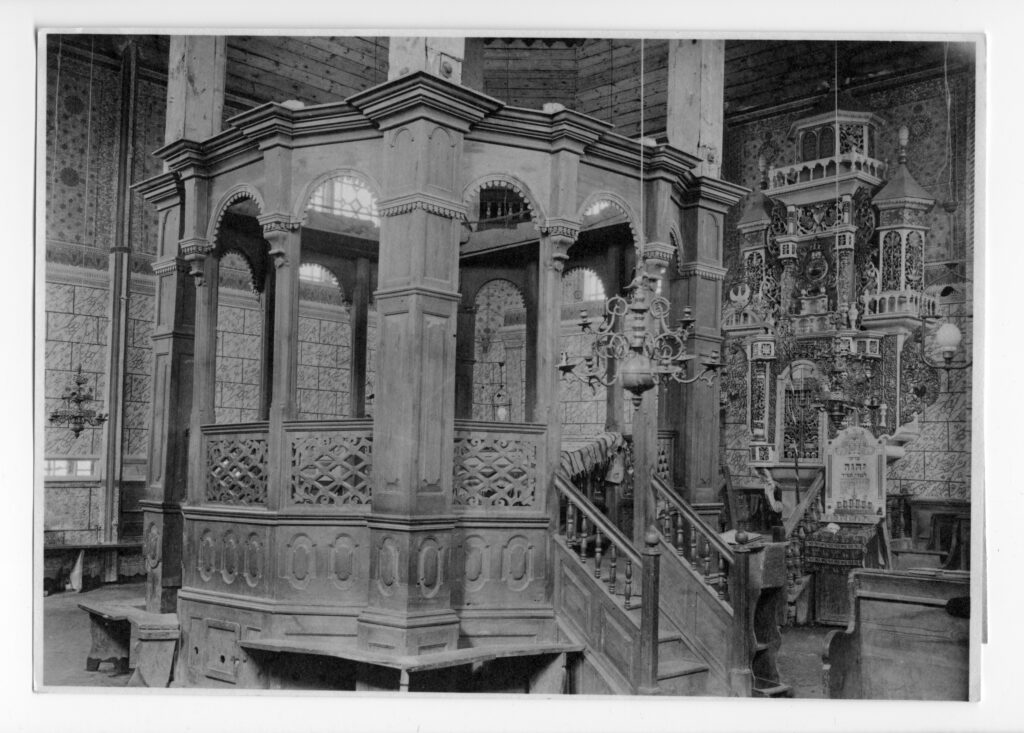
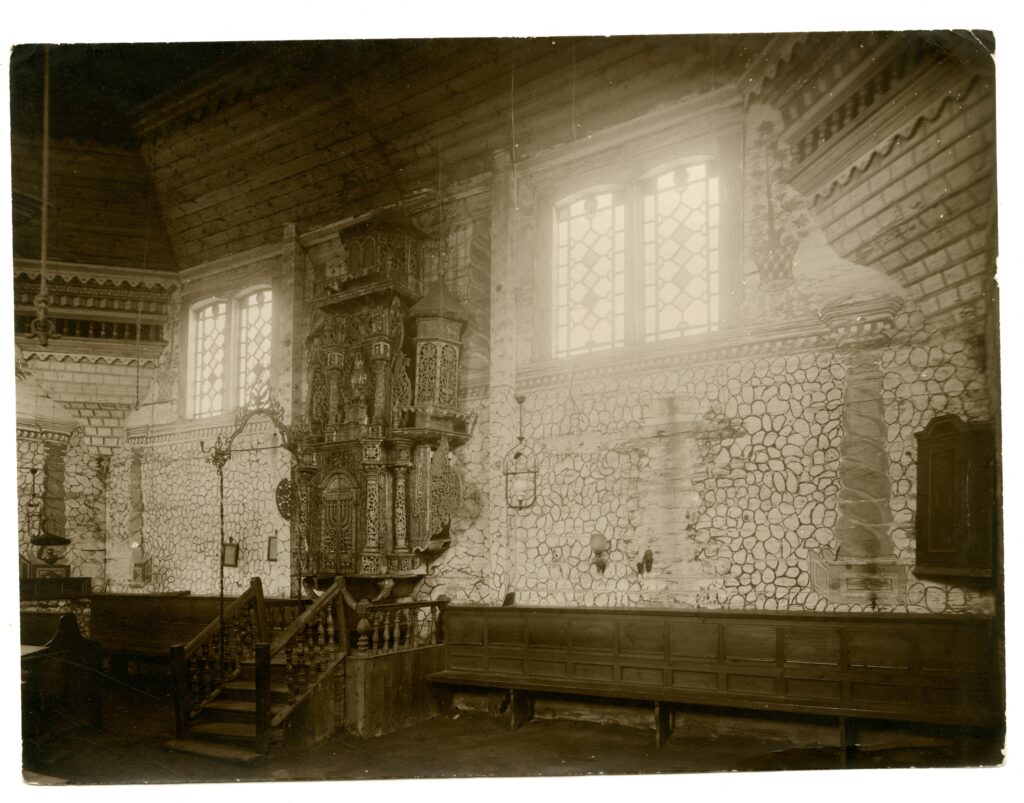
The synagogue featured a richly decorated wooden interior, with abimah, the raised platform for reading the Torah, that resembled a small pavilion. Particularly notable was the two-storey Holy Ark (aron ha-kodesh, where torahs are housed). Raised on a platform and crowned with a double-headed eagle, it is said that the craftsman devoted years of his life to its completion; he would sleep in the synagogue while local women brought him food to sustain his work. Allegedly, a mechanism in the ark made it so when one opened its doors, one of its adorned carved lions extended the torah outwards in its paw. When one congregant was given the honour of opening the ark, he allegedly died on the spot upon seeing the moving lion– leading to the permanent deactivation of the interior mechanism.
Zelwa’s Jewish community and its storied synagogue, was ultimately destroyed during the Second World War.
-
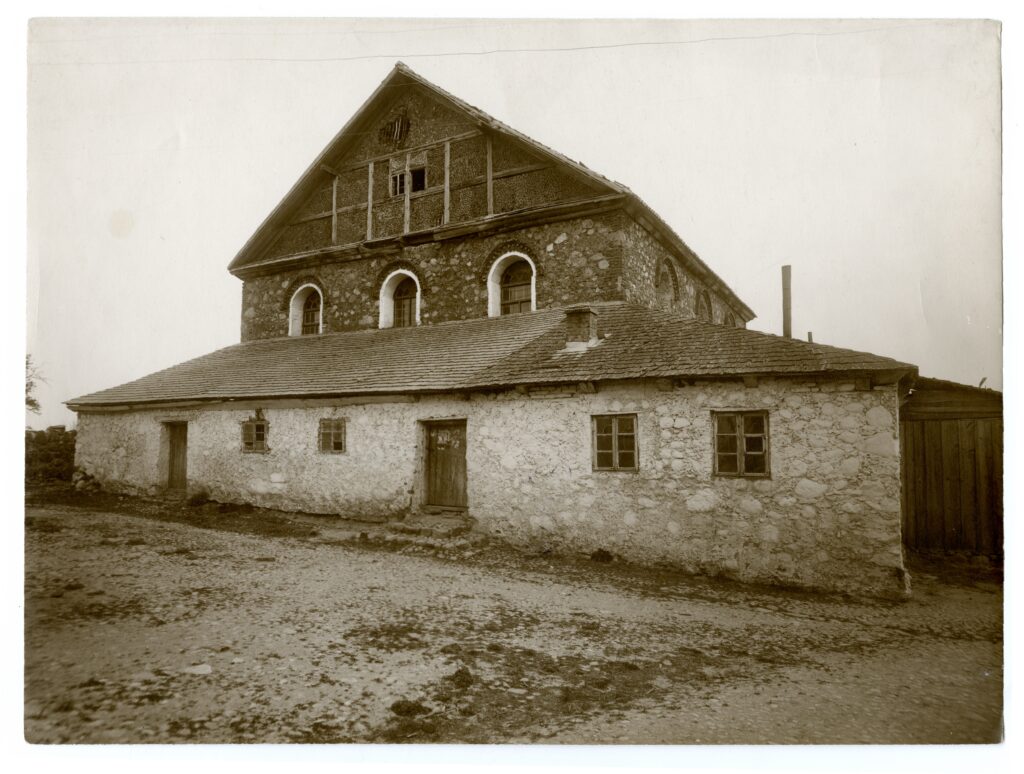
Institute of Art of the Polish Academy of Sciences
Exterior, The Synagogue of Zelwa (Synagogue w Zelva, Date Unknown).
-
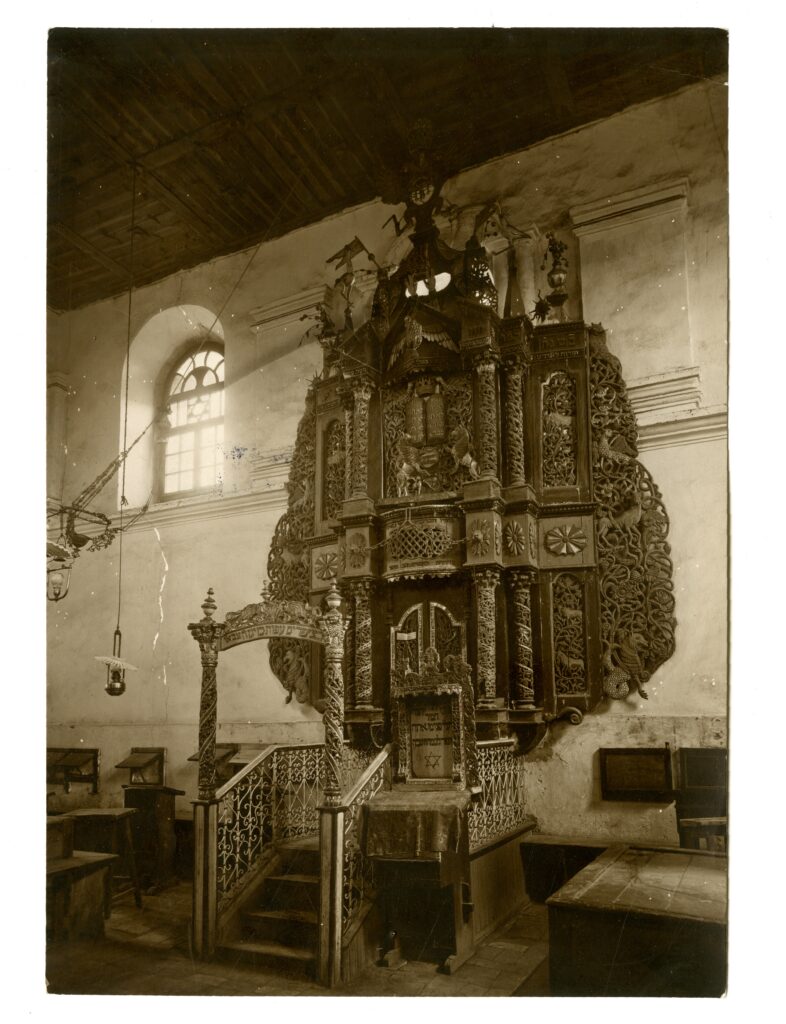
Institute of Art of the Polish Academy of Sciences
Interior, The Synagogue of Zelwa (Synagogue w Zelva, Date Unknown)
The synagogue of Zelwa's aron ha-kodesh.
-
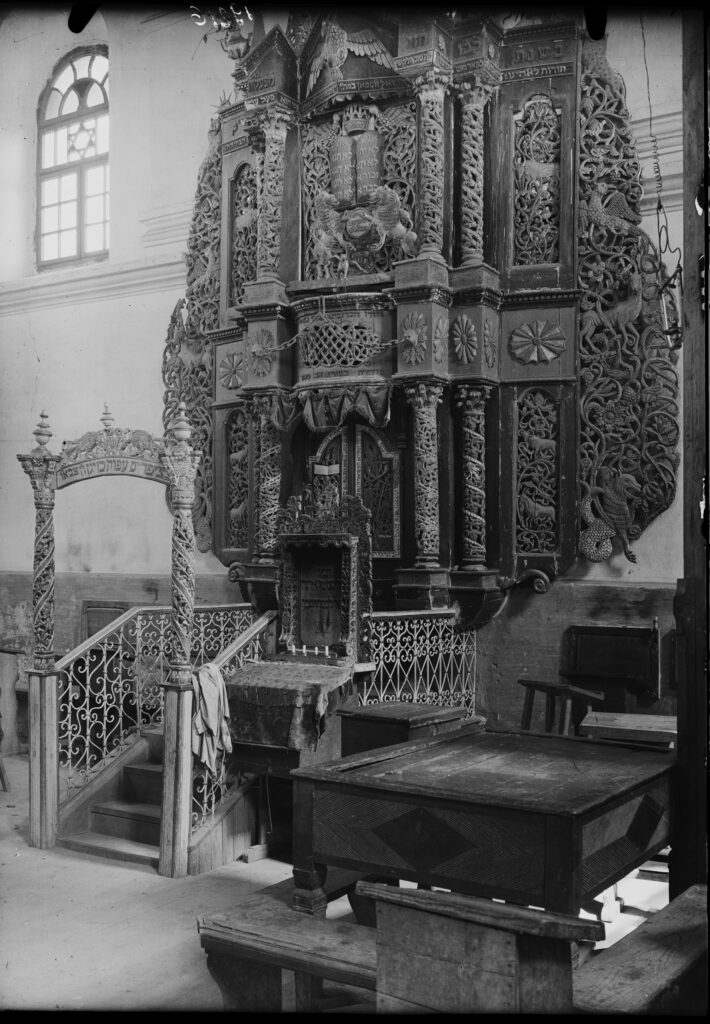
Institute of Art of the Polish Academy of Sciences
Interior, The Synagogue of Zelwa (Synagogue w Zelva, Date Unknown)
The synagogue of Zelwa's aron ha-kodesh.
-
Institute of Art of the Polish Academy of Sciences
Interior, Synagogue of Zelwa (Synagogue w Zelva, Date Unknown).
The synagogue of Zelwa's bimah.
The Synagogue of Gwoździec
In 1640, the Jewish community of Gwoździec erected a synagogue that would later be regarded as one of the most beautiful in the Polish-Lithuanian commonwealth. A small town on the Czerniawa River, near Kołomyia, in the region of Pokuttya in Galicia, Gwoździec’s synagogue was a wooden structure covered with a Polish roof (known as the Kraków type). The oldest part of the building was the main prayer hall, with a square plan and an octagonal dome above it. Over time, the building was repeatedly altered, with additions including a vestibule, women’s sections, and a brick annex in the south-western corner, which served as a cheder and a heated prayer room used in winter.
The synagogue’s furnishings included a tall, two-storey Holy Ark (aron ha-kodesh) and a polychromed bimah in the form of an octagonal pavilion. According to legend, a Jewish craftsman involved in the construction used the same knife for carving the aron ha-kodesh that had been used on the wooden Holy Ark in the synagogue of the Ari Aszkenazi in Safed.
The synagogue gained exceptional fame for its polychrome interior, which covered nearly the entire building. Created and renewed between the 17th and 18th centuries by several artists, the paintings depicted biblical scenes, religious symbols, animals, and inscriptions, all embedded in rich vegetal and geometric ornamentation. Although the decorations were produced over many decades, they maintained a coherent character and are considered among the finest examples of Jewish synagogue painting in Eastern Europe.
The wooden synagogue was significantly damaged during the First World War and later underwent reconstruction in the interwar period. It was ultimately destroyed during the Second World War in 1941, following the German invasion. With its destruction, the life of the local Jewish community also came to an end.
It is also worth noting that the roof of the Gwoździec synagogue, which was reconstructred according to early documentation at the end of the 19th century, is now part of the core exhibition at the POLIN Museum of the History of Polish Jews.
-
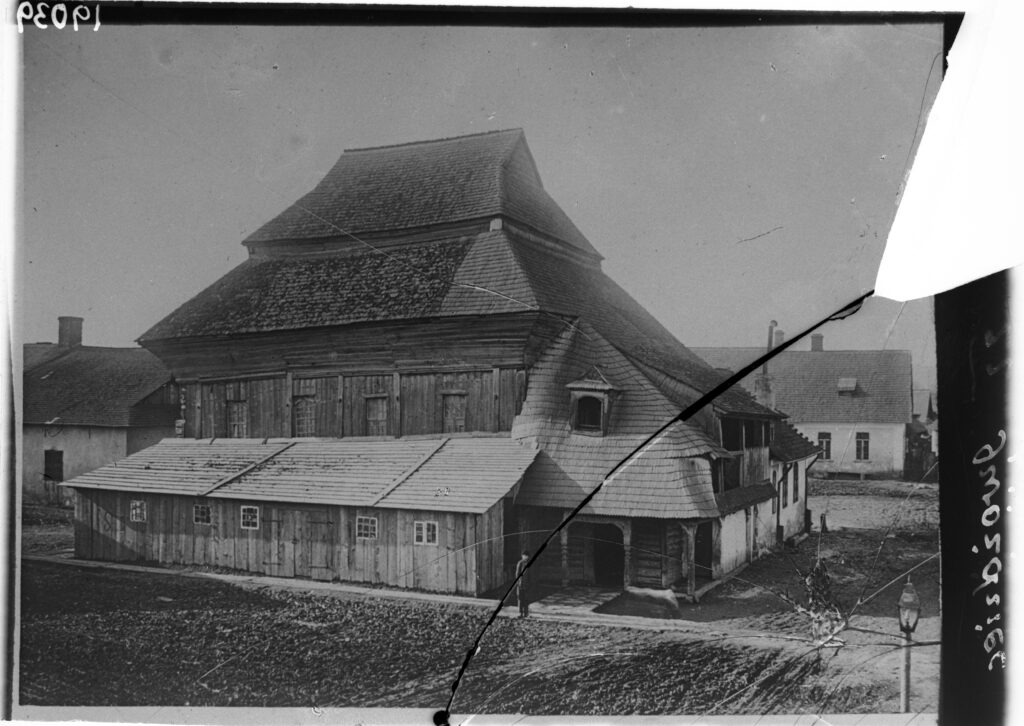
Institute of Art of the Polish Academy of Sciences