
Welcome to Synagogue Stories: Montreal
This collaborative project functions as a resource supplementing the Montreal Jewish Museum’s Official Collateral Event at La Biennale di Venezia: Nabatele, an open-air installation by Anna Kamyshan.
In these stories, which highlight synagogues past and present in Montreal, in Italy, and in the former Pale of Settlement and surrounding regions which are found in what is now Poland and Lithuania, readers will recognize aspects of Nabatale through architectural references and the life it could sustain within. Spanning geography, tradition, and time, these synagogues reveal themselves to be more than houses of worship; they are also sites of collective memory, resilience, and belonging. For the synagogues that no longer stand, the legacy of their congregants becomes their ultimate Ner Tamid – the eternal and enduring light, found as a perpetually burning lamp in all synagogues.
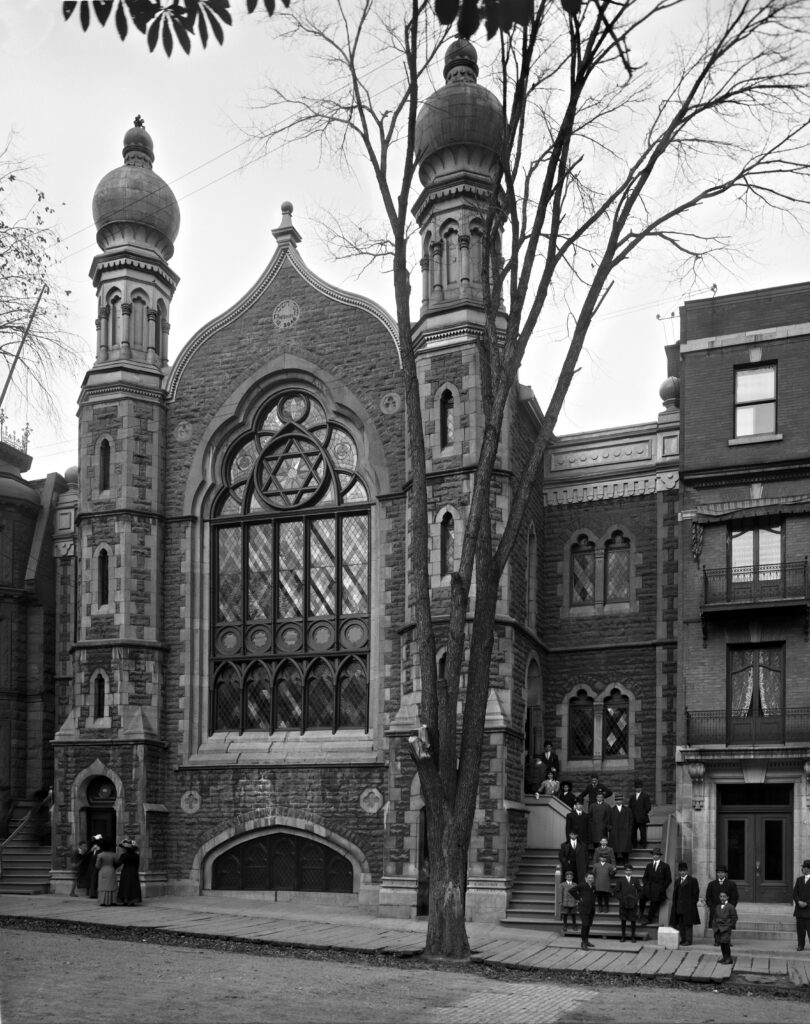
Here, we bring our attention to Montreal, featuring synagogues such as The Bagg Street Shul, The Spanish and Portugese Synagogue, Tifereth Jerusalem, Temple B’nai Jacob, and Congregation Shaar Hashomayim.
The Bagg Street Shul (Temple Solomon)
Tucked away in the Plateau neighbourhood of Montreal, the Congregation Temple Solomon, stands as Montreal’s oldest continuously active synagogue still operating out of its original building (on the corner of Bagg and Clark since 1921). Best known by its colloquial name, the Bagg Street Shul, its humble size and hand-painted interior murals evokes the local craftsmanship of Jewish Eastern European life in small settlements or shtetls. In places like Montreal, it is an example of diasporic architectural memory carried primarily by Ashkenazi (meaning of Eastern European origin) Jewish immigrants.
Around the time of its founding, the Bagg Street Shul was one of two dozen such small synagogues, also known by the Yiddish term shuls or schools, in the former and densely populated Jewish quarter of Montreal. These shuls were representative of Jewish immigration and settlement trends during the late 19th and early 20th centuries in Canada and the United States. In the early 20th century Montreal’s wealthier, more integrated, and more anglicised congregations would move westwards from what is now known as Montreal’s Old Montreal and Chinatown neighbourhoods. At the same time, Montreal’s recently emigrated, working class and Yiddish-speaking Jewish population, including those who first attended Bagg Street Shul migrated north along Saint Laurent Boulevard. This street, also known as “The Main,” formed the spine of the city’s historically Jewish neighbourhood.
Today, visitors of Bagg Street Shul will immediately notice its lovingly preserved original interior, emblematic of many synagogues found in the Pale of Settlement. The building features a wooden interior with built-in furniture, intricate wooden carvings – including the Torah ark where the sacred Torah scrolls or holy Jewish texts are kept – and a striking series of Jewish Zodiac murals painted along the base of the women’s gallery. The murals, which face the main sanctuary, were created by father and son of the Shadewasser family, and are notable for a unique blending of Jewish and Canadian symbolism.
Gesturing to the second commandment’s assertion to not depict forms of God’s creation, the Shadewassers replaced human figures with animals such as bison and reindeer, a somewhat common solution used to adorn Jewish places of worship while still honouring the traditional restrictions on icons. The richness and vibrancy of these decorative details reflect the deep pride this community and congregation held and continue to hold for their shul. A recognized Heritage Site of Quebec, the synagogue continues to flourish thanks to its dedicated community members and the many informal visitors who pass through its doors each year.
-
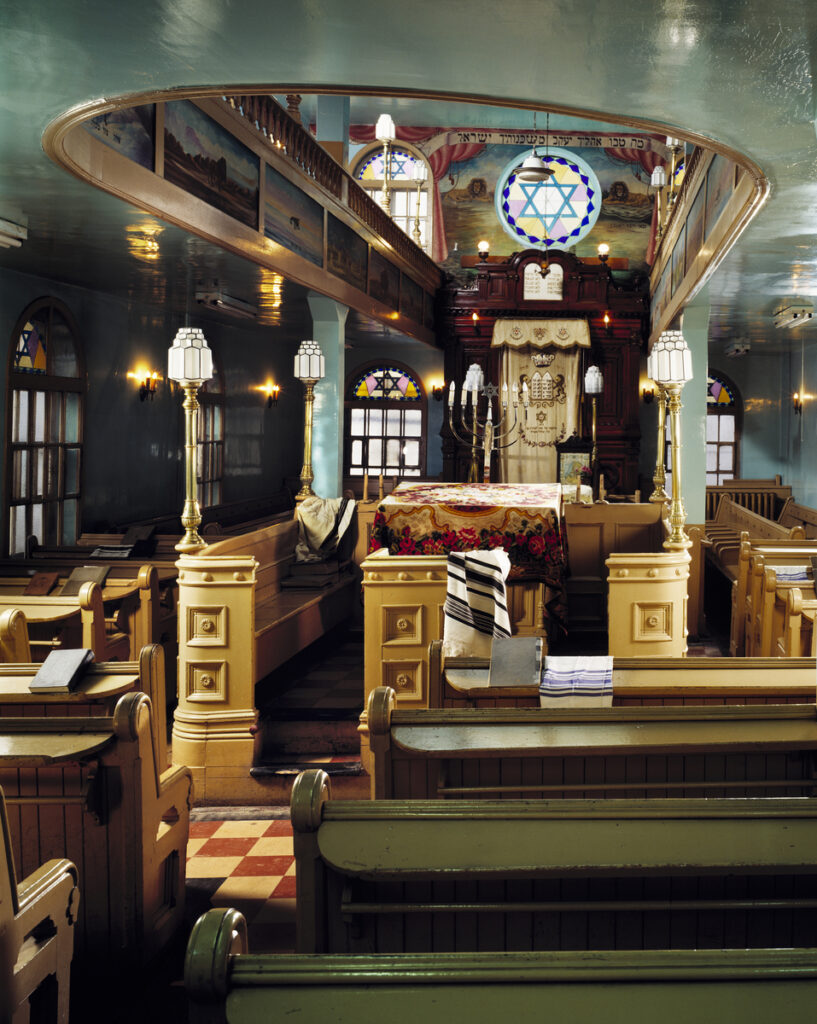
Neil Folberg Vision Gallery
Interior, Bagg Street Shul (1994)
From the series "And I Shall Dwell Among Them: Historic Synagogues of the World"
Courtesy of Vision Neil Folberg Gallery, Jerusalem, Israel. -
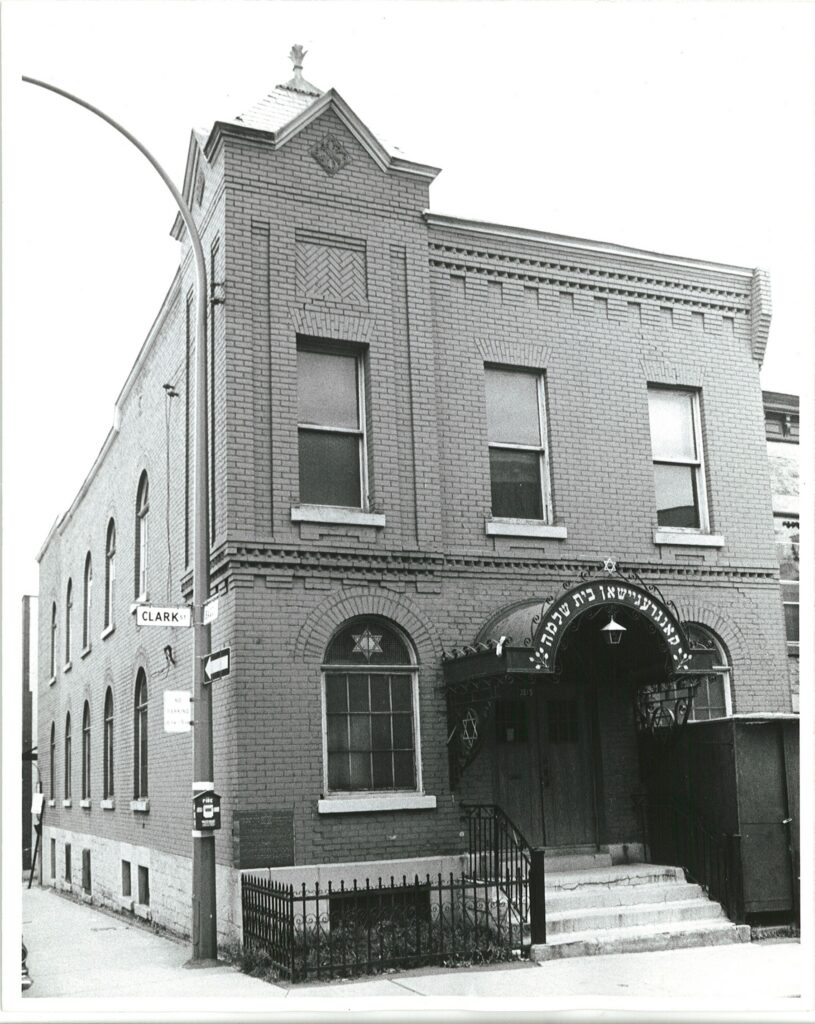
Jewish Public Library of Montreal
Exterior, Bagg Street Shul (Date unknown)
Courtesy of the Jewish Public Library Archives. Photograph Collection. CA JPL-A 1255–[83-014a]-PR000533.
-
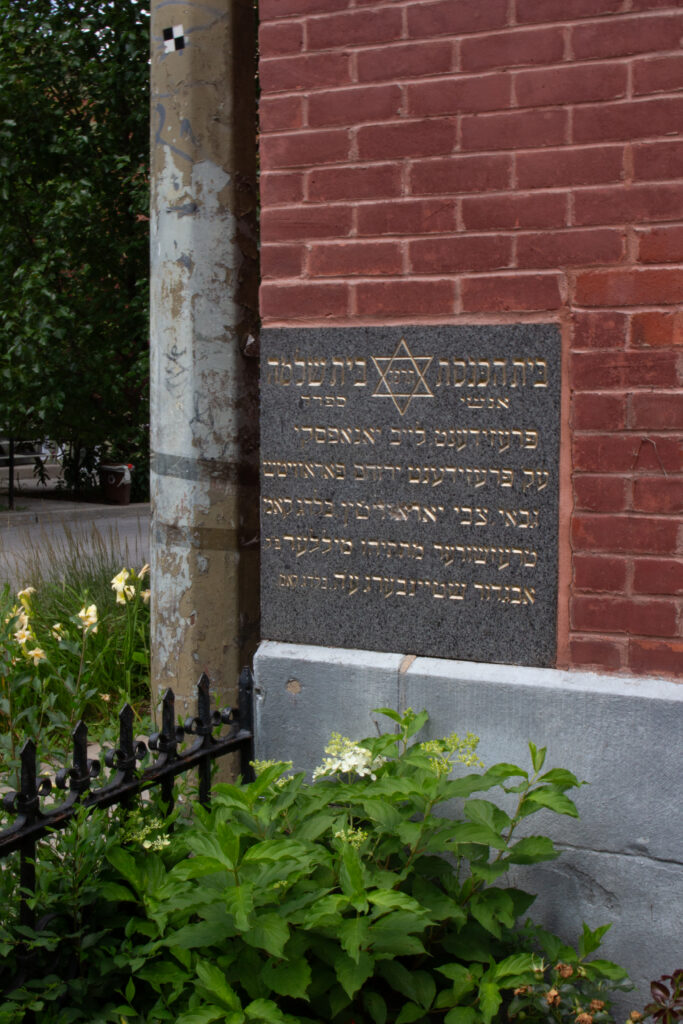
Montreal Jewish Museum
Exterior Plaque, Bagg Street Shul (2026)
The Spanish and Portuguese Synagogue (Shearith Israel)
Founded in 1768, the Spanish and Portuguese synagogue, or Shearith Israel, holds the record as the oldest Jewish congregation in Canada. When France ceded New France to Britain in 1760, the ban on Jews in the colony was abolished, inviting waves of Jewish settlers. The Spanish and Portuguese synagogue was set up by the first of these Jewish settlers in Quebec, who were primarily of Sephardic (meaning of Spanish and Portuguese) origin and who founded the synagogue in the Sephardic tradition.
Relocating three times, and moving westward from its original location in the anglicized and affluent Golden Square Mile neighbourhood (today part of Montreal’s downtown), the congregation has remained remarkably intact and has evolved to serve Jewish communities of different origins. Its location built in 1890 was constructed and embellished in a style described as Judeo-Egyptian. The lotus flower columns as well as the placement of the windows and doors were designed to evoke Judaism’s eastern origins. This architectural trend can be linked directly to 19th century Europe, as emancipation was anticipated and Jews began constructing synagogues that commanded equal respect and rights. The reference to Egypt was meant to represent strength and longevity, qualities that Shearith Israel still holds today.
Now known for its multiculturalism, the Spanish and Portuguese Synagogue’s congregation changed with the influx of Jewish immigrant survivors of WWII and waves of Sephardic Jewish immigration from North Africa and the Middle East in the 1950s onward. Today, to accommodate its vibrant and culturally diverse community of over 800+ families, the synagogue hosts its minyamim (religious services) in many liturgical traditions. They offer five different services for Rosh Hashanah, the Jewish New Year and a very important holiday: Spanish and Portuguese, Iraqi, Moroccan, Lebanese, and Ashkenazi.
-
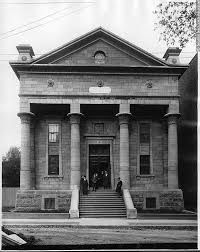
McCord-Stewart Museum
Exterior, Shearith Israel (1910-1911)
Wm. Notman & Son (1882-1919). Sherith Israel Synagogue, Stanley Street, Montreal, QC. 1910-11. Notman Photographic Archives. VIEW-10762.
-
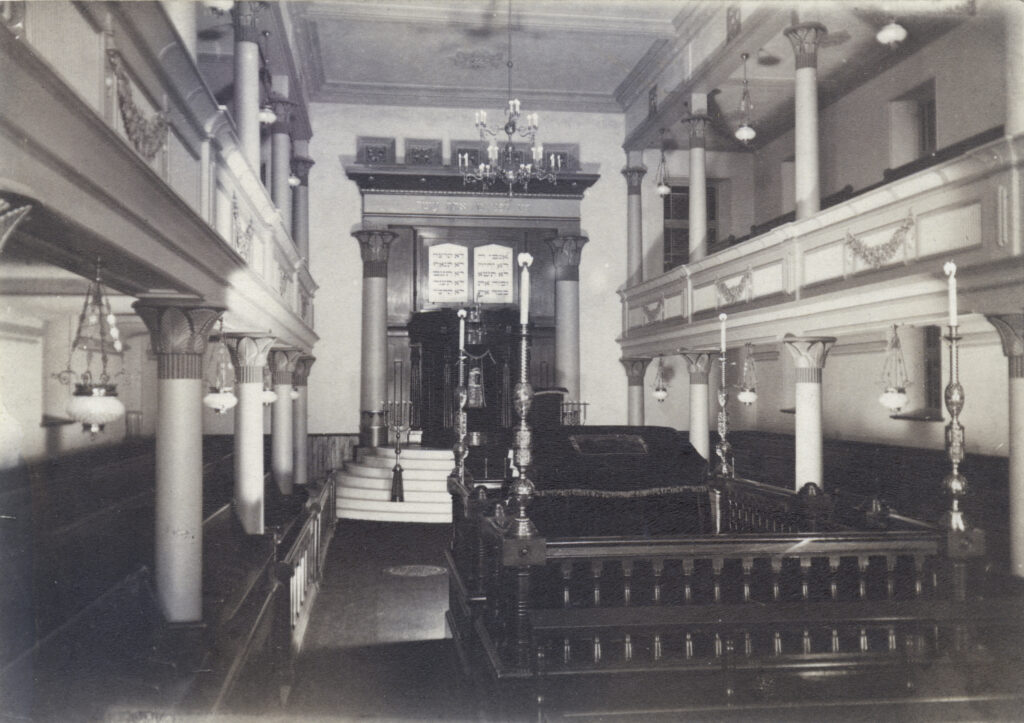
McCord-Stewart Museum
Interior, Shearith Israel (c. 1890)
Interior of the Portuguese Synagogue, Stanley Street, Montreal, QC, about 1890. Sherith Israel Synagogue, Stanley Street, Montreal, QC. About 1885-1895. Photography – Documentary Collection, MP-0000.849.13.
Congregation Tifereth Jerusalem (the Red Shul)
Temple Tifereth Jerusalem originally stood on Rue Cartier, in Montreal’s Rosemont Petite-Patrie neighbourhood, and its evolution shows us the internal complexities of the city’s tightly knit Jewish communities. Its construction in 1911 was made possible by the congregants themselves; local Jewish craftsmen, carpenters, plumbers and electricians, predominantly Russian Jewish immigrants, who dedicated endless hours after their workdays to bring the synagogue to life.
While there was deep closeness amongst its members – it is said that kiddush, the meal served after Saturday morning services, would often take place in the homes of various congregants – there were also many disagreements about leadership. Following these ongoing disputes, another synagogue was constructed nearby. The new building’s white facade lent it the yiddish name di Veise Schul (the White Shul) while Tifereth Jerusalem gained the nickname di Roite Schul (the Red Shul) because of its red bricks.
As time went on, congregants dispersed into other neighborhoods and it became difficult to maintain membership. In 1962, the decision was made to merge with the Jewish Community of Eastern Cote St. Luc & Hampstead. Although the original synagogue building no longer exists, the congregation is still operating today as part of the thriving Modern Orthodox Tifereth Beth David Jerusalem, or the Baily Shul as it is affectionately known.
-
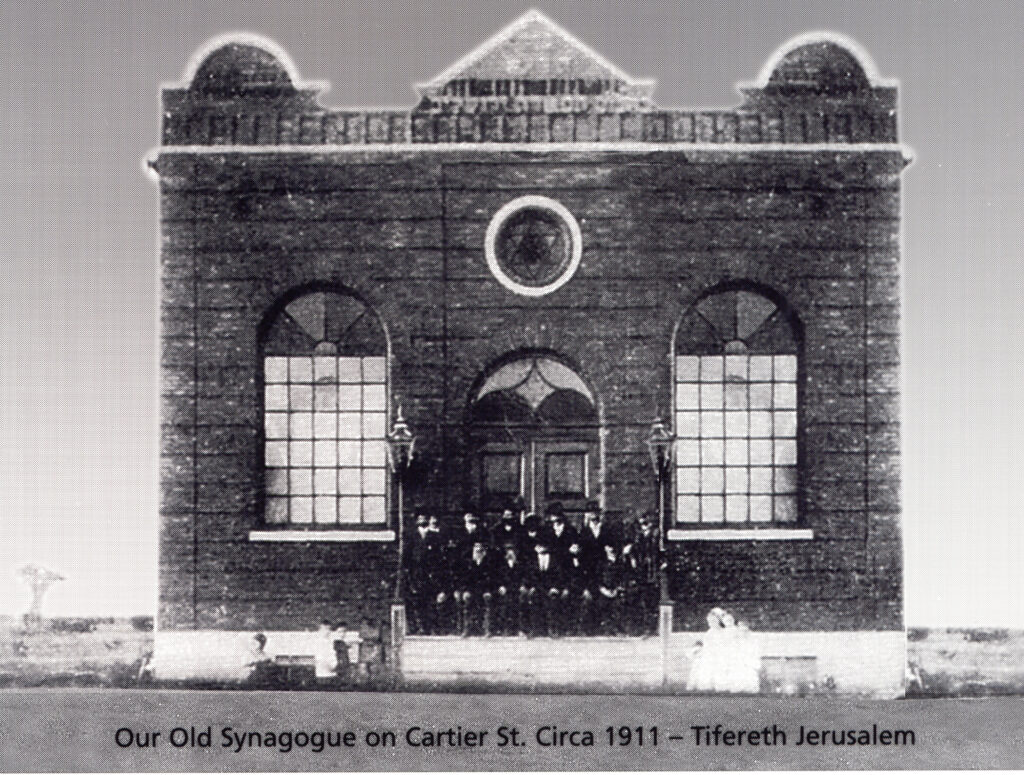
Congregation Tifereth Beth David Jerusalem Synagogue Archives
Exterior, Congregation Tifereth Jerusalem (c. 1911)
Tifereth Jerusalem, 1919-1956. Archives of the Congregation Tifereth Beth David Jerusalem. Photo Illustrations of Canada. "Traces of the Past" by Sara Ferman Tauben. p. 78.
Temple B’nai Jacob
B’nai Jacob was the first synagogue built in what is now known as the Mile End neighbourhood, its construction intended to attract the growing Jewish communities moving farther north in Montreal. Built in 1918, its Romanesque exterior harkened back to synagogues in France, such as the synagogue in Nancy and the Grande Synagogue de la Victoire in Paris, while its interior followed in the more traditional Pale of Settlement Ashkenazic architectural styles. It is thought that the architect replicated synagogues from France as a gesture to B’nai Jacob’s French Canadian milieu.
The synagogue’s former building is now home to the Collège Français, which purchased the site in 1964, and is just a few blocks away from the famous Fairmount Bagel shop. Common of the neighbourhood and its many repurposed Jewish buildings, raised Hebrew text remains on the upper archway; a trace of its early history. As Mile End’s immigrant Jewish population began to move to Montreal’s suburbs, the congregation merged with a nearby synagogue and followed them westwards to the Snowdon neighbourhood. It is now known as Chevra Kadisha B’nai Jacob.
-
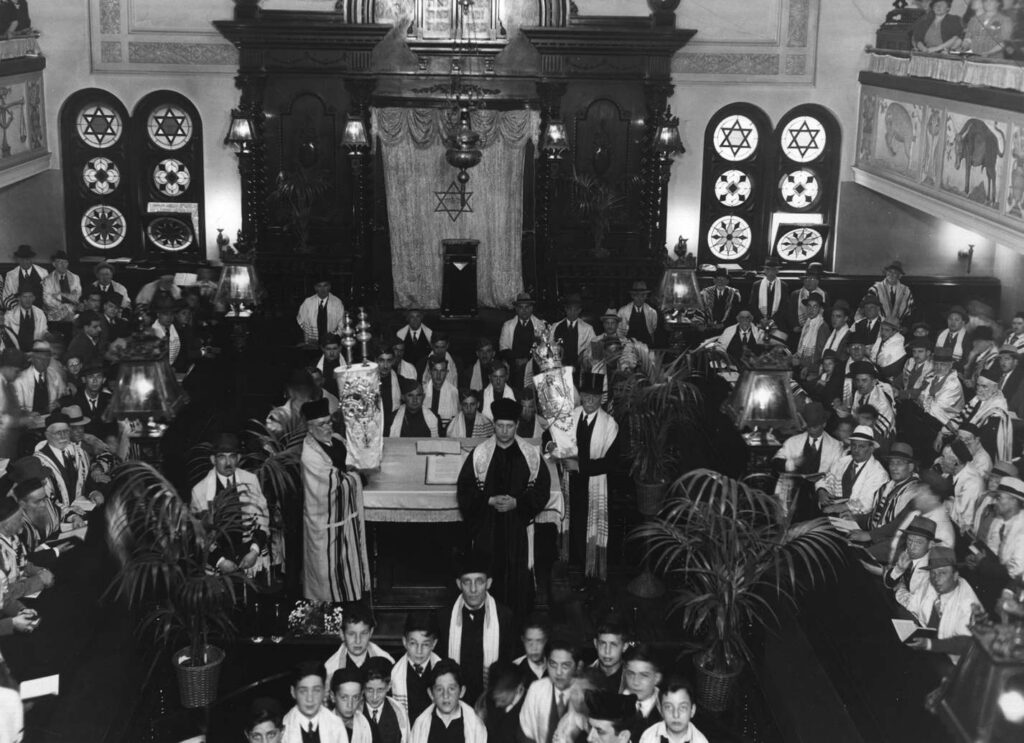
Alex Dworkin Canadian Jewish Archives
Interior, Temple B'nai Jacob (1945)
Temple B'nai Jacob synagogue service for Shavuot, with servicemen, Montreal. Shows interior of the B'nai Jacob on Fairmount Ave. 1940. Alex Dworkin Canadian Jewish Archives. Canadian Jewish Congress organizational records. PC 01-01-071A.
-
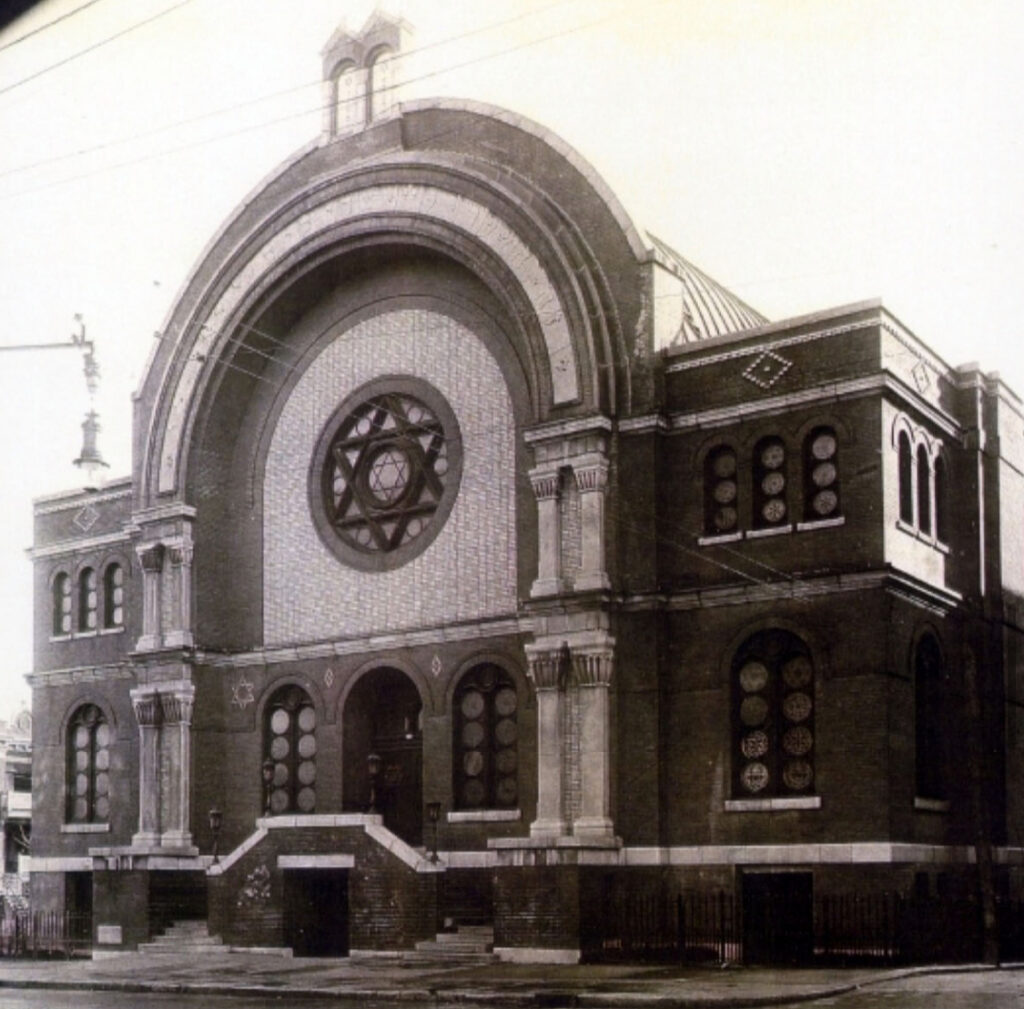
MEM – Centre des mémoires montréalaises
Exterior, Temple B'nai Jacob (Date unknown)
Temple B'nai Jacob, 1919-1956. Date unknown. Archives of the Chevra Kadisha B'nai Jacob. Photo Illustrations of Canada. "Traces of the Past" by Sara Ferman Tauben. p. 53. Collection of Sara Tauben.
-
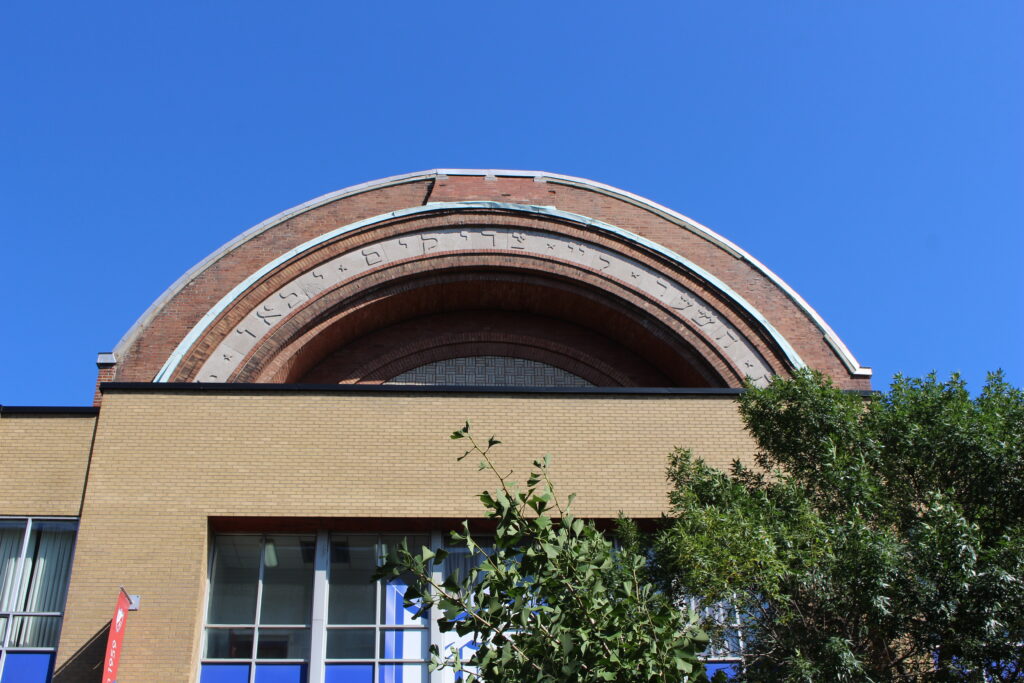
Montreal Jewish Museum
Exterior, Collège Français, formerly B'nai Jacob (2026)
Note the exposed archway of the former Temple B'nai Jacob behind the new facade of Collège Français, who purchased the site for the construction of the high school school in 1964.
Congregation Shaar Hashomayim
Congregation Shaar Hashomayim, meaning the Gate of Heaven, is the oldest Ashkenazi synagogue in Canada and is a slice of the complex story of Quebec’s evolving Jewish landscape. Despite the Spanish and Portuguese Synagogue welcoming newly arrived Jews to the community in the 18th and early 19th centuries, their services followed a Sephardic rite. At the time, many Ashkenazi Jewish arrivals integrated into Montreal’s then dominant Sephardic tradition. But, as the 19th century progressed and more Jewish immigrants arrived from Europe, an increasing desire and demand grew for the opportunity to worship according to Ashekanzi tradition. The growing Ashkenazi community first congregated in 1846, incorporating as the Corporation of English, German and Polish Jews, and opened its first purpose-built synagogue in 1859 on rue Saint-Constant (now rue de Bullion) just east of present-day Chinatown. As the congregation grew, a grander building was built “uptown” on McGill College Avenue and consecrated in 1886.
To accommodate its ever-growing congregation, in 1922 the Shaar moved westward to Montreal’s Westmount neighbourhood, where it remains today. While its former building on McGill College Avenue signified the growth of the Ashkenazi community through the grandeur of its unmissable Romano Byzantine style, intricate front windows, and towering minarets, the magnificence of its present Westmount location is indicative of the continued success of its congregation. Beyond its significant scale, the synagogue is also known today for being Montreal’s largest synagogue. A vibrant centre of the Modern Orthodox community, they are known beyond the Jewish community for their Grammy award-winning cantor and choir, and for their ties to Leonard Cohen, whose grandfather and great-grandfather were presidents of the congregation.
-
Sarah Ferdman Tauben, Traces of the Past
Exterior, Congregation Shaar Hashomayim (Date Unknown)
Built between 1885-86, McGil Street was Shar Hashomayim's first location. Congregants gathered here until 1921, when the congregation moved to the congregation's new Westmount location.
-
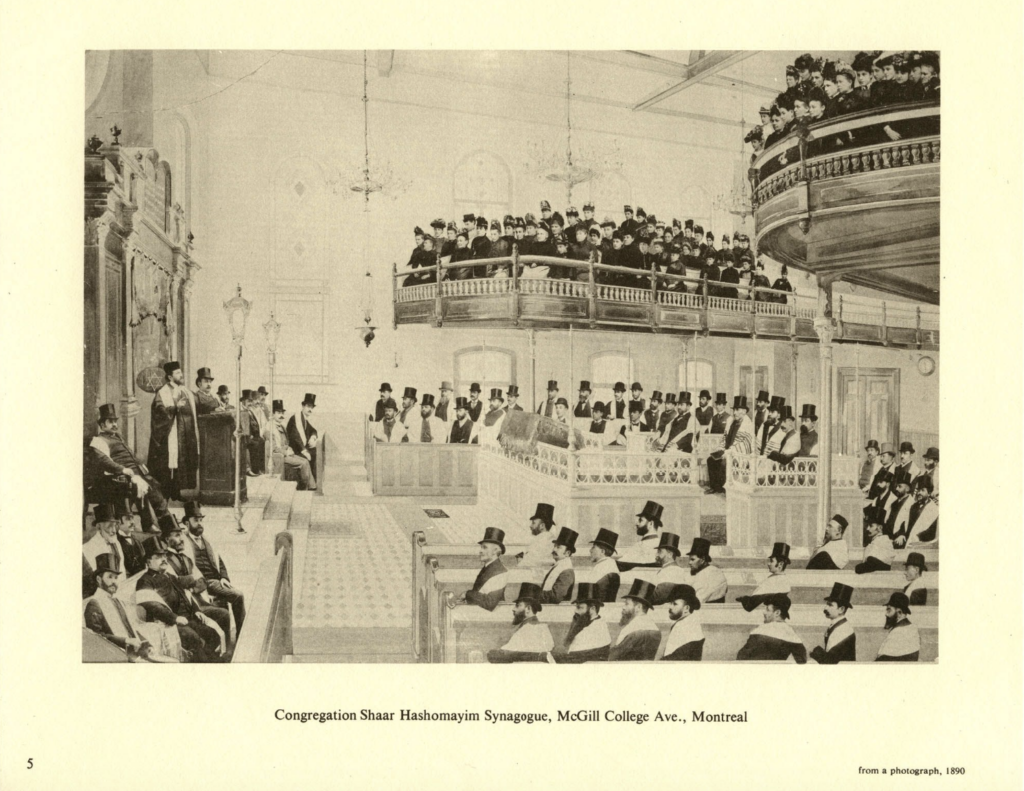
Congregation Shaar Hashomayim Museum and Archives
Interior, Congregation Shaar Hashomayim, McGill College Avenue (1890)
Congregation Shaar Hashomayim Museum and Archives, Montreal. Rogers Arnott & Sauer, Interior of English, German, and Polish Synagogue on McGill College Avenue, 1890, composite photograph, 24.6 x 18.7 cm.