
Welcome to Synagogue Stories: Italy
This collaborative project functions as a resource supplementing the Montreal Jewish Museum’s Official Collateral Event at La Biennale di Venezia: Nabatele, an open-air installation by Anna Kamyshan.
In these stories, which highlight synagogues past and present in Montreal, Italy, and the former Pale, readers will recognize aspects of Nabatele through architectural references and the life it could sustain within. Spanning geography, tradition, and time, these synagogues reveal themselves to be more than houses of worship; they are also sites of collective memory, resilience, and belonging. For the synagogues that no longer stand, the legacy of their congregants becomes their ultimate Ner Tamid: the enduring light.
Here, we bring our attention to Italy, featuring synagogues such as The Synagogue of Cuneo (Sinagoga di Cuneo), The Great Synagogue of Rome (Tempio Maggiore), The Great Synagogue of Trieste (Tempio Israelitico di Trieste), and The Great German Synagogue (Scuola Grande Tedesca).
The Synagogue of Cuneo (Sinagoga di Cuneo)
The Synagogue of Cuneo in Italy’s alpine Piedmont region, near the borders of Switzerland and France, is still housed in the same building from when the area was the Jewish Ghetto. While both the synagogue and ghetto were constructed in 1611, its present appearance dates from 1884 when following unification in 1870, the building was finally considered for renovation. Emancipation of the Jewish peoples had taken place nearly twenty years prior, in 1848.
Simple yet elegant, the facade features two dark wooden arched doorways framed in stone and surmounted by two windows. It is flanked by two Corinthian columns supporting a cornice bearing a Hebrew inscription from the Book of Exodus: “They shall make Me a sanctuary, and I will dwell among them.”
The prayer hall is located on the second floor and is richly decorated with elegant frescoes and a trompe-l’œil ceiling that creates the illusion of a dome. The interior layout, redesigned at the end of the nineteenth century, includes rows of benches facing the Tevah, the raised platform from which the service is conducted, and the Aron ha-Kodesh, the Holy Ark that houses the Torah scrolls. The Baroque Aron ha-Kodesh, completed in 1783, is decorated with a large menorah and symbols of the Temple in Jerusalem. Inaugurated in 2015, on the lower floors of the synagogue are the “Davide Cavaglion” Library and Center for the Study of the Jews in Piedmont.
One of the synagogue’s most distinctive features is an unexploded cannonball embedded beneath the Tevah, which struck the building during the Austro-Russian siege of 1799 but failed to explode. To commemorate this miraculous escape, the Jewish community established a local celebration known as the “Purim of the Bomb.”
Outside, the courtyard still preserves the historic oven once used to bake the unleavened bread or matzah for Pesach (Passover).
-
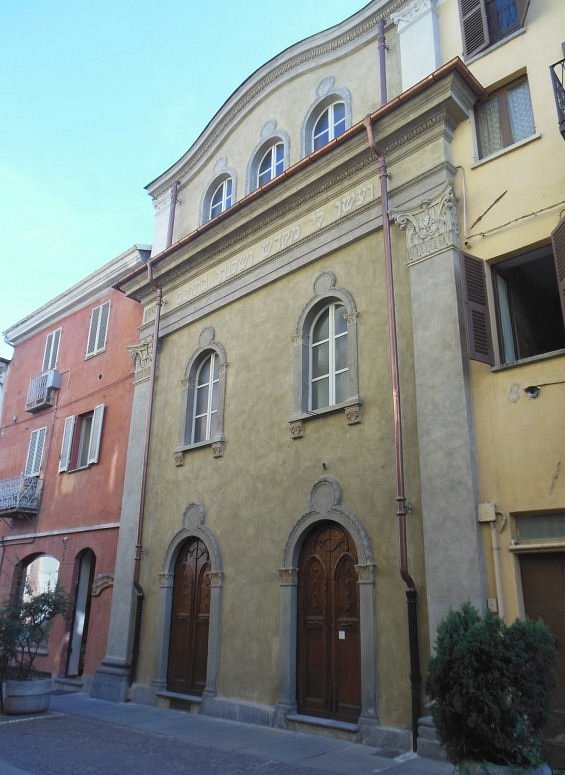
Museo Nazionale dell'Ebraismo Italiano e della Shoah – MEIS
Exterior, The Synagogue of Cuneo (Sinagoga di Cuneo, 2026)
-
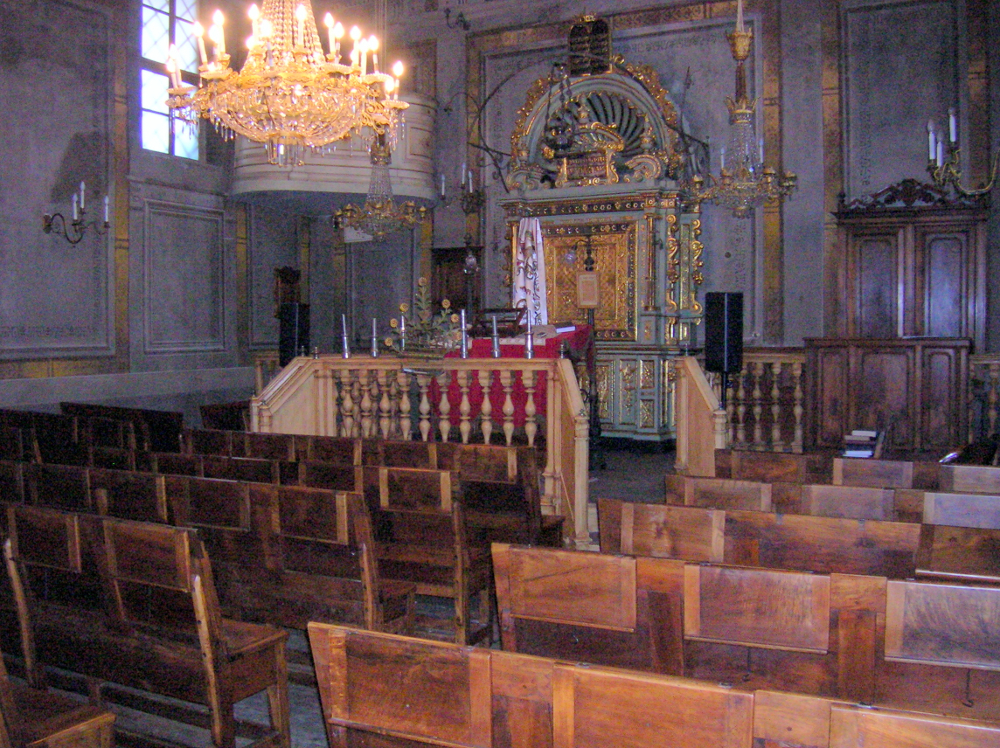
Museo Nazionale dell'Ebraismo Italiano e della Shoah – MEIS
Interior, The Synagogue of Cuneo (Sinagoga di Cuneo, 2026)
The Great Synagogue of Rome (Tempio Maggiore)
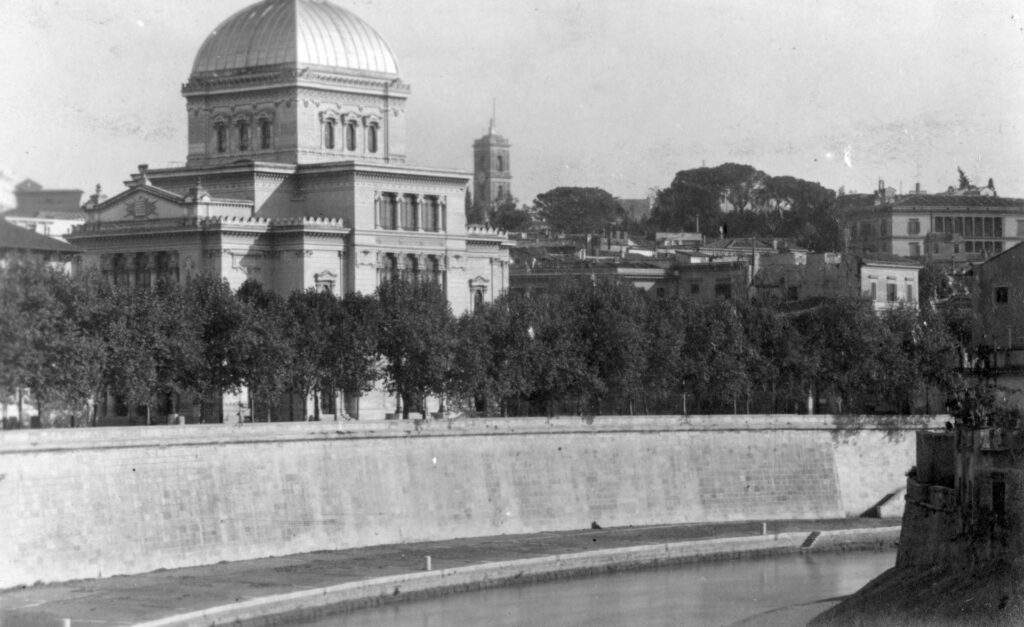
Between the banks of the Tiber River and the Portico of Octavia, a monumental building from ancient Rome, stands the Great Synagogue of Rome– also known as the Tempio Maggiore. The building occupies one of the four blocks created after the demolition of the Jewish Ghetto, where Jews were confined by papal decree from 1555 to 1870.
The history of the Synagogue is closely connected to the political and social changes that led to the emancipation of Jewish peoples in 1848 and and the transformation of Rome and Italy after 1870. In 1889, a competition was announced for the design of the building, but it was not inaugurated until July 1904. Designed by engineer Vincenzo Costa and architect Osvaldo Armanni, the Tempio Maggiore thus became both a symbol of Jewish liberation and a new landmark for the city, now the capital of the newly unified country of Italy.
The Synagogue has a Greek cross floor plan and is crowned by its distinctive square-based aluminum dome. The dome is illuminated by twelve windows and painted in the colors of the rainbow, interspersed with palm and cedar trees, while the ceilings are adorned with starry skies. The building is designed in an eclectic style, combining influences from Greek and Assyrian architecture with elements of Art Nouveau.
The interior walls are richly decorated, with elegant floral motifs in various shades of gold. Natural light filters through stained-glass windows located at the level of the women’s galleries, which are supported by sturdy columns. Beneath these galleries, the side aisles preserve valuable marble furnishings dating from the sixteenth and seventeenth centuries. These furnishings originally belonged to the Cinque Scole (Five Shuls), the ancient synagogues of the Roman Ghetto that were demolished after the construction of the Tempio Maggiore.
Today, the Tempio Maggiore continues to symbolize the deep bond between Rome’s Jewish community and the city itself, bearing witness to a shared history of cultural, social, and political change that has shaped both throughout the centuries.
-
Museo Nazionale dell'Ebraismo Italiano e della Shoah – MEIS
Exterior, The Great Synagogue of Rome (Tempio Maggiore, Date Unknown)
-
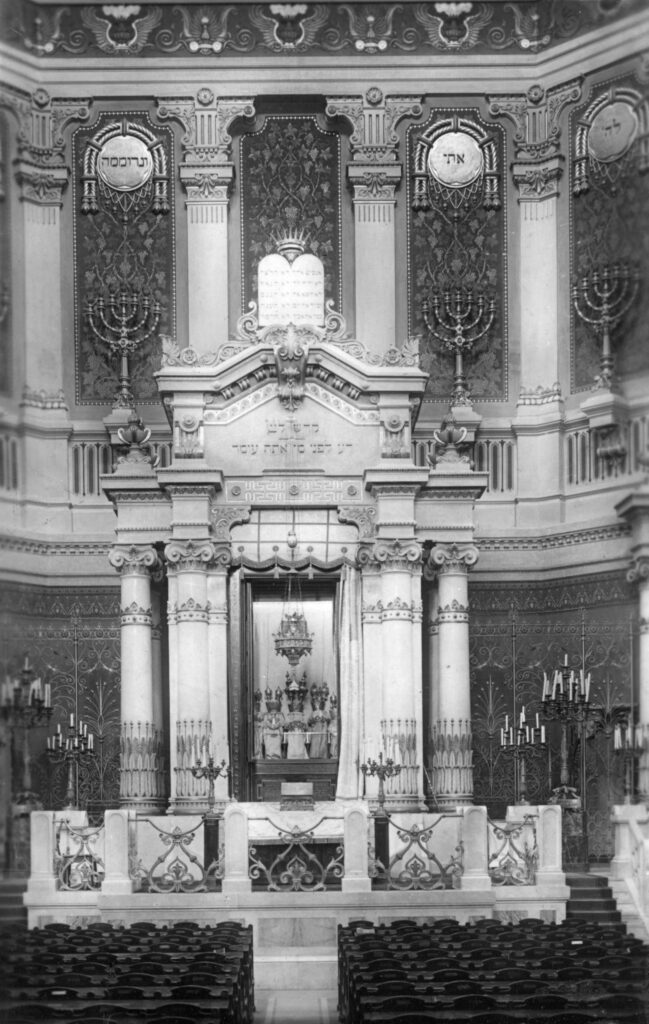
Museo Nazionale dell'Ebraismo Italiano e della Shoah – MEIS
Interior, The Great Synagogue of Rome (Tempio Maggiore, Date Unknown)
The Great Synagogue of Trieste (Tempio Israelitico di Trieste)
The earliest evidence of a Jewish presence in Trieste dates back to the thirteenth century, although the community grew significantly during the eighteenth century thanks to privileges that were gradually granted to Jews by the Habsburg dynasty. Under Habsburg rule through the 19th Century, Trieste flourished as one of the most important and cosmopolitan port cities of the Austro-Hungarian Empire. In 1746, the first of the city’s four synagogues was inaugurated, but as the community expanded a larger and more representative place of worship became necessary.
In 1903 the Jewish Community of Trieste launched a competition for the design of a new synagogue and, in 1906, commissioned the architect Ruggero Berlam, assisted by his son Arduino, to design the building.
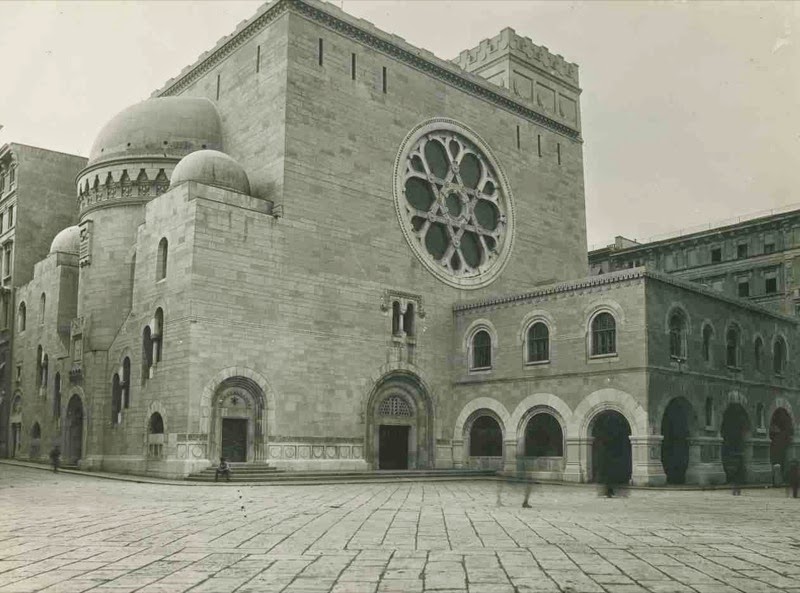
Inaugurated in 1912, the synagogue is a monumental building with an almost cubic plan. Its side facades are distinguished by two large rose windows featuring a decorative pattern inspired by the Star of David, whose stained glass fills the interior with natural light. At the far end of the prayer hall stands a large apse with a semi-dome covered in golden mosaic, housing the monumental Aron ha-Kodesh– the Holy Ark that contains the Torah scrolls. Its copper and bronze doors are surmounted by a pink granite aedicule supporting the Tablets of the Law carved from Carrara marble and flanked by two large seven-branched bronze menorot. During the Second World War, the synagogue was vandalized by Fascists and, during the Nazi occupation, was used as a repository for books and works of art confiscated from Jewish families.
Today, the Synagogue of Trieste is one of the largest in Europe and remains the religious center of the city’s Jewish community. Its liturgy combines both Ashkenazi and Sephardic traditions, preserving the heritage of the four historic synagogues that were replaced by the new building in the early twentieth century.
-
Museo Nazionale dell'Ebraismo Italiano e della Shoah – MEIS
Exterior, The Great Synagogue of Trieste (Tempio Israelitico di Trieste, Date Unknown)
The Great German Synagogue (Scuola Grande Tedesca)
Before the establishment of the Venice Ghetto (1516), synagogues were located within private homes; only later did they become independent places of worship. The oldest synagogue built after the Venice Ghetto’s establishment is the Scuola Tedesca (c. 1528), which is of Ashkenazi rite. Since then, the synagogue has undergone several renovations; the last taking place in the nineteenth century with the synagogue ceasing regular operations in 1917.
The synagogue is housed within a pre-existing building. Its exterior is distinguished by its plain five-window façade and the so-called “liagò” on the synagogue’s opposite side: a projecting structure typical of Venetian architecture. Inside, the “liagò” corresponds to the area containing the Aron ha-Kodesh (Holy Ark). This feature is also found in the Scuola Canton, the Scuola Italiana, and the Scuola Levantina.
Scuola Tedesca’s Aaron ha-Kodesh dates back to 1672, and is made of gilded wood. Its exterior is decorated with floral motifs, while the interior is adorned with the Ten Commandments inlaid in mother-of-pearl.
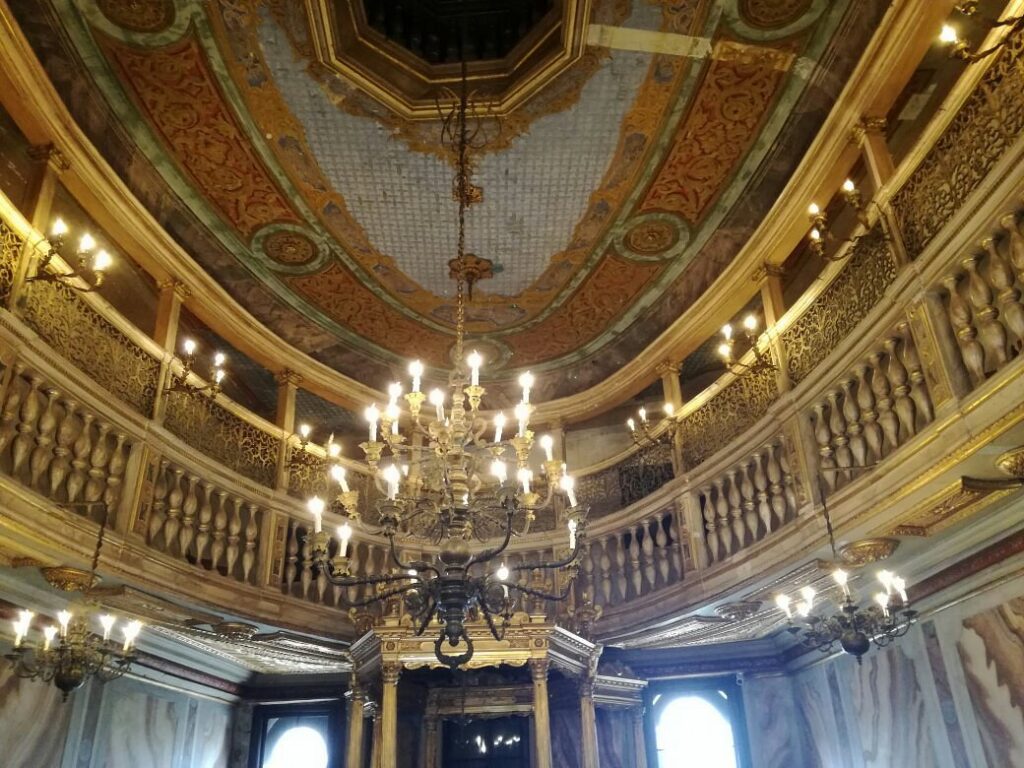
Scuola Tedesca’s bimah -the raised platform from which the Torah is read and the religious service is conducted- has a canopy supported by eight decorated columns. Benches are arranged along its sides, following the characteristic bifocal layout of Venetian synagogues. As is common amongst Italian synagogues, the bimah and the Aron ha-Kodesh face one another on opposite walls, with the congregation seated along the sides and facing the central aisle. The women’s gallery is on the upper level and surrounds the central hall, surmounted by a lantern that provides a bright light to the interior.
In 2016-2017 the World Monuments Fund restored the synagogue and in 2020 it was once again opened for worship to host the prayers of Yom Kippur. On that occasion, the shofar -the ritual horn typically made from a ram’s horn- was sounded there for the first time in more than a century. Today, visitors can visit Scuola Tedesca as part of the Museo Ebraico di Venezia visitor route.
-
Museo Nazionale dell'Ebraismo Italiano e della Shoah – MEIS
Interior, The Great German Synagogue (Scuola Grande Tedesca, 2026)
The Great German Synagogue (Scuola Grande Tedesca)'s women's gallery.