October 13, 2022 - March 5, 2023
Public Intimacy
Where is the line between public and private?
Though not often explicitly posed, we navigate this question every day to guide how we move through the world. Depending on time, place, and who surrounds us, individual and collective definitions of public and private invariably shift. Public Intimacy asks us to consider this changing definition, and the liminal space between.
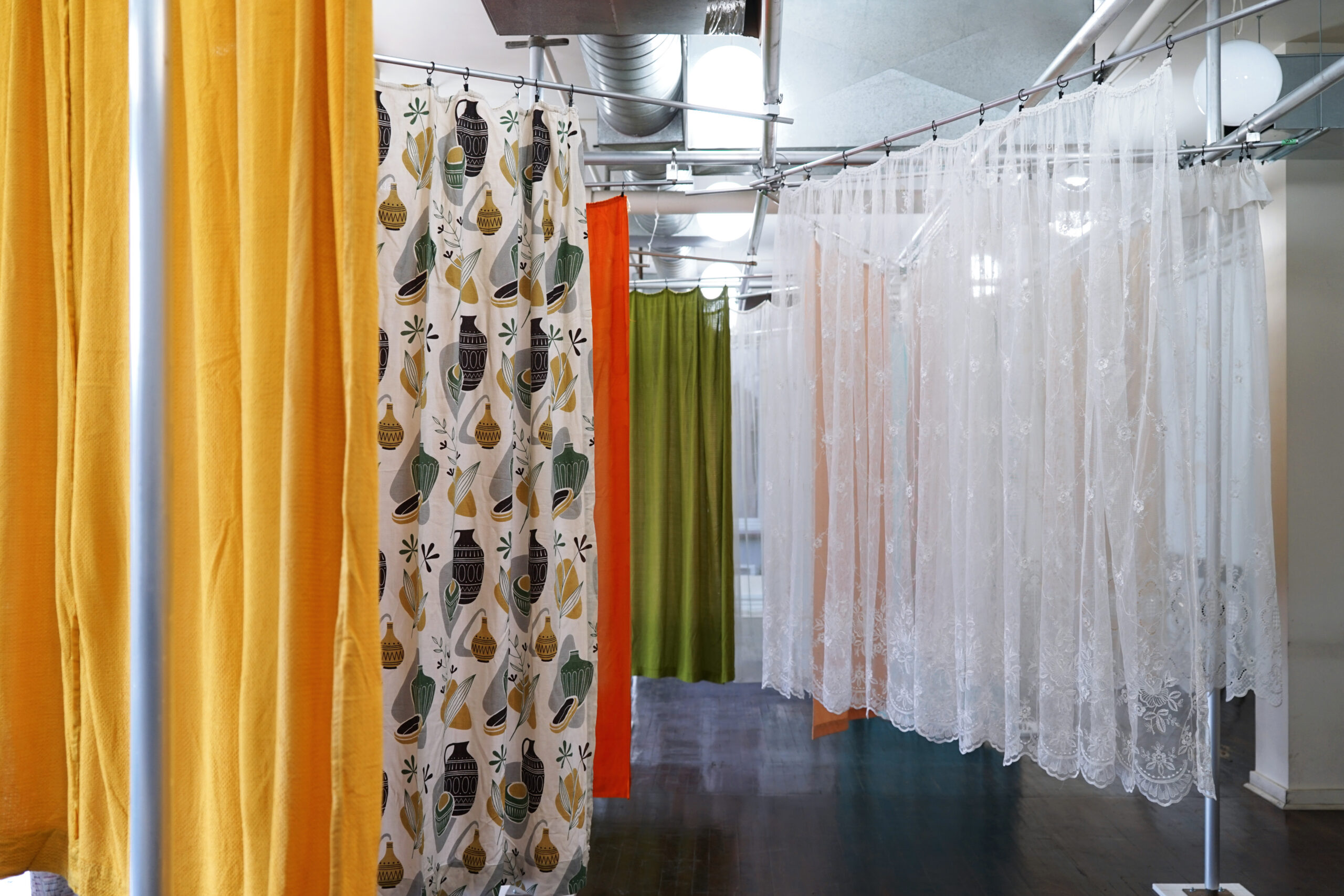
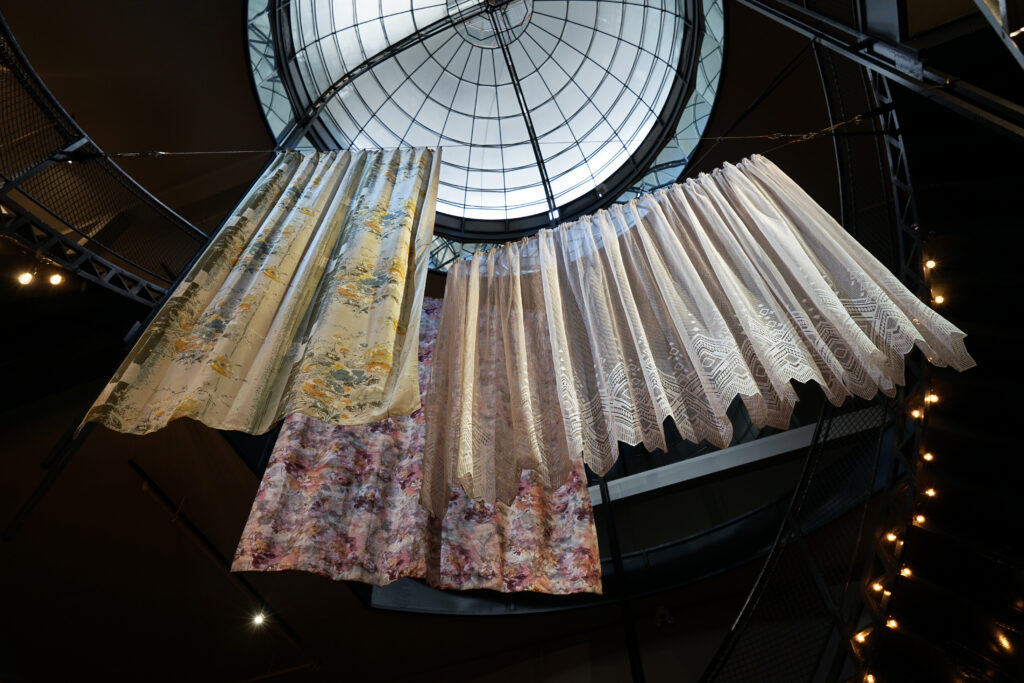
The works presented in Public Intimacy each originate from a real domestic space. The curtains you see are second-hand, sourced from throughout Germany, and hung in homes much like the ones photographed and on display. The textiles and photographed facades draw on domestic structures used to separate public and private spaces. The curtain, practically and symbolically, points to the tenuous divisions and changing frame of where private space gives way to public. In as much as it provides refuge from the outside world, the curtain equally hides from view or shuts us off from what may be happening on our doorstep.
Sophia Hirsch and Johannes Mundinger created this body of work drawing from and within the domestic spaces of Berlin, Offenburg, and other German cities – a regional context still contending with a history of state and civic violence from the Holocaust, as well as a contemporary resurgence of antisemitism and xenophobia in the rise of neo-Nazi movements and the far-right. In addition, our world is more connected than ever before, and in the wake of a global pandemic, new spaces and considerations have opened up questions on how we act or what we say both online and in real life. When or where do we draw the curtain? And what does it block out?
As the artists consider this reality in their own locale, their work invites you to consider in equal measure your own “curtains,” their contexts, and what they may delineate.
-
Sophia Hirsch and Johannes Mundinger
Public Intimacy
Suspended curtain installation
-
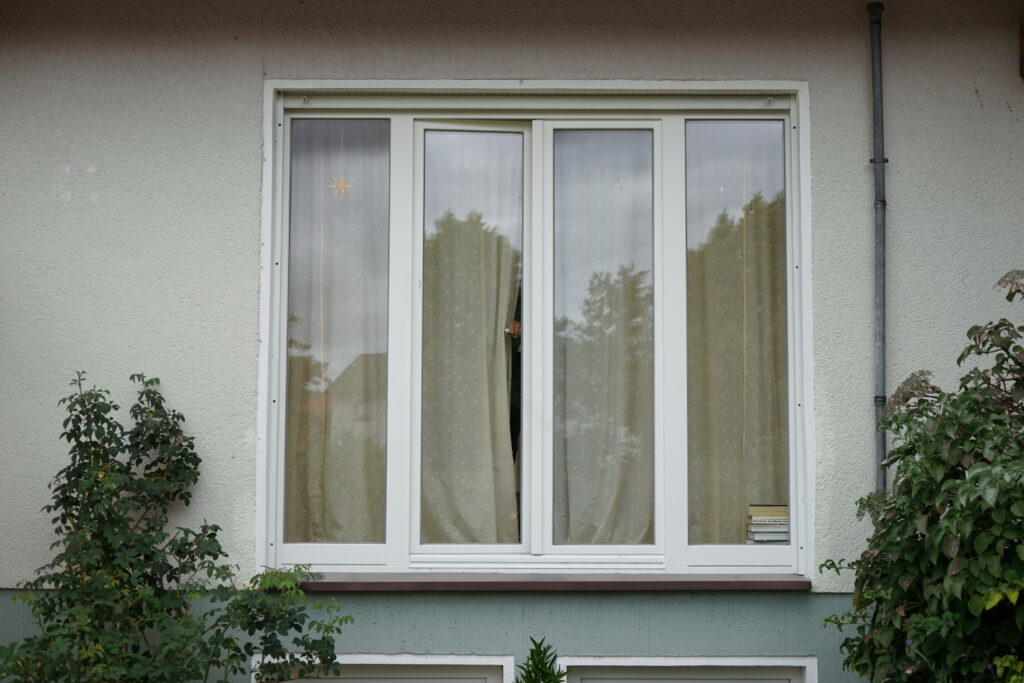
Sophia Hirsch and Johannes Mundinger
Fensterbild
Photograph
-

Sophia Hirsch and Johannes Mundinger
Public Intimacy
Suspended curtain installation
A curtain is a tool to divide inside from outside, separating private sphere from public space. It works as the eyelid of an apartment, making a shelter for intimacy. On the one hand, it creates a hideout from the gaze of others, a temporary escape from social control.
On the other hand, in German the expression “to draw the curtains” is often used to refer to people who decide not to see, not to intervene in current events. We want to explore the field between the possibility of individual freedom and ignorance towards wider social realities.
The idea of the silent observer, the very (in-)active role of the bystander, whether in our private lives or historical events, was the idea that started this project. The person behind the curtain, who doesn’t do much else other than watch events unfold. A figure that hides and is often ignored, but crucially influences the course of history.
The curtains themselves are of different origins; donated pieces, found in abandoned buildings, and bought second-hand. They differ in fabric and pattern – but are all pieces that were once chosen as just the perfect item for someone.
Visitors are welcome to walk through and experience the installation physically. You can move one curtain aside, but you will find another one in front of you. Visitors are invited to pull them aside or draw them together, to find individual ways though the installation or create new spaces within it.
Sophia Hirsch and Johannes Mundinger are continuously collaborating on murals, installations, and exhibitions.
Sophia Hirsch was born in 1987 and is based in Berlin, Germany. She graduated from the Weißensee Academie of Art, Berlin, and the University of Art and Design, Halle. She has also studied at Bezalel Academy of Art, Jerusalem.
Johannes Mundinger was born in 1982 in Offenburg, Germany, and is based in Berlin. He graduated from Münster School of Design, where his exchange studies led him to the Academy of Fine Arts, Brussels.
They have worked with institutions such as the Museum Kunsthalle Wilhelmshaven (2017), the Jewish Museum Cracow (2014) or Yeoju Museum, Korea (2020).
In 2013 they won the jury prize of the Berliner Kunstverein for their installation Kritische Masse and were invited as artists in Residence to The Art Cube Artist’s Studios, Jerusalem (2017), Yeobaek Seowon, Gyenggi-Do, Korea (2019) and Begehungen Chemnitz (2021).
They have painted murals for numerous institutions and cities, mostly within Europe, but also in Mexico, Korea and Israel.
ARTISTS
Sophia Hirsch and Johannes Mundinger
ARTISTIC DIRECTOR
Alyssa Stokvis-Hauer
GRAPHIC DESIGN
Austin Henderson
EXHIBITION TEAM
Pippa Bartlett, Austin Henderson, Anya Kowalchuk, Alyssa Stokvis-Hauer
TRANSLATION
Benoit Pelletier
CONTRACTOR
ShopDogs MTL
PRINTING
MFBB Lettrage
Funders
We acknowledge the support of the Conseil des arts de Montréal and the Consulate General of the Federal Republic of Germany in Montréal.