Now On - Until January 31
Seam Allowance
A sensitive contemplation on histories of labour and migration, Seam Allowance is a site-specific installation that traces a family’s journey from Eastern Europe to Montreal.
Despite the queues at border checkpoints, immigration is a story seldom told in a straight line. Since the rise of nation-states in the nineteenth century and the increased regulation that followed, newcomers are often stalled in their passage to a new life, turned around, barred entry, or required to wait in uncertainty before entry is granted. The journey can be unpredictable, repetitive, and mundane.
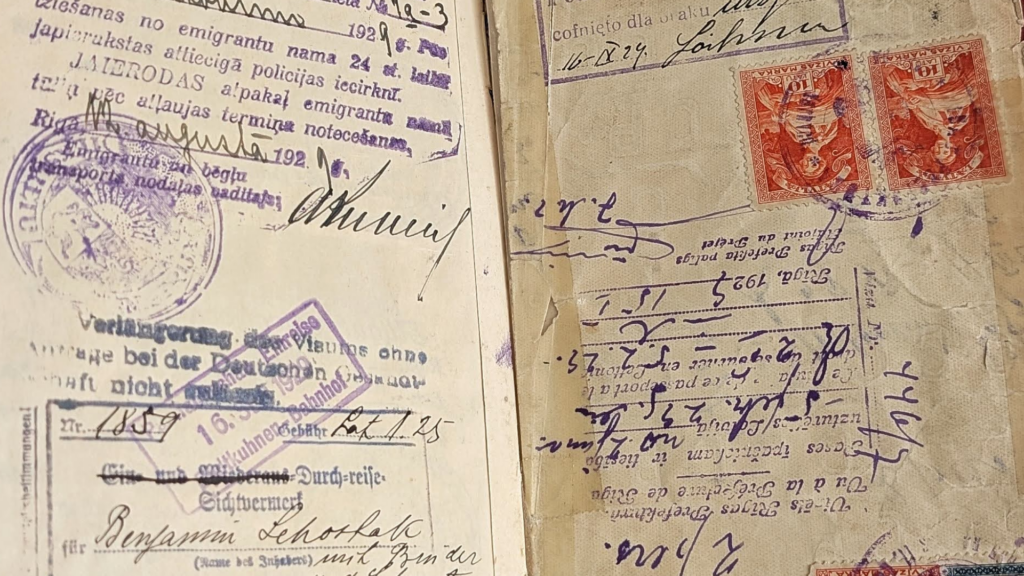
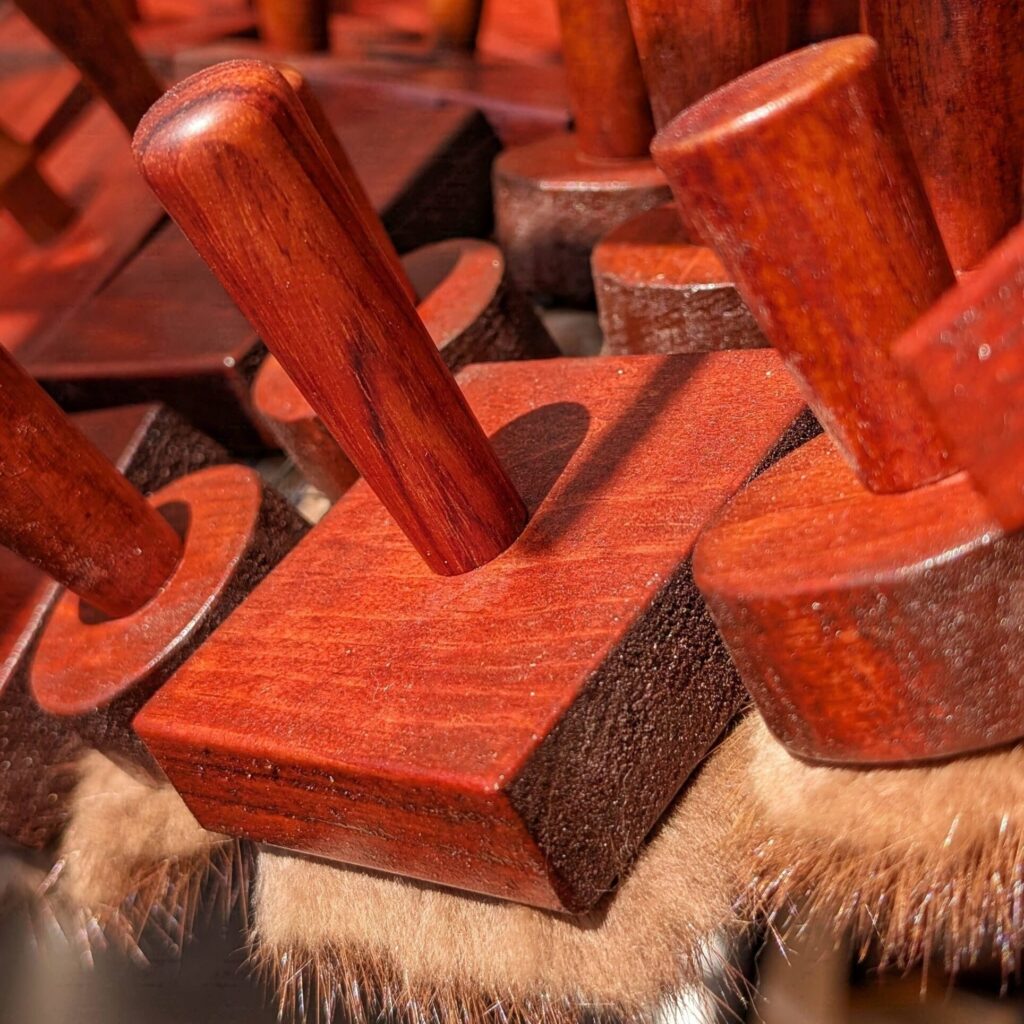
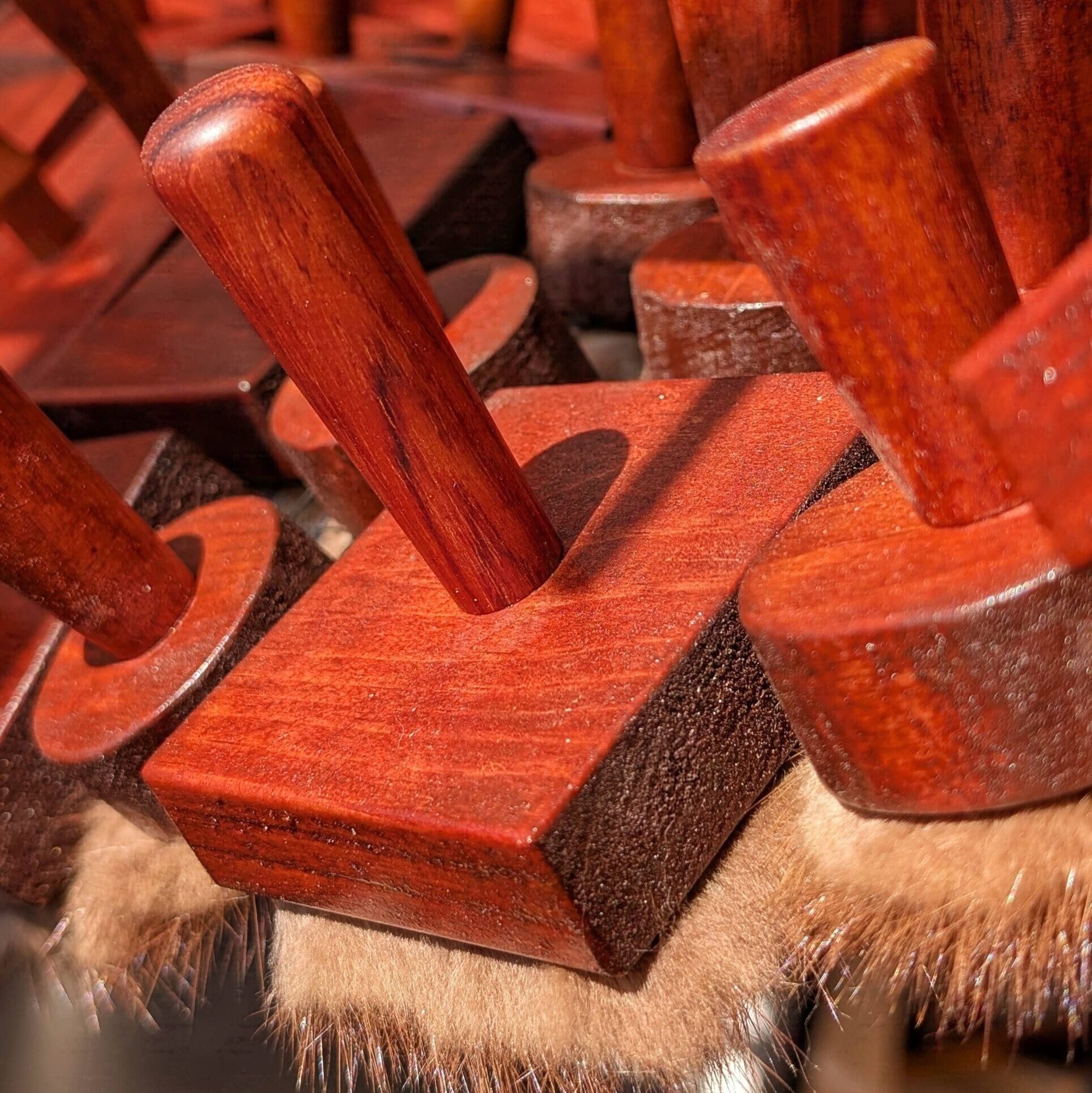
In Seam Allowance, Rob Shostak uses the passport of his grandfather, Arthur, to visualize his family’s passage between Eastern Europe and Canada through the late 1920s. Replicates of over 100 wooden stamp handles hang in a floating topography, each modeled from the imprints found in the passport’s wrinkled pages. Shostak further alludes to this voyage in the canvas backdrop, where his intentional stitching follows the path of his family’s journey westward across Europe to the United Kingdom and into Canada. Reminiscent of the undulating voyage across land and sea, the suspended stamps also function as handheld tools of movement, power, and the repeated regulation of an immigrant’s journey to a new life.
When Shostak’s grandfather, Arthur, arrived in Montreal, he opened a furrier business with his brother, Sam. Family archives note one location operated in the Old Port at 736 Rue Notre-Dame Ouest, and another in the Belgo Building at 372 Rue Sainte-Catherine Ouest. To situate his family’s profession in the broader patchwork of Montreal’s Jewish garment industry, the bases of each stamp handle are not finished with rubber markers, but with patches of fur.
Unlike rubber, fur is absorbent, an insulator, and a protector from the cold. Fur can be considered as the inverse to the hard rubber stamp. Instead of pushing the movement of bodies forward or backward, fur offers a pause, enveloping the body in its softness and warmth. While the mark of a stamp may grant safe passage, fur brings with it a promise of security and survival.
The unusual volume of stamps in Seam Allowance allude to the repetition inherent to systems of migration and tailoring. If every stamp is a direct reference to an imprint in Shostak’s grandfather’s passport, there are millions more for migrants who followed a similar passage. Each patch of fur can be seen as a fraction of the many coats made, repaired, and worn to shield wearers from harsh Montreal winters. Here, the stamps are not just tools, but also witness to the emigrant movement and the journey that follows.
At once a sensitive reflection on familial histories, Shostak’s compassionate examination of immigration and labour reveals connective threads to the present. The H. Fisher & Fils site itself once operated as a furrier from 1924 to 1934, under the name Harry and Millie Herman’s Furrier Shop. With Seam Allowance, this space is once again pulled in a new direction that, from one family’s story, speaks for countless experiences of labour, manufacture, and migration within and beyond our city.
Rob Shostak is a multidisciplinary artist from Montreal and based in Toronto, Canada whose practice navigates the intersections of place, memory, and time. Through installation, performance, and digital media, his work often takes on a whimsical form while engaging with questions of space, perception, and the traces that shape our experience of everyday life.
Shostak is perhaps best known for his playful landmark costumes, wearable art that transform Toronto’s architectural icons into embodied installations. His practice also extends into culinary space using baking as an experimental medium for thinking through memory and materiality. His installation Parchment at FENTSTER Gallery (2022) featured community-collected parchment papers exploring the mark made by baking challah bread for Shabbat.
His work has been featured by DesignTO, The Bentway, and Toronto’s waterfront as part of Winterstations and Ice Breakers. Additionally, his work has been published by Architectural Record, Azure, Domus, The Toronto Star, and CBC among others.
Shostak holds a Master’s of Architecture from the University of Toronto and a BA in Psychology and Humanistic Studies from McGill University.
-
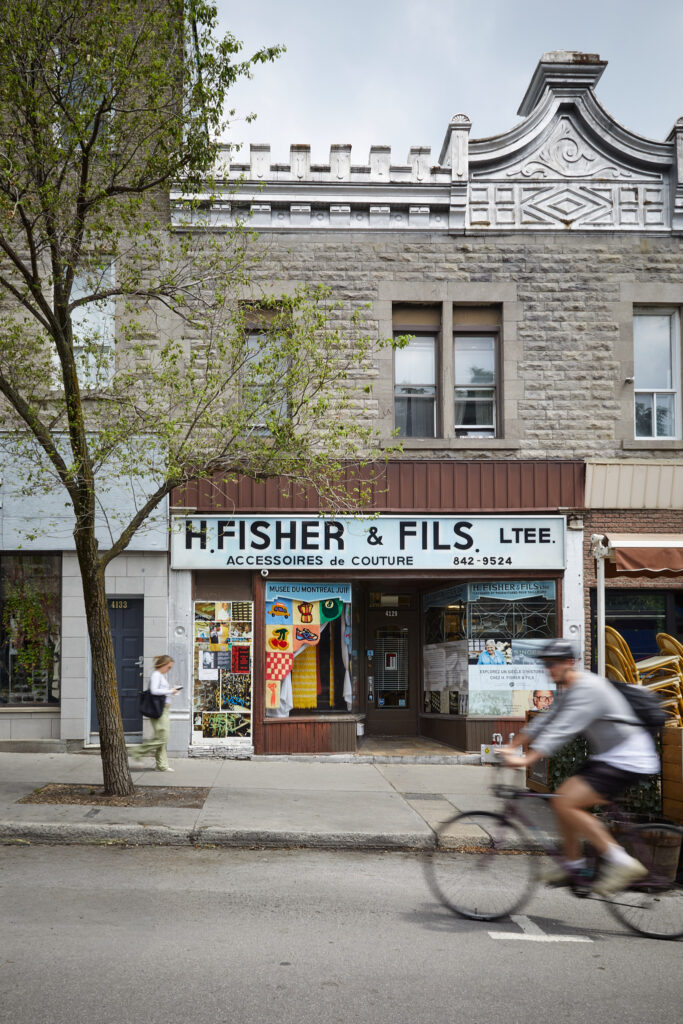
Photo: Laurence Poirier
-
Photo: Laurence Poirier
-
Photo: Laurence Poirier
-
Photo: Laurence Poirier
My practice uses order and repetition to approach ideas of place, memory, and time. I am drawn to questions that resist easy representation: how memory forms and fades; how we orient ourselves within spaces and systems larger than ourselves; how stories emerge through process and form.
Seam Allowance begins with my grandfather’s Soviet passport, issued in 1928 and used as he immigrated to Canada as a teenager with his brother and sister. After settling in Montreal, he worked in the garment and accessory trades and later as a furrier.
I translate each of the approximately one hundred inked impressions into a wooden hand stamp that could have left it. Fur replaces the engraved rubber surfaces: the outlines remain, but the text is absent. The instruments of control and authorization cannot produce a consistent, legible mark. Instead, they bear the material of his later livelihood. Connected in a dense, orderly grid, the stamps form a fabric-like surface with the proportions of the original passport.
In the surrounding cloth, a seam traces his route from Ukraine to Canada over land and sea. The single piece of fabric is cut and sewn back together along the journey, recording movement through an act of making.
These transformations connect the regulated procedures of migration with the patterns and repeated gestures of textile labour.
– Rob Shostak
ARTIST
Rob Shostak
ARTISTIC DIRECTOR
Alyssa Stokvis-Hauer
CURATORS
Taryn Fleishchmann Austin Henderson
Alyssa Stokvis-Hauer
Sponsors
This project has been made possible in part by the Government of Canada.