
Listen to this Oral History
Description
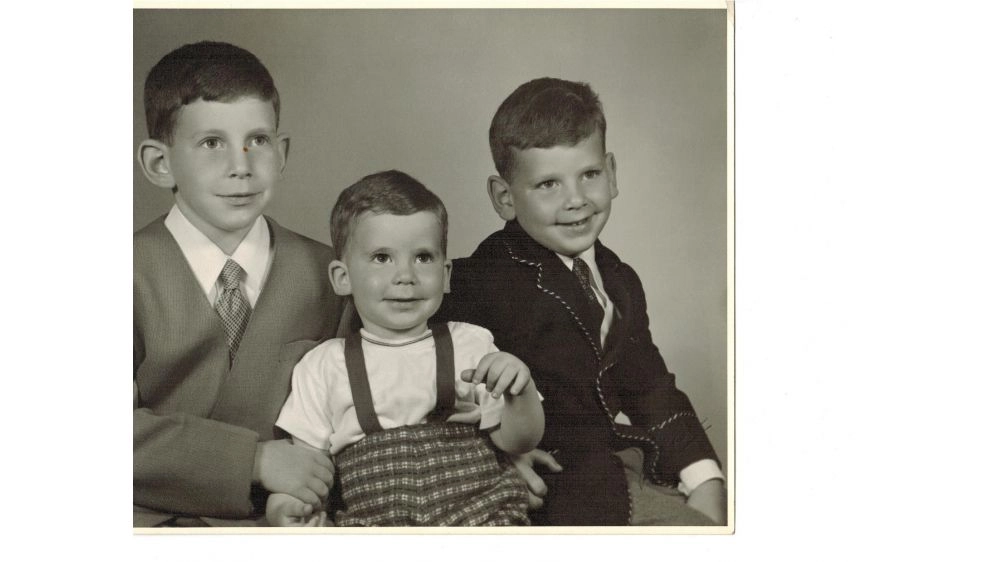
Richard King recounts his own childhood cultural experiences growing up in Montreal. His stories include Yiddish school, camp Kinderland and fond memories of growing up with his father and younger brothers.Transcript
(0:00 - 1:36)
My name is Richard King. I'm 70 years old, almost 71. I was born in 1945 and grew up in Montreal.
Well, growing up with my father was like living in a sitcom. My father had a great sense of humor. Our mother died when my brothers and I were very young. It was a week before my seventh birthday in 1952. You'd think from that experience it would have crushed my father's spirit, but somehow it didn't. I can't remember any specific funny incident. I can say that most of the incidents with him were funny. He wasn't a disciplinarian. I only realized when I became a father myself that I probably never heard the word no. Even when he was angry, even when I did something he didn't want me to do, somehow he never, he never said no to me or my brothers. We never had curfews. We just knew when we had to be home.
Because we were growing up essentially four men in a house, we lived a little bit like it was a frat house. And when my father remarried my stepmother in the, in the 60s, she was the civilizing influence. We got nice furniture. We moved to a nicer place. But up until that point, we never really cared. Like, I never noticed that we were living kind of, you know, this frat life, this frat house existence.
(1:36 - 3:26)
I was… I’m what's called a red diaper baby, which means my parents were part of the Jewish left wing, which is politically usually misunderstood. Jews were considered to be communist rebel rousers bringing ideas into Canada and the United States that were foreign to the ethos of those countries. In fact, the motivation to join the left wing movement was based on the fact that only the left was providing any opposition to Hitler. The Liberals and the Conservatives… in the United States, the both the Democrats and the Republicans were either indifferent to the suffering of the Jews or favored it. People seem to be very shy about remembering that Franklin Roosevelt himself, the great liberal leader, turned back a shipload of Jews, sending them to their death.
The policy in Canada was none is too many. So that was the motivation that put the Jews on the left. As a result, red diaper babies had the best upbringing possible because we grew up believing in something. We all had social consciences. You know, we took that in with the air we breathed. Virtually everything we did had kind of a left wing tinge to it. The funny thing about it is, or maybe the interesting thing about it is, we were totally immune to any kind of polemic or brainwashing. We just took it as normal that you had to care about other people and that if someone was suffering, you did something about it. We were children. We didn't see it as left or right.
(3:26 - 6:25)
Part of growing up in that environment was going to Beaver Camp. Later, Kinderland was, instead of going to Hebrew school, we went to Yiddish school because for that group, Yiddishkeit was cultural, not religious. And we went to something called the Morris Winchevsky School. To learn Yiddish. I was a very bad pupil. Whenever I was called upon to read, I would rip the page out of the book and say I didn't have that page. After a while, the teachers just gave up. The interesting thing about it—and I only found this out much, much later, and it was only when I was, I think, in my 30s that I realized how much I had missed—all the teachers that they had in that school were immigrants from Poland or Germany, were highly educated men who were reduced to teaching a bunch of snot-nosed Canadians how to speak and read Yiddish. And if I'd paid attention, I probably would have got a lot about these people. There was one person in particular. We called all the teachers Lehrer. So it was Lehrer Stern, Lehrer Hirsch, and so on. My father thought the world of Lehrer Stern, thought he was brilliant, and he would go and visit with him, you know, just like that, because he thought the man had a lot to say.
I should add that both my parents went to university. They're both university graduates, which is very unusual for someone of my age and my religion. But McGill at that time, at the time my father went, had a quota on Jews. My father wanted to study chemical engineering, but because he was Jewish, he was unable to get into the engineering faculty. As a result, he did a BSc with a major in chemical engineering. My mother did degrees in social work, which is kind of the family business, and apparently there were no quotas on Jews in social work, which suggests that McGill didn't take it all that seriously as a discipline. So, you know, it was at McGill where I suppose my parents were radicalized, not unlike students, generation after generation.
In keeping with my parents, or really my father's political ideology, two memories kind of stand out, two political memories. One, my father was a member of any number of discussion groups. So there were always people around the house talking about whatever the issues of the day happened to be. As a kid, I don't really remember what they were, but I do remember the passion with which all these things were discussed. So it was a very lively atmosphere. And all those friends were on the political left. So it's not like there wasn't much in the way of argument; it was more discussion.
(6:25 - 7:29)
When my first wife—her name was Deirdre O'Donnell, so you can see right off the bat, not what you'd call Jewish, came from an Irish-Catholic combined Scots-Presbyterian background in Quebec City, lived in Montreal because she went to McGill—when she first met my family and she would come to dinner at our house, she would hear my father and whichever sibling of his happened to be there arguing in Yiddish. And they were really going at it hammer and tongs. And at one point, she asked me, why don't they like each other? Which really surprised me because they loved each other, to which I said, Deirdre, they love each other. Why do you think they don't like each other? And she said, because they're always screaming. I said, that's just the way we talk. You know, her family was much more subdued. After she understood that it was okay to raise your voice, she was able to join the discussion, of course, in English.
(7:29 - 9:37)
Now I was older and I went as first a counsellor in training, following that as a counsellor. So this must have been in the late 50s, early 60s. The counsellors were uniformly intelligent. It was really quite amazing how smart they were. One of the counsellors—actually was a section head—was a fellow named Gerry Cohen, who was a Rhodes Scholar. He stayed at Oxford. He later… he was a student of Isaiah Berlin. And until his death, he occupied the Isaiah Berlin chair in philosophy. So the level of humour at that camp was really high because you had all these college students who were studying arts and humanities, who were able to make fairly sophisticated jokes. The high school students—and I was more in that group, sort of the younger group—were also very intelligent. At the time, when you were in your last year of high school, in grade 11, you took, you took all your matrics in one go, in the month of June. And when the results came out, if you got over 90, you placed, it was called placing in the province. And just about every counsellor at Camp Kinderland, who went—with the exception of me—placed in the province. I quit high school and never took the exams.
As a counsellor, again, we were all kind of lefties. Our parents were lefties. The camp directorate were lefties. But I can't think of anybody who went there that does not have fond memories of the place. In fact, there's a website on Facebook devoted to Camp Kinderland. And to this day, I wouldn't say I'm very friendly, but I still see some of the people, like Miriam Zilberstein and Billy Byers, with whom I was a counsellor at that camp.
Disclaimer
Please note that the views and opinions expressed in these recordings are those of the interviewee alone and do not necessarily reflect the positions of the Montreal Jewish Museum, its staff, or its Board of Directors. These recordings are presented as personal recollections for historical and educational purposes. Individual accounts reflect the interviewee's personal perspective and lived experience, and have not been independently verified for factual accuracy.
These transcriptions and translations have been produced using automated transcription and translation tools, followed by human review. Despite this process, inaccuracies may remain. If you identify an error, please contact research@imjm.ca with the page link and your suggested correction.