
Listen to this Oral History
Description
Listen to Shirley talk about growing up in the 1930s Westmount Jewish community, experiencing and defying anti-Semitism in Montreal and how her work in volunteering led her to change two laws. After being unable to train as a teacher because of McGill University's quota on Jewish students, Shirley went on to learn secretary work and co-run her husband's business. Shirley became a prolific activist, volunteering in education projects, advocating for penal reform and campaigning for Jewish rights. In her position as Vice-President of the National Council of Jewish Women, Shirley overcame the divisions between Montreal's Francophone, Anglophone and Jewish communities to campaign successfully for young offenders to be offered rehabilitation rather than imprisonment. Find out why working as a coalition of women was so significant to Shirley in spite of the segregation and hostility that shaped much of her life as a Jewish woman in Montreal.Transcript
(0:00 - 1:15)
I'm from New York, actually. They grew up in New York. My father was a second generation New Yorker and my mother had come at four years old to New York.
And things were not, the economy in the States at that time, just before I was born in the early 20s, was not very good and my mother's cousin had already come to Montreal and she encouraged my parents to come here because it was a growing city and there were opportunities here that you didn't have in New York. So they did come and then established themselves and my father went into business here. And so I grew up in the west end of the city and went to, in those days it was called Rupert Simon's Public School, and we used to trudge up that hill in snowstorms with huge snow banks, like they were close the size of me, you couldn't see me from the road.
(1:16 - 3:12)
And I stayed and we lived in that house until I was 12 and then we moved to Westmount because my grandmother lived with us, my two uncles lived with us until they got married. In those days families didn't take their own apartments, they lived on Famille because of the economy and because this was lifestyle in those days, you know. So I grew up with two uncles in the house and that was fun.
I mean for me it was great, my mother I don't know because you have to do all the, and my grandmother also. So, and my grandmother was very religious and so they moved to where the synagogue, close to the synagogue, the Shaar Hashomayim, a street away so she could easily manage to get to synagogue and I very often went with her. And so I had a traditional background, we had a kosher home and no problem about even having the rabbi for dinner kind of house.
So that was basically my background. And went to high school here and graduated high school and then I decided I would take a stenographer's course because in those days I wanted to be a school teacher actually, but there was a limit to how many Jewish kids could get into programs at McGill and or the Macdonald College where the teachers were trained. I also worked for a little while at the Bay which was called Morgan's and I had a problem.
(3:13 - 3:55)
I worked in the book department which I loved because I loved to read and what happened was that at the Bay at that time the manager was a very anti-semitic. There was one Jewish sales girl in at the Bay who worked in the ladies department and she was respected and she was I think a manager, a buyer, and she had a sense of style and so on. And so they didn't, when it was time for me to be actually made manager of the book department, they did not give me that job.
(3:55 - 4:57)
They wanted to put me in another department and I said no I'm not going there. So I went up to the manager and I said forget it. I left and then I met my husband.
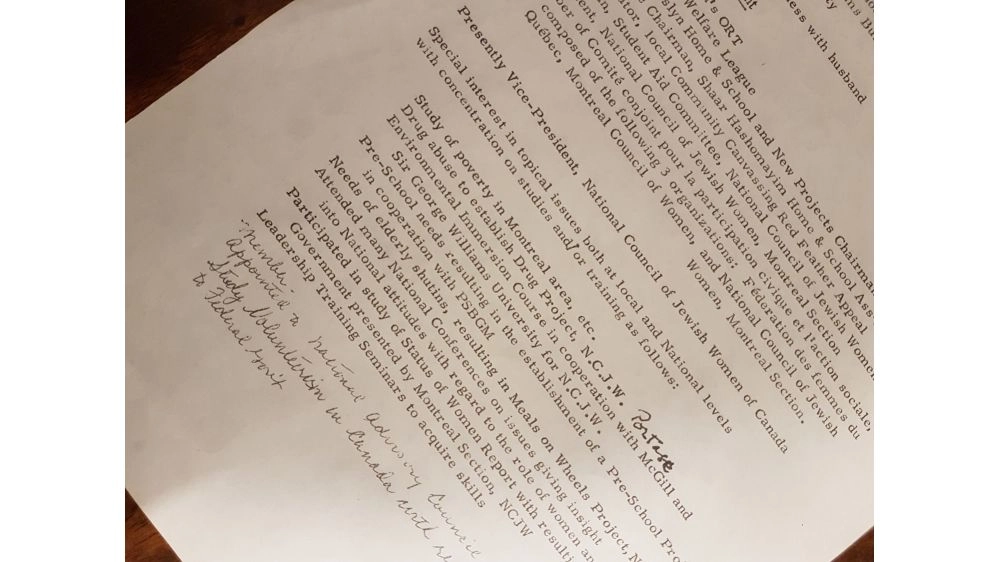
So I started to be a volunteer in many ways and as you see from my CV, I enjoyed it. I met wonderful people and we did make really interesting things. We created a lot of programs that are still in existence like the Golden Age Club and things like that.
It was very interesting. The Montreal community was divided, the French community, the Jewish community, and others. And council, we decided that it's time for us to learn about each other and to work together because we had a common cause.
(4:57 - 5:43)
At that time there was an issue with the laws about young offenders and how they were being but wrongfully, you know, committed to jail or something where they needed really psychological services and that sort of thing. So we called on the Fédération des Femmes de Québec. We called on the non-Protestant one of the Council of Women and the Montreal section.
(5:44 - 6:48)
So we had the three denominations and we figured the only way to do that and to get us to work together would be to have a cause. And so at the time with this law intending, we decided we work on getting a change in the law concerning young offenders. And that worked beautifully.
And we would speak in French and we speak in English and we'd make friends. And the women, eventually a Jewish woman, became the president or chairman of the Fédération des Femmes de Québec, you know, because we respected each other. And separate school boards is something that disturbed me terribly because that separated, to me, that separated the children and created the French and English separation.
(6:49 - 8:52)
Because what happened if you wanted your child to be educated in English and you were not Catholic, you couldn't go to Protestant school or vice versa. If you were Catholic, you went to a Catholic school and it was part of the law. And the only thing that they had a problem with was then what would they do with the Jewish children, years of origin, at the beginning.
And the Catholic school board said, absolutely no. And so finally, they offered the Jewish community their own school. And they said, no, we don't want to be ghettoized.
So finally, the Protestant school board said, okay, 99 years or something, you can come to the Protestant school so the Jewish children could go to a Protestant school. And we had a hard time. I had a very hard time.
My mother used to come to school and give the teachers a little gift from time to time because they were so anti-Semitic that it was pathetic. Some of them weren't, but some of them really made it hard for the kids. And, you know, getting into university, we were told at graduation that if you, there's a quota at McGill.
And you, normal students, normal, could come in at 70 percent or something. Jewish students, 75 or 85 percent, you know. And then only so many in the medical faculty and any faculty. It was a hard time at that time.
Disclaimer
Please note that the views and opinions expressed in these recordings are those of the interviewee alone and do not necessarily reflect the positions of the Montreal Jewish Museum, its staff, or its Board of Directors. These recordings are presented as personal recollections for historical and educational purposes. Individual accounts reflect the interviewee's personal perspective and lived experience, and have not been independently verified for factual accuracy.
These transcriptions and translations have been produced using automated transcription and translation tools, followed by human review. Despite this process, inaccuracies may remain. If you identify an error, please contact research@imjm.ca with the page link and your suggested correction.