
Listen to this Oral History
Description
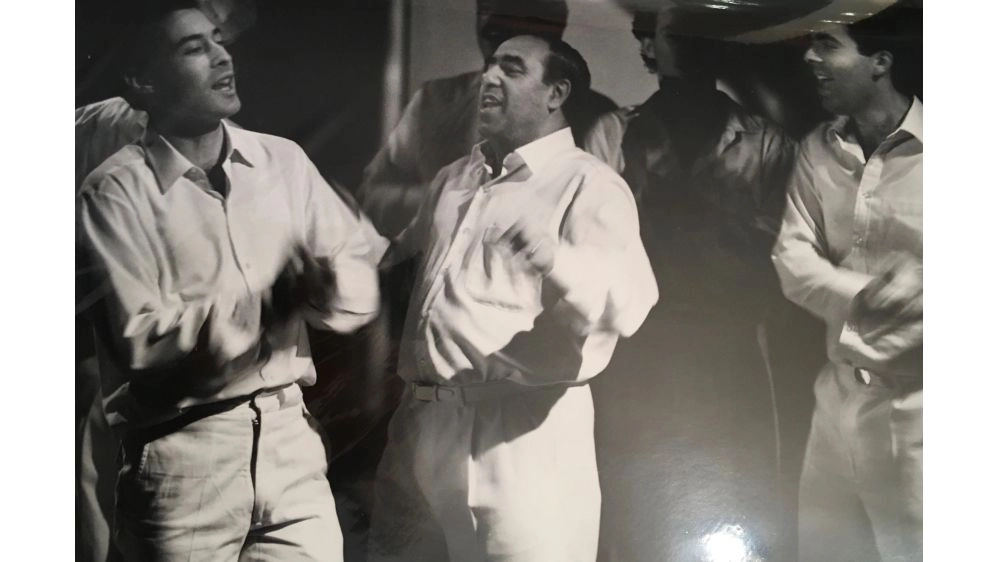
Shirley and Bernard Herman reflect on their many years of involvement with the Dora Wasserman Yiddish Theatre.Transcript
(0:02 - 0:09)
So if you could start by saying your names for me, that would be good. Okay, Shirley Herman. My maiden name was Lerner.
(0:10 - 2:44)
Bernard Herman. My friends call me Bucket. Shirley was born in Montreal, but I was born in Riga, Latvia.
I came to Montreal about 10 days before the Second World War. August 17th to 20th, about 100% sure. I was nine years old.
It's amazing, I'm 87 years old and I can remember everything. I remember coming and we were here about a week or so in August, the last week of August ‘39. And when sitting in the car driving September 1st, we turned on the radio and we hear that Danzig was invaded.
That was the first day of the war and I can still hear the screaming in my ears today, the screaming in the car. And I remember though, my first day in school, Alfred Joy School on Fairmount and Querbes, I think it is. And I came in the front door, my father registered me and then he left and I came out the side door and I was lost.
I didn't know where I was. And I remember being upset, I think I even cried a little bit. And there was some boys came over to me and I spoke to them and I remained friends with these two guys for years and years afterwards.
In Latvia, at home, because my father was originally from the Ukraine, so we spoke Russian. On the street and downstairs, we lived in an apartment building so we played with all the other kids. Of course, we spoke Latvian.
And the school I went to in Riga was a Hebrew school, but the language of instruction was German, because you know, German is the cultural language. And so my third language was German. So I spoke three languages fluently.
And since my father lived in America, he spoke English at home a lot, so I picked up the English as well. So by the time they came to Canada, I spoke English more or less. When we still lived in Latvia, and my father was traveling back and forth, he used to come with one valise full of the newspaper, the forwards.
(2:44 - 3:25)
And remember, this is before television. So at night or whatever, my mother used to read to me a lot and a lot of the things that she read was Bintel Brief from the forwards. So I must have known Yiddish because I followed what she read to me in Yiddish.
I was born in Montreal, and I was born on St. Cuthbert Street near St. Lawrence near Schwartzes and the Moishes and all that. I spoke only Yiddish until I was six years old. And I went to a Protestant school board, the English school board.
(3:25 - 4:51)
Then I got typhoid fever, and I was out for many, many, many months. When it came time to go back to school, the old famous Dr. Alton Goldblum, the father of the famous two Goldblums, said, no way, you're just learning to walk again. You still can't eat properly.
You can't go to school after school. So my mother went to the principal, Mr. Wiseman, crying. And Mr. Wiseman sent me for free.
We were very poor. A tutor twice a week for the Yiddish and there was a little bit of Hebrew there because Israel wasn't a state yet. And it was a Zionist school but not a religious school.
So Yiddish and a little bit of the Hebrew. And in May, we moved to Laurier. And I started going to day school in Folk Schule for nothing in a class of rich children, Burman, national type and here I was.
And in the fall, in grade four, he came in. So we were the two so-called scholarship children in Folks Schule day school until today. I thank God that we had a wonderful education.
(4:51 - 5:42)
And time goes on. And now my granddaughter teaches in Folks Schule. Montreal is a very tight community.
In the old days, we all lived on Park Avenue. When you walked on Park Avenue, it was wall to wall Jews. That's where we met the girls.
That's where we met our friends. And during the holidays, it was like Fifth Avenue, New York. So even to this day, you go to Florida and you stand in a pool talking to someone.
And within five minutes, you make a connection with a guy you're talking to. His grandmother's uncle came on the same boat as your father in-laws sister. Montreal is a beautiful, beautiful Jewish community.
(5:43 - 6:36)
Dora Wasserman came to Montreal and her life's dream was to start a Yiddish theater because she was a Yiddish actress back in Russia. And after the war, she did a lot of performing in DP camps. Of course, to start a theater with no money, but you had to know Dora, she managed to organize it.
And she managed to create a very, very, very cohesive group of people. And they became like family. And her house, Friday night, the black bread, what did she say? You had the black bread and borscht.
She made soup enough for 50 people for a week. She made it. She never cooked, but that borscht in a big pot.
(6:36 - 6:50)
It had everything in there. For the whole week, one soup. It was known as in Yiddish, shit, shit.
Shit means to pour. But in English, it means something else. But we used to call it the shit, shit soup.
(6:51 - 7:02)
And we put out a little cookbook that I have. We have tons of it, extras at the archives. And it starts with Dora's soup, shit, shit soup.
(7:03 - 7:40)
So Dora was trying to organize a group. Yeah. And she started with Jewish People's School.
And, you know, again, everybody knew everybody. Now remember, we want to be in a Yiddish group, but we also like being on stage. So it served two purposes.
It served the purpose of our being able to perform. But also, we had a very strong Yiddish cultural affinity, which I have to this day. If I really want to express myself from the gut, I will switch to Yiddish.
(7:40 - 7:56)
Every place got its own emotions, and its own drive, and its own politics, and its own arguments and fights. You learn an awful lot backstage. You learn an awful lot about personalities, and about egos, and upstaging.
(7:58 - 8:22)
But usually, during and just before a performance, tensions run high. Not always. Not with everyone.
But occasionally, there is a bit of a skirmish. But once the show starts and after the show, it's all got forgotten. I remember he came home one day, and they were doing Yiddish drama.
(8:22 - 9:07)
And from Sholem Aleichem, like big authors, you know, singer comes home one day, and he says, we're going to do a musical. Because the first eight years, we didn't do musicals. Yes.
So I looked at him, I started laughing. Musical? The star, Pichus, can sing? A musical? I thought they were crazy. They came to rehearsals.
It was a disaster. Till the end, it was a disaster. Shirley, let me tell the story.
Now, none of us were singers. And here we were doing Shtetl Wedding, and the rehearsals really didn't go too well. And we had our final run before opening night tomorrow.
(9:08 - 9:23)
And I remember Jerry Friedman, alav hashalom, we were walking down the round stairs in the theater. And he says, if I can get out of this, I'm going to make a fool of myself. This is terrible.
(9:24 - 9:45)
Anyways, he can't, the show must go on. The next day we do the show, and during intermission, everybody came to, what happened? What happened? Because the show was flawless. It went like, you know... Was there an audience there? We still talk about it, can't understand what happened.
(9:45 - 9:52)
You need an audience, you see. Was there an audience? Yeah, eventually people knew us. They traveled a lot.
(9:52 - 10:06)
We performed in Russia. Oh yeah, we were, I think, the first group. You know, the Americans had the ping-pong, and I think we were the similar version for Canada.
(10:07 - 10:29)
Because, okay, I mean, the Royal Canadian Ballet may have gone there, but people like the amateurs and the semi-amateurs, we were, I believe, the first group. We spent three weeks in Russia, and we were playing to sold-out audiences. The halls were, like, overflowing.
(10:29 - 10:49)
And it's one of the most emotional moments in my life, when I see a thousand Jews sitting there crying. And this was during the last of those, 1988, 1989, just the beginning. Karl Marx's statue was still backstage.
(10:50 - 10:56)
It's very hard to kill Yiddish. It is so expressive. It is so beautiful.
(10:57 - 11:12)
It takes out the guts. Here, I'll give you the best example. We put on a show by a French-Canadian... Les Belles Sœurs, Michel Tremblay, who was the playwright of Quebec.
(11:14 - 11:30)
Les Belles Sœurs, the girl, the lady who played the lead role, was born in France. First language was French. But her father was a Yiddish actor from Poland.
(11:31 - 11:49)
So she spoke Yiddish, and she said, Bertie, this play is made to be played in Yiddish. You cannot replicate scenes in a kitchen in any other language, maybe Italian to a certain degree. Yes.
(11:49 - 12:06)
But Yiddish, that's it. He wrote the play for the Yiddish drama group, and she was absolutely right, because I saw the plays in different languages. As they say in Yiddish, Hotish ken tam, but Yiddish, it was wonderful.
(12:07 - 12:21)
It's a language that takes the best words from other languages, gives it a twist. I'm telling you, you cannot swear in Yiddish, no matter what I say. I can make it sound beautiful.
(12:22 - 12:40)
Today, there's no more, you know, we don't put on a full-fledged production, because the Jewish community is... The old people are dying out. And the new generation doesn't speak Yiddish. And these are facts that some of us are finding hard to accept.
(12:40 - 13:02)
You'll always find someone who's going to want to learn something exotic, but it's not going to be a mass... You don't have an audience anymore. It's not a mass language anymore. I don't want to sound negative, because it's very painful.
(13:04 - 13:20)
Yiddish was very important in my life, but unfortunately, I don't see too much of a future for it. It'll peter out slowly, but it's going to peter out.
Disclaimer
Please note that the views and opinions expressed in these recordings are those of the interviewee alone and do not necessarily reflect the positions of the Montreal Jewish Museum, its staff, or its Board of Directors. These recordings are presented as personal recollections for historical and educational purposes. Individual accounts reflect the interviewee's personal perspective and lived experience, and have not been independently verified for factual accuracy.
These transcriptions and translations have been produced using automated transcription and translation tools, followed by human review. Despite this process, inaccuracies may remain. If you identify an error, please contact research@imjm.ca with the page link and your suggested correction.