
Listen to this Oral History
Description
Listen to Joshua Levy and his grandmother Ruth Levy tell the story of Ruth's last-minute escape from Nazi Germany and her new life in Canada working at her family's fur business in Old Montreal.Transcript
[00:00-1:11]
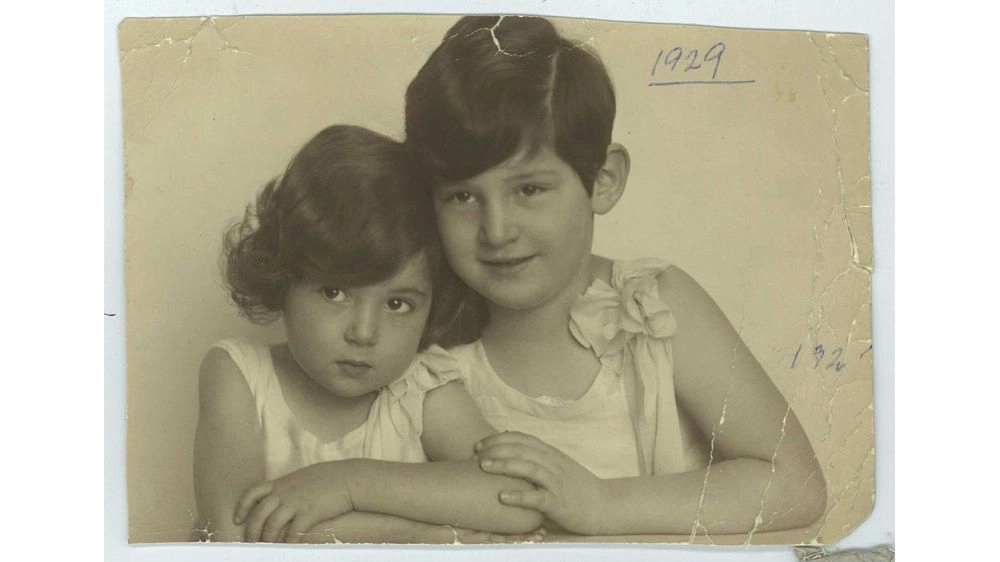
[Joshua Levy, her grandson] I’m going to talk about my grandmother, Ruth Levy, who was born 1925 in Berlin, Germany.
Thriving metropolis, recovering from World War I. Great place to be at the time unless you were Jewish, which she was, which became more of a problem as her life progressed. But she was born there and her family had originally come over from Romania.
Her father had a fur trade, a thriving fur trade, and was making coats for Princess Elizabeth, future queen of this great country of Canada. She had a life you’d see in the movies probably. She had a pet parrot, and a horse, and a governess and it was a great time for a very young kid.
Of course, they, when she was eight, had to start wearing a Magen David on her chest. But, you know, when you’re eight, it’s not so obvious things are getting worse. In school, they started handing out Nazi pamphlets, but she was young enough for the first few years that she really didn’t realize what was going on.
[1:12-3:09]
She was protected by her family. One of my grandmother’s father’s friends, who was pretty high up in the Nazi government, said that, you’ve got to leave, you’ve got to leave right now because they’re going to come for you maybe tomorrow. And they left that night, but they had to all split up. So my grandmother, who must have been 13 or 14 at the time, and her older sister, took a train to Switzerland. And at the time, they didn’t have a passport that would let them in, so my grandmother had to fake tears. And basically, she was a very cute kid who had won a competition for cutest kid. And she had to say, please, we have to, we’re just going to see our family. We’re not stopping in Switzerland. We’re just going through, please, please.
And she convinced them to let them into Switzerland where they got off. And they were there for almost a year and then went over to Canada in September 1939 on the last boat before the war. If they’d gone on the next boat, it was sunk by the Nazis. And according to my grandmother, they were booked for that boat. And my grandmother, according to her, had a feeling, and they rebooked their tickets.
Right when they were about to leave, right when they were about to get out of Nazi Germany, the train was boarded, and she heard them call her name in German to come to the conductor. And she went, and they told her to get off the train. And my great-grandmother got off the train. And the Nazis were standing there, their swastikas and the like, and they said to her, Mrs. Weissler, we’re so sorry we forgot to give you a receipt.
Because they were not only Nazis, but Germans, and very, very disciplined. So they gave her a receipt. She very well could have been shot on the spot, but she got her receipt and went back on the train and got out of Germany at the last second.
[3:10-3:40]
[Ruth Levy] We didn’t know anybody in Montreal. And we just asked where was the Jewish people living around there. And they told us St. Bernard, Park Avenue around there.
And we worked the apartments on Park Avenue, Laurier, around there. And the first thing the woman asked us, are you Jewish? And we said, yes. She says, well, we don’t, we don’t rent to Jews.
I looked at my mother and I said, well, why’d we come to Canada?
[3:41-4:08]
[Joshua Levy] So my great-grandfather had to start over. So he went back into the fur trade in Montreal, had a factory in old Montreal, which at the time looked the same, except that it was very, it was dilapidated back then, not a tourist spot, but it was all factories and animals having their fur taken off and not a pretty place. She worked, I guess, in her late teens for him, skinning the animals.
[4:09-4:44]
[Ruth Levy] When I went out of school and all that, I worked there as an accountant for them. And of course, also, I learned the fur business. You know, he bought a lot of raw furs from, like, Miss Muskrats and whatever other small furs they were.
So I knew the business, and if my father was away and if one of his workers was away, when the farmers came to come with their furs, you know, to sell them, I could sell them because I could buy them because I knew what to do and how to offer the price and all that.
[4:45-5:03]
She caught wind that she wasn't getting paid fairly, that other people for her position were getting paid better. So she asked her dad for a raise.
Her dad said, are you crazy? You’re my daughter. I paid for you for all your meals and your clothes. You’re not getting a raise. So my grandmother quit and took a job at the competition. You know, that’s not fair.
[5:04-5:30]
[Ruth Levy] I decided to get a job somewhere else, so I went to Schecter, Schecter’s Wands, Schecter Wands.
I worked there, and they gave me a good salary, and the accountant for my father said, you know, you made a big mistake. You let Ruth go. She was not only our accountant, but she was looking at everything else in your place. So he says, try to get her back. And anyway, finally, he offered me enough money. I went back to my father.
[5:31-6:05]
[Joshua Levy] One thing that I found really shocking a few years ago as I was walking on Francis Xavier and St. Paul is there’s a place there which now I think is called Santos. It was a Java U before, and in the back that it says parking space reserved for Weissler Pelts, for Weissler Furs in English, which I don’t know, and it's only about three feet off the ground. I don’t know how that escaped, you know, the separatist movement, but still there, still parking spot waiting for my family to pull up and to start the fur business again.
Disclaimer
Please note that the views and opinions expressed in these recordings are those of the interviewee alone and do not necessarily reflect the positions of the Montreal Jewish Museum, its staff, or its Board of Directors. These recordings are presented as personal recollections for historical and educational purposes. Individual accounts reflect the interviewee's personal perspective and lived experience, and have not been independently verified for factual accuracy.
These transcriptions and translations have been produced using automated transcription and translation tools, followed by human review. Despite this process, inaccuracies may remain. If you identify an error, please contact research@imjm.ca with the page link and your suggested correction.