
Listen to this Oral History
Description
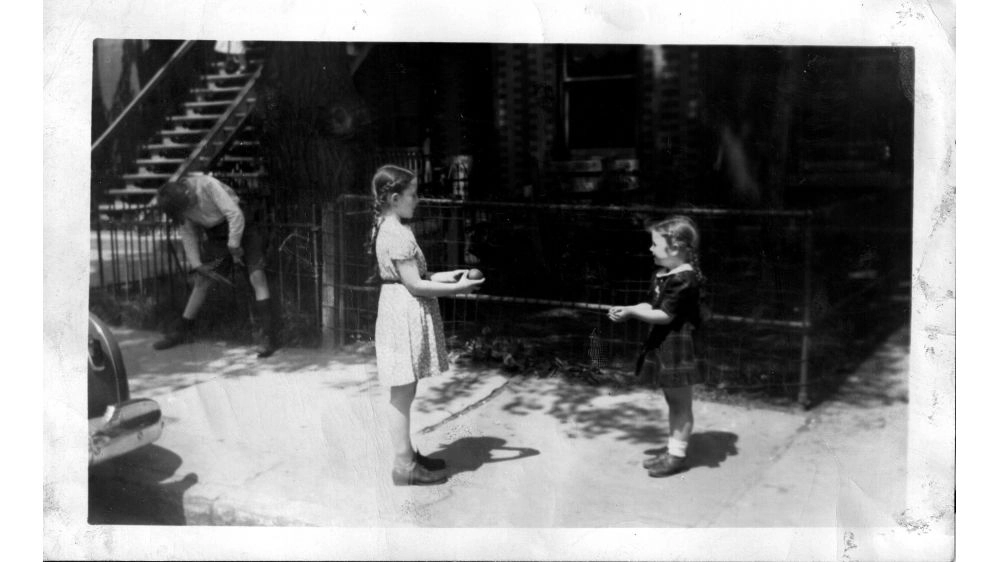
The couple recounts stories of Mary's father's printing business and growing up in the Mile-End of Montreal.Transcript
(0:00 - 1:33)
Mary Warshaw: First of all, I was born at 4843, which is in the back parlor of the flat where two bachelor brothers lived, the Brockman brothers. Now the third brother owned—they call them doors; in Yiddish, it's zekster—six doors. So you knew exactly it was two double… it was a double duplex [Len Warshaw: Two triplex], sort of [Len: … two triplex… double triplex]... and, yeah. And the Brockmans, they had triplets. So they were born downstairs, they were about a couple of years younger than I was. We lived on middle floor, and the Kravitzes lived on the right floor.
There were gardens and trees everywhere. Nobody knew what a garden was. You know, don't forget the Jews weren't allowed to own land in Europe. They looked at this dead ground, they had the vaguest idea what to do with it. But one year, the next row house, a family moved in the Weisskopfs, and she planted flowers. And my sister used to steal them. Masha, she’d go on over… She loved flowers. She was the only one on the several blocks that ever grew anything. Now, of course, it's all Italians and Portuguese, and their gardens are beautiful.
So yeah, there were the triplets there, and… but we lived on the second floor. The Kravitzes lived downstairs. He was a peddler, and he had a horse and wagon, and he always smelt horse.
(1:33 - 2:47)
Now the lanes are beautiful. See, we had coal sheds, because we had coal heating, and… which was, you heated your stove and you cooked on it in one room. The rest of the house was not heated.
So I have an anecdote. And there was always frost on the windows. So with our fingers, you know, we would draw pictures on the windows. One day, Masha saw frost on the front handle. She licked it. It was a metal handle. Her tongue stuck. My aunt came running from downstairs: What is happening to the child? Screaming! Of course, it melted eventually. But yeah, that frost was, yeah.
Yeah, my father had his printing shop, 4844 St. Lawrence, which was like: ours was here, his was there, two streets in between. He started off when he was about 14 years old, and he went to Warsaw. They lived in Ghan.
But he started off, he had a printing shop in Verdun, and in the front, it was a candy shop. My mother spoke not a word of English, but she learned in that candy shop, and he had his printing shop in the back. From Verdun, they moved to St. Lawrence, but St. Lawrence, just south of Mount Royal.
(2:47 - 4:43)
And then he moved to 4844, which is how I knew about it. And it was there until a few years ago, he sold it to some guy who knew nothing about printing. But… And he… My father stayed on with him for a long time just to show… but he failed. [Interviewer: Right]. And now it’s an art gallery.
Invitations, fliers for advertising, various things, posters, and he did all the stuff for the Yom Babsha Yeshiva, which was on Mount Royal.
Len: They also… They all… a lot of his business, a lot of it was making invoice pads, you know, like all the businesses that [Mary: I still have one] needed pads with invoices or mail slips.
Mary: And also, he made tickets for the theaters. In those days, to persuade you to go to the theaters, they used to give you bonuses. And I had…My mother had a whole set of dishes—they never went to the theater. But my father got a whole set of dishes. I still have a couple of them. And that was because he printed the tickets for the theater. So yeah, that's the kind of thing he did. Yeah, until he retired.
(3:56 - 4:43)
So… And we had the coal sheds in the back. And the coal men used to come through, again, a dead yard, which was a backyard.
Len: There were lathes.
Mary: There was a lathe. And the horses and wagons used to come to pick up the garbage. And always a ragman. “Rags, rags!” [Len: [laughs]] [missing audio].
Len: But the lathes were… [unintelligible]. They brought in ice, like, they brought in, you know, big chunks of ice. You didn’t have refrigerators, you had iceboxes.
Mary: The ice came through the front.
Len: Ours did [unintelligible].
Mary: No, ours came through the front and had these ice picks.
Len: The milkman came in front.
Mary: The ice man did, too. The ice man came… the ice man came in front. But the peddlers were in the back, yeah, at the garbage, of course.
(4:43 - 7:12)
I do remember the first bagels they started to make. There was… It was on St. Lawrence, in… not too far… [missing audio]... and it was a porte-cochère, you know, where they used to, it was like… [missing audio].
Well, my brother, he went to the yeshiva. Actually, my parents put him into a Protestant elementary school, you know, kindergarten. And the rebbes at the yeshiva—which was very close to us… it was on Park Avenue and St. Viateur, I think, somewhere around there—they said, what? You're sending your son to, you know, you've got to send him to yeshiva. And my father was making all their invitations. And so they, yeah, so they sent him to the yeshiva, which, by this time we were living, actually, in Outremont, you know, on the [unintelligible], which wasn't that far.
But it was a horrible place. Some… I believe that some of those rabbis were really sadistic. My father appreciated them because they had a lot of religious knowledge, which he did not do—they're not at all religious. But I think they were sadistic.
Len: What do you mean? If the guy went there, he told [unintelligible].
Mary: Yeah, they were sadistic.
Len: I got beat up by the teachers.
Mary: By the teachers he got… Anyhow, there was one kid who used to beat Butchie up. So Masha and I got together—you know, for this kind of thing, we cooperated—and we waited till all the kids came out… we waited till all the kids came out of school, and we jumped him. It took two of us. It was a big, fat kid, probably grade six. One of us sat on him, and the other pummeled him. And he never… I went, this is for Yitzhak Edelstein. And they never… he never bothered him again.
Len: English speaking kids. And they came in gangs sometimes. So we used to do, we used to also organize teams and stuff. But we had one savior. He was a French Canadian on our street. And he was older than most of us in our gang. Big, tall guy. He wasn't too clever, but he liked us. And he became our… kind of our protector, you know. So I'll never forget the time that some kid came up to me, and he was going to, you know, attack me or something. And this guy comes running out, and he grabs him, and he says, you touch my friend, I pass my boot by your heart strings.
Mary: That was the story of Butchie. But it was… He subsequently went to Strathcona. You know, and he graduated seven years.
Disclaimer
Please note that the views and opinions expressed in these recordings are those of the interviewee alone and do not necessarily reflect the positions of the Montreal Jewish Museum, its staff, or its Board of Directors. These recordings are presented as personal recollections for historical and educational purposes. Individual accounts reflect the interviewee's personal perspective and lived experience, and have not been independently verified for factual accuracy.
These transcriptions and translations have been produced using automated transcription and translation tools, followed by human review. Despite this process, inaccuracies may remain. If you identify an error, please contact research@imjm.ca with the page link and your suggested correction.