
Listen to this Oral History
Description
Irving Wolfe leads his nephew Max and MJM Fellow Fionn Adamian around the Plateau, discussing childhood pranks, events at the old Jewish Public Library on Esplanade, and being raised by an entire community.Transcript
[00:00-1:09]
After a summer in Val-David, Izzy and his family returned to Montreal aboard the same Canadian Pacific steam train which had brought them to Val-David. The streets of Montreal loomed as broad boulevards. As the cab approached the intersection of Duluth Street and Esplanade Avenue, Izzy heard the thud of the big bass drums and the high-pitched military bugles.
It was Sunday afternoon, and that meant a parade by the Royal Canadian Grenadier Guards from their armory just up the block on Esplanade. Tanks, jeeps, and Ack Ack guns rumbled down the street, backed by hundreds of infantrymen, all marching to the cadence set by the military band. Some had recently returned from active duty overseas. Others were about to depart to an uncertain future.
[1:10-2:02 Military Music Plays]
[2:03-3:13]
Across the street, scores of pitched tents dotted Fletcher’s Field. Red Cross tents, hospital tents, army tents, all kinds of tents.
A person could give blood, volunteer for the army, or read and see stories and photos of the war. Army recruiters swarmed everywhere, and victory-bond hawkers worked the crowds. It was a great big rally round the Union Jack party. It happened every Sunday afternoon for the duration of the war.
Izzy scrambled across Esplanade Avenue and wandered among the military displays on Fletcher’s Field, where he caught up with Abby and Boomy, two street buddies who lived on the block. The three of them were inseparable, except for the summer, when Izzy went to Val David and his friends went elsewhere.
Izzy caught up with his friends in one of the Red Cross tents. It was set up for blood donations. A dozen people lay on cots, needles stuck in their arms, and blood dripping into collecting bags beneath.
[3:14-4:12]
Soon sated with this sight, the trio headed for Paperman’s Funeral Home on St. Urbain Street, just a little to the north of Duluth Street. There were frequently a couple of military funerals on Sunday afternoon, Jewish boys from Montreal who had been killed in action. The bodies were brought home for a Jewish burial.
Not every Jewish soldier was brought home for burial. Many remained in Europe, some in other distant parts of the globe. The coffins were always draped in the Union Jack. Sometimes a soldier’s helmet rested atop his coffin.
A couple of years later, Paperman’s appeared to get busier on Sunday afternoons. More military funerals. The radio told about a big invasion in Europe. Soldiers were landing in Normandy. When he thought he had enough of all this activity, Izzy went home.
[4:13-5:08]
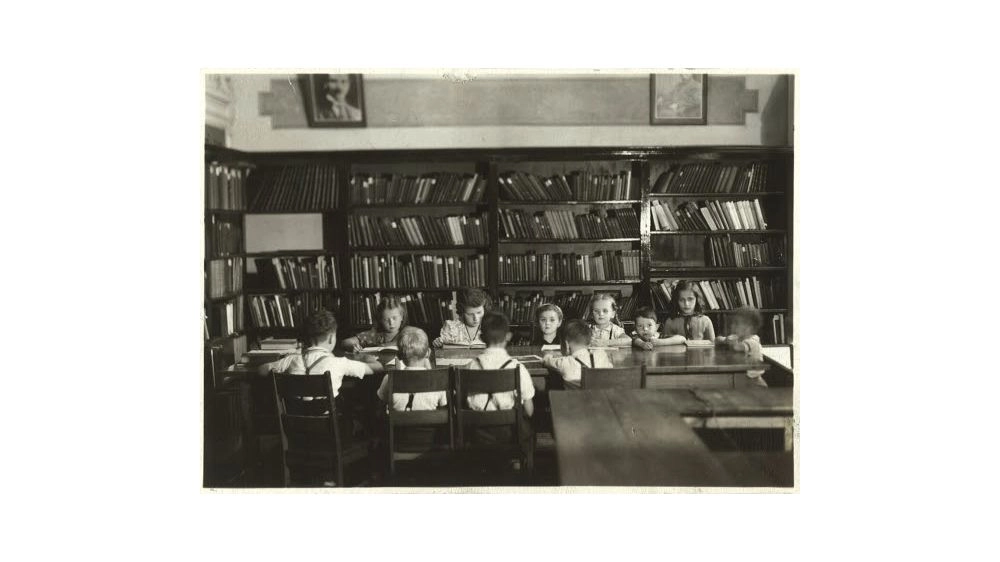
To the triplex he called home, immediately next door to the old Jewish Public Library. The library was home to Melech Ravitch, a frequent lecturer on Jewish literature, philosophy, and folklore. Izzy’s father was a regular member of the audience.
He need only walk next door to slate his thirst for these Yiddish lectures. At home, while the adults strained to listen to the war reports over the radio, Izzy played his Spike Jones recording. Then their Führer says, we is the master race, we heil, heil, right in their Führer's face.
Izzy could never get enough of that record.
Disclaimer
Please note that the views and opinions expressed in these recordings are those of the interviewee alone and do not necessarily reflect the positions of the Montreal Jewish Museum, its staff, or its Board of Directors. These recordings are presented as personal recollections for historical and educational purposes. Individual accounts reflect the interviewee's personal perspective and lived experience, and have not been independently verified for factual accuracy.
These transcriptions and translations have been produced using automated transcription and translation tools, followed by human review. Despite this process, inaccuracies may remain. If you identify an error, please contact research@imjm.ca with the page link and your suggested correction.