
Listen to this Oral History
Description
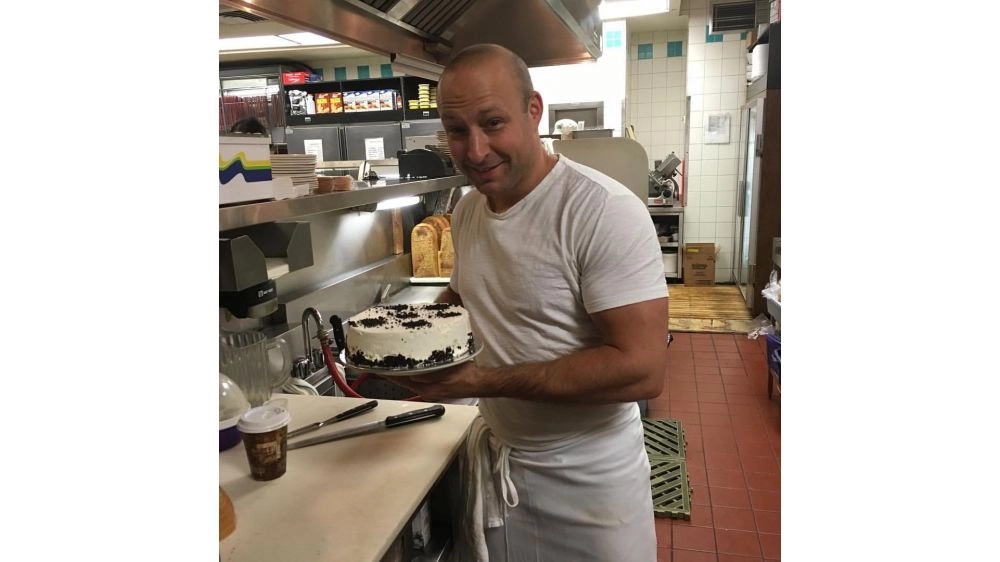
Hart Fishman, Snowdon Deli owner, discusses the past, present and future of the deli, its food, and its importance for the community.Transcript
(0:00 - 2:47)
My name is Hart Fishman. I grew up in Montreal, Quebec. I grew up in the West Island in Pierrefonds, one of the rare Jewish families in Pierrefonds, although I was born in NDG.
I was born on Somerled in Bessborough, but I grew up my whole life in Pierrefonds. I went to Riverdale High School, then I went to John Abbott, went to Concordia for a brief little stint of university, but the restaurant life just took over for me and that's where I am today. I've been here at the store for, I'd say, almost six years.
My grandfather and my great-uncles, his two brothers were the original founders of the deli since 1946. My grandfather himself was never an owner here, but everyone knows the three brothers. His two brothers came back from the war after the Second World War.
In 1946, my great-uncle Joe, my great-uncle Abe opened up the deli with the help of their brother-in-law, Ben Ash. He had the Ben Ash delis. When my Zadie came back from the war two years later, he joined the brothers and the three brothers started the deli.
I myself, I've always been working in restaurants. I used to run the Eggspectation downtown on Montagne and Maisonneuve for eight and a half years and then about six years ago, my cousin, he eventually wants to retire and he's like, Hart, come learn about the store, see if you like it, if it's good for you and you can buy into the store. It was hard for me to leave my previous job.
I liked it very much, but it took me a little while to realize this is not a regular restaurant. This is more of a big Jewish community center. This is not like a place where you can just serve and go.
You develop friendships with your clientele, you develop relationships and it's emotional while being here and totally, totally different than any experience I've had working in restaurants before. I took on a great responsibility here and I'm very happy for it. As a kid, I would come in, I would go behind the deli counter on the pallets.
I remember that very vividly. I remember a lot of the staff and the waitresses which are still here today and it's emotional for them because they worked for my grandfather and now they're working not for me, but working with me as the grandson. I thank God for that, that we have a staff that's been here for 40, 50 years.
You can't find that anywhere. They love this store. They kept the store running.
A lot of customers come here three times in a day. You'll have the early morning guys which will be here at 5.15, 5.30 before we even open. They're already here because the fresh bread comes in and the milk and the eggs come in and the bagels and the rolls.
(2:48 - 4:20)
They can come in the morning, have some white fish, have some black bread, have a little schmear of dried cottage cheese, have some hairy and sour cream. You can get anything you want. They come in the morning, then they come back in the afternoon and then if there's a show at the Segal Center, they'll come back again at night time, so three times in a day.
Sometimes on a Sunday, we'll have four generations in the store at the same time. It brings a real tear to your eye. I feel like bawling my eyes out half the time.
You'll have the parents with their kids. The parents are in their late 20s, early 30s with their kids and their parents who are in their 60s and then their great-grandparents or the parents' parents. So you have four generations in the store.
It's happened a couple of times you've had five generations in the store. You have a woman who's 103, her daughter who's in her 80s, that daughter who's in the 60s, the daughter who's in the 40s and then the kids who are in their 20s. Five generations.
We're very lucky for that. I think a lot of customers, the majority of our clientele are over 50, over 60, which is very good. We cater to everybody but we really spend a lot of time, we focus on our elderly clientele because they need it and they deserve it.
They damn well deserve it. I have clients that have been coming here since the day that we opened in 46 and they're still coming here today getting the exact same recipes, the exact same food that they have. People say why don't you do this, do this, do that.
(4:20 - 4:33)
We're progressive but we keep the same food and the same standard that we've always had. It's important. If somebody wants an eggplant or chopped liver, you can't change that.
(4:34 - 5:55)
Keep it the same way it's been for 72 years. I verified all the recipes, make sure everything is the way that myself and my partners want it to be and it's going very well, thank God for that. I've always been in this neighborhood.
I live on Trans Island of Vézina just down the street. This is a very old Jewish neighborhood. I know that when my grandfather and his brothers opened the store here in the 40s, there were hardly any Jews on this side of Montreal and people were like you're crazy.
All the Jews were near Papineau and in the Mile End and in Duluth and Clark and Mount Royal and St. Urbain. I don't think Jews could even buy land in Hampstead until the 1950s but I do believe that from the store opening up here and a little bit before, Jews were coming to this side slowly slowly and once they knew they can get their food here, I think a lot of Jews started to move to this side and we built up, built up, built up more and more and more and more. This is a very culturally Jewish area, right? You have the Snowden Y here, you have the Cummings building, the B'nai B'rith building, the Segal Center.
You have, I think, from Queen Mary all the way down, all the Queen Mary down to Vezina. You have like 12 city blocks just all Jews. I don't know how many are in this area here, probably 20-30,000 in this area.
(5:56 - 7:34)
That's a lot. We have a large large Jewish clientele. We have an ever-expanding non-Jewish clientele which is amazing which we need that to continue into the future.
A lot of the regulars that come here are not, I wouldn't say they're mostly all Jewish because they're just people that live in the Snowden area who come for fresh food and people will just come in say, give me six eggs, I want just six eggs, I want a liter of milk, give me a rye bread, you know, and some eggplant and that's it. But we don't doctor it up with onions or tomatoes. We let the customer do that if they want.
A lot of customers will order eggplants, say give me a small container of chopped onions and tomatoes, no problem. On any given day, if it's busy in the store, you know, I have a capacity of 100, I think 104 clients, you know. If we fill up, everybody knows everybody here.
So you could have a table at the back and a table in the front and somebody's screaming, what are you talking about, Larry? You know, and they're heckling each other, the customers, and one customer say, what, tell that table to be quiet, they're too loud. And the other customer says, the other customer will be like, stop it, leave us alone. Or then some tables, oh, look, it's my cousin over there.
Oh, it's my cousin over there. Everybody's cousins, everybody knows everybody. And it's a lot of fun.
You get groups of guys that comes from the Y, and you got the accountants that play bridge and play poker. And then you got to, you have all the girls that can come in from the sisterhood from the shoulder, something like that, or they're playing Mahjong. And there's a lot of, it can be a lot of fun.
(7:34 - 8:08)
It's like a drop-in center more. A customer can come in just for some black bread and cream cheese and a coffee that could be like four bucks, and they could sit for an hour and just talk. And we're not in the position here to be telling people, oh, I need the table.
Come, hang out, enjoy yourself, whatever it is it is. We're not smart business people here. I'll be the first to admit that.
We're not. We're not like a Heimishe kind of style of serving, where even you give to the client, give them some Danish, give them some cookies. You don't have to charge for everything.
(8:08 - 8:38)
You give, give, give. You don't have to give everything, but sometimes you do that, and you do that because it's good, because it's good for the community. Not only for the Jewish community, it's good for the community that you represent.
What's good for the Snowden community is good for everybody. Wherever a new restaurant opens, if they're good for that community, then it's very good for everybody. We're not industrious business people, and I don't think we're ever going to be.
(8:39 - 8:54)
We're not here for that, I don't think. I'm not here for that. And maybe I'm stupid, but this place has been around for too long to be just a burn-and-turn business.
This is for something else.
Disclaimer
Please note that the views and opinions expressed in these recordings are those of the interviewee alone and do not necessarily reflect the positions of the Montreal Jewish Museum, its staff, or its Board of Directors. These recordings are presented as personal recollections for historical and educational purposes. Individual accounts reflect the interviewee's personal perspective and lived experience, and have not been independently verified for factual accuracy.
These transcriptions and translations have been produced using automated transcription and translation tools, followed by human review. Despite this process, inaccuracies may remain. If you identify an error, please contact research@imjm.ca with the page link and your suggested correction.