
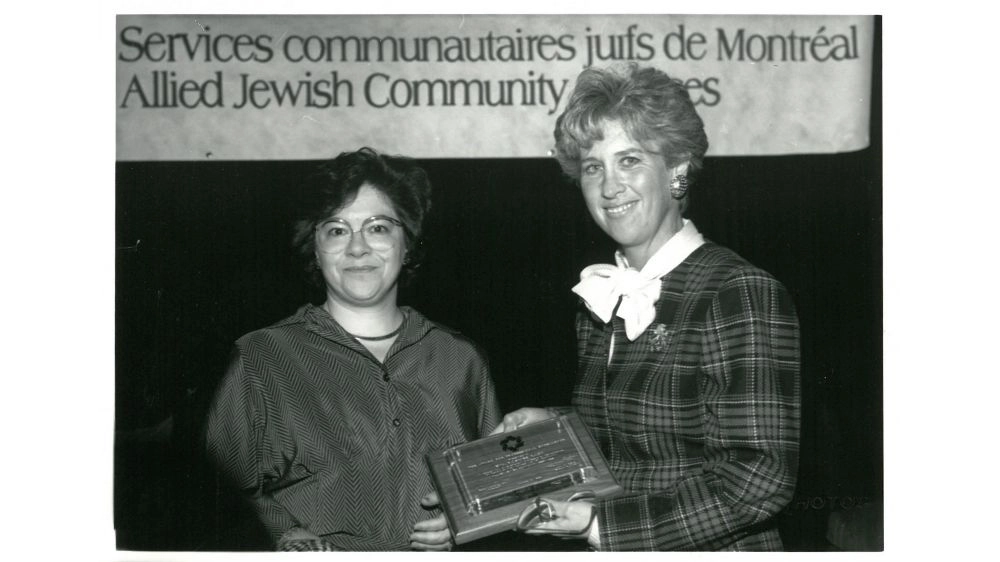
Listen to this Oral History
Description
Listen to Eva Raby discuss the many exciting programs and innovations that she introduced at the Jewish Public Library as the children's librarian and then as the library's director, followed by her personal reflections on the challenges and profound rewards of working for decades at the library.Transcript
(00:00 - 01:07)
Books was in our blood. I think, my grandmother, the publisher, I mean I never knew her of course, but my mother never stopped talking about her. And our home was always filled with books, so I always say to me, “a house is not a home unless it looks like a library.” And that’s what our houses, if you go into any of our houses, it’s full of books. And I knew very, from the time I was a kid, I wanted to be a librarian. So I went into that field, I actually started working at McGill, that was what I wanted to do. But in the end, life brought me back into the Jewish fold and McGill was retrenching. I had two children and I took a leave of absence, and once I had left McGill, even to work part-time, at that point they were retrenching budget-wise and they never gave full-time contracts anymore. And eventually, there was no more work at McGill, and I ended up working at one Cegep, at Vanier’s, for a couple of years part-time.
(01:08 - 01:51)
And then when my daughter was going into Grade 1, I read that the Jewish Public Library has a full-time position for a children’s librarian, and this was a new position–they were going to create a full-time children’s library and wanted somebody–and I was working part-time at Vanier, bored to tears. So I called up to get an interview and it was Trepman who had been the director before, had tried to recruit me years before when I was still at McGill and I was not interested. But the director at that time, Zipporah Dunsky Shnay, the daughter of my beloved Blair Dunsky.
(01:52 - 02:12)
So I came for the interview and I said, “I’ve been a librarian for a long time, I know how to run a small library, I know what to do as a librarian, but I had never been a children’s librarian. The only thing I know about children’s books is the books I read to my kids.” She says, “I’m not worried about you, you know: you come, you work!”
(02:13 - 02:24)
So I started off, and I think when you don’t know quite what you’re doing, you sort of want to do everything. So I started learning about what it is to be a children’s librarian, I took courses in children’s literature.
(02:25 - 02:45)
Then one of the first things that I noticed was that nobody was in the library. It was dead. But on Sunday morning, when it was storytime, suddenly the place was filled. So I knew just by observing that outreach is important and programming is important.
(02:46 - 03:17)
And then a group of mothers who had gone to toddler storytelling at the Cote-St-Luc Public Library–at that time Cote-St-Luc allowed you to register for one semester at a time but then you couldn’t continue–so there was a group of mothers with their kids and they needed a place. They wanted a place to do children’s programming. So they said, “could we do it at your library?” So I said, “sure, let’s give it a try,” but they were running the program. Then I thought this is crazy, you know, my library should be coming from me.
(03:18 - 03:59)
And I was sent to this conference called Every Child where I think every great storyteller there ever was, was there, and all the children’s writers were there, and all the illustrators were there. I was so lucky. They ran that conference twice in New York City, two years apart, and both times Zipporah, you know, let me go and I learnt to do storytelling. I found– I guess there’s in all of my family a little bit of a ham, and I used to do amateur dramatics when I was a kid, and everything that I was sort of came out–the best of what I was, I think, came out–working with the children and the families.
(04:00 - 04:10)
I was the children’s librarian here for seventeen years, and I knew while I was doing it, I said, “these are the golden years. These are really the golden years.”
(04:11 - 04:31)
And I brought in– I didn’t invent it because I learnt it when I went to these conferences and I went to the American Library Association conferences and they used to have all kinds of workshops– because when I started, storytelling was only for five year olds to eight year olds, then there was storytime maybe for three to four year olds.
(04:32 - 05:21)
But then this group of mothers came in with their two year olds and I saw they were just dying for it, so I went to workshops to learn what to do. Then I noticed that mothers were working more and more, and they only had one year leave to be with their children so they wanted to bring their kids in when they were one, so I went and did courses and stuff on how to do things with the one year olds. Then we started doing them for six months old. By the end, I think we were running– I was personally doing about 4-6 programs a week with the six months old, with the year olds, with the two year olds, and it was just great. It was just great.
(05:22 - 05:55)
To this day, I go around town and I meet– I call my mum my mothers. And their kids are bringing their kids here, to storytelling at the library! And they say, “Oh, Eva! Because of you, my son is an engineer! Because of you, my daughter’s this!” And I said, “Thank you very much but you’re the one who brought them. You’re the one that read to them. It’s okay, I’ll share the, you know, the honours.” But it’s really nice, I felt. That’s when I really felt I am part of the community.
(05:56 - 06:16)
And though it’s hard to be– you know, community’s a very demanding one, sometimes it’s very hard because everybody wants a piece of you. You belong to them! But on the other hand, I guess, it’s one of the most satisfying things I could possibly have in a life, is to know that you’ve had this kind of an impact.
(06:17 - 06:42)
And I always said being the librarian is the greatest because you do have a certain position of trust and authority on the part of the children, but you’re not in charge of them, you’re not like a teacher. It’s sort of a more intimate and warmer relationship. And one, I think you have to earn it, but once you’ve done that, I think it’s the most rewarding to have.
(06:43 - 07:15)
So those were the really good years, but, listen, I changed my whole career, I became a children’s librarian when I was forty. I had had a whole career at McGill and at Vanier before that, so after seventeen years when I was doing these up-up-up-up-up! down-down-down-down-down! with the kids, it was getting harder and harder to get up from that floor with the little ones! I realized it started to get physically more difficult.
(07:16 - 07:55)
Although I have to say, to the very end–people used to laugh at me–before every single program, before every single storytelling session, we used to do bedtime stories in the summer, we started that the very first summer, that was very exciting. And I was always nervous, it was like an actress, you know, going out. ‘Cause I knew, you know, you lose– if you lose the attention of those kids once, you’ve lost them. You’ve just lost them. And I said to myself, “the minute I stop feeling like that is the day I should stop doing it,” because it’s the adrenaline, it’s the, I dunno, that little something.
(07:56 - 09:05)
So it was just at that point that Zipporah retired. And she encouraged me, she said “I want you to apply.” Me, to become the director. I said, “I don’t know the rest of the library, I’m the children's librarian!” She said, “Don’t knock it. You know enough.” And she encouraged me very much, and her husband encouraged me. And I’m glad I did, because it was time. And then I became the director and for a while I was going around and thinking, you know, what do you think you’re doing? But in the same way, I learnt to do the children’s librarianship, I learnt to be a CEO, because I stopped being the librarian. When you run an institution, you’re doing different things. And I also was able to get a magnificent grant from a Jewish institution in the United States for programming. And that’s, if you notice one of the great things of this library, the amazing amount– that’s when it started. That’s when it started.
(09:06 - 10:11)
One of the crazy things that we did and it was Zipporah’s idea initially–at the beginning, she was actually as a volunteer on the committee–was a program–and she’s the one who even came up with the name–called Biblio Voyage. And she was modelling it after a program they had at the Montreal Museum of Fine Arts, where they took members on trips, on art trips having to do with art for two-three-four days. And she wanted to do that for the library, so we started it– I think we had it for about four years. We did about four programs a year. Most of them were within the city. So we would go to learn about special collections or we’d go to Ottawa for the day to go to different libraries, we could go up north to private homes to see their art collection. And each program was very carefully scripted and planned by the volunteers. There was a committee of volunteers that were dedicated.
(10:12 - 11:07)
But we also did overnight trips. So we started off with–we did it two or three times–trips to the National Yiddish Book Centre in Amherst, which we went by bus. And everyone who came on the trip had such a good time. This group of volunteers, we planned a trip to Savannah and Charleston. That was sensational. We were about fifty people on this trip. We flew down, and then we took a bus and we went to Jewish places and non-Jewish places. And everything was so carefully worked out, it went like clockwork. And what it did, I didn’t even realize it was happening, but it gave– it bonded a group of people to the library, they became our biggest volunteers, and I realized, I mean, this is why you built programs like this, just by doing it. So it was fun.
(11:08 - 12:01)
They tell me, it really put the place on a different kind of map. It was important because when my parents were involved with the library, it was Yiddish. It was founded really by the Yiddish-speaking, secular Jews and, in fact, the library always was as much a cultural centre as it was a library. It was as much to meet the authors, it was as much to talk about why you like the books. It was also called the Jewish People’s University at the time because many of the immigrants were not allowed to go to non-Jewish institutions, to the universities, and they wanted to learn, so they would learn English and English literature at this library. But in terms of collections, it was very much a Yiddish library, in terms of programming and stuff like that.
(12:02 - 12:26)
But by the time I became the director and sort of, I think, the decade before it was sort of already switching to a generation for whom Yiddish was not the first language anymore and French was very much a working language of our community that had to grow. We did a lot of work. We did a lot of work but it was great.
(12:27 - 13:05)
And I was lucky because I was given a “carte blanche” by my boss, by Zipporah. She said, “just do it.” And because I was planning it, I couldn’t complain there was too much work because I was the one who put it on! But I always said, I think work is a joy if you can structure your own workload and if you have a vision and if certain people who support you in it, it’s a joy. It’s not work. So… [unintelligible]. Yeah, it’s fun.
Disclaimer
Please note that the views and opinions expressed in these recordings are those of the interviewee alone and do not necessarily reflect the positions of the Montreal Jewish Museum, its staff, or its Board of Directors. These recordings are presented as personal recollections for historical and educational purposes. Individual accounts reflect the interviewee's personal perspective and lived experience, and have not been independently verified for factual accuracy.
These transcriptions and translations have been produced using automated transcription and translation tools, followed by human review. Despite this process, inaccuracies may remain. If you identify an error, please contact research@imjm.ca with the page link and your suggested correction.