
Listen to this Oral History
Description
A Sephardic Jewish woman originally from Morocco shares her life story, reflecting on Jewishness, identity, and immigration.Transcript
(0:00 - 0:30)
I grew up in Casablanca, Morocco. At the time, Casablanca had a Jewish quarter in the old city, and that's where I lived. It was on Rue du Soldat Albert Lévy. All of my aunts and uncles lived on that street, along with my cousins—it was really where the whole family was.
(0:30 - 1:03)
Later, while I was still in Morocco, we moved to the newer part of the city. After that, I went to live in Paris, where I completed my university studies. I first came to Montréal as an immigrant in 1971, because my family was already settled here—three of my sisters were living in Montréal. I later returned to France to continue my studies, and then settled permanently in Montréal in 1979, when I accepted a position with a large company.
(1:04 - 1:32)
During my first year in Montréal, I lived in the Snowdon neighbourhood, on Bourret Street, because my mother lived there. Her apartment overlooked the community garden. It was also a neighbourhood where many Sephardic Jews lived, so people were able to see one another and stay connected.
(1:33 - 1:55)
There was also a kosher bakery at the corner of Côte-Sainte-Catherine Road and Victoria Avenue. I immediately fell in love with Montréal winters. In Paris, the weather is always grey, people are depressed, and there's not much to do. Since I love skiing, I used to have to travel all the way to the Alps whenever I wanted to ski.
(1:55 - 2:23)
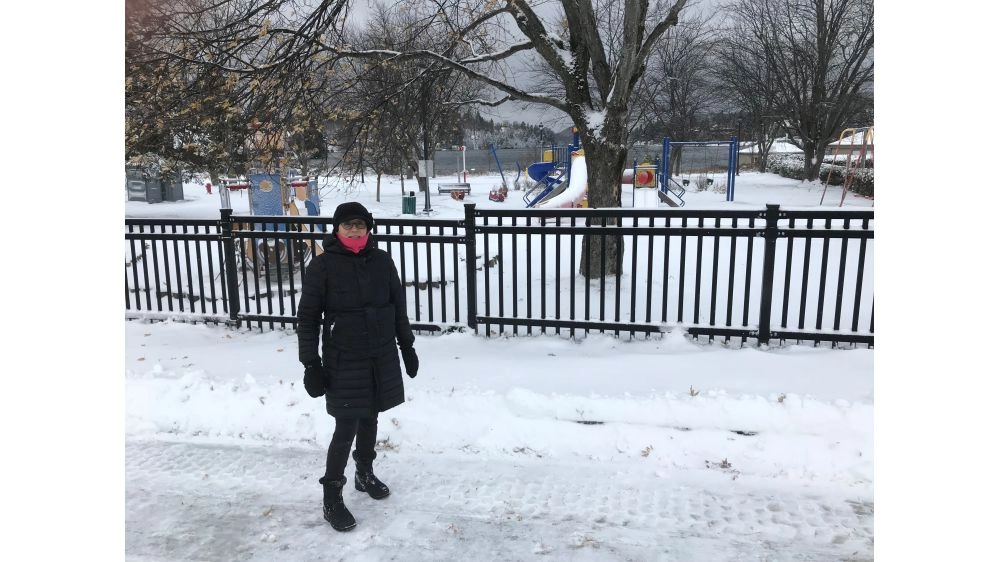
Here, from my very first year, I was skiing almost every weekend. I dressed warmly, so I could spend entire days outdoors. I fell in love with winter immediately. The bright blue winter skies were such a contrast to the grey, overcast skies I had known in Paris.
(2:23 - 3:09)
I integrated very easily into Québécois culture. In fact, I almost became a bridge between cultures. My husband was Québécois, and I came to love many expressions unique to Quebec French—phrases like « tire-toi une bûche » ("pull up a chair") and many others. I really appreciate the richness of the Québécois language. At the same time, I remained very involved in the Jewish community. For a period, I volunteered with JIAS (Jewish Immigrant Aid Services), helping newcomers settle into Montréal.
(3:10 - 3:38)
I also served on the board of directors of JIAS. At that time, we were receiving immigrants from Argentina, and later we began welcoming immigrants from France, around 2004–2005. JIAS asked me to become chair of the Bonjour France Committee, because they were having difficulty understanding the mindset and expectations of the French immigrants who were arriving.
(3:38 - 4:05)
JIAS was accustomed to assisting immigrants who arrived with very limited financial means and who often needed financial support from the Jewish community. They would welcome them with small gift baskets and other tokens—a thoughtful gesture, but one that reflected a kind of social-service approach.
(4:05 - 5:04)
The French immigrants who began arriving were very different. Many were doctors, lawyers, or other professionals with financial resources. They weren't looking for financial assistance from JIAS. Instead, they wanted to understand how the Jewish school system worked, how the Jewish community was organized, and how life functioned in Montréal.
For them, it was a real culture shock. In France, Jews generally don't define themselves as Ashkenazi or Sephardi—they simply see themselves as French Jews. But when they arrived in Montréal, they suddenly found themselves expected to identify as either Ashkenazi or Sephardi. Here, however, "Ashkenazi" was often associated with the English-speaking Jewish community. Many French Jews actually felt culturally closer to Montréal's Sephardic community.
(5:04 - 5:54)
As a result, the usual ways that the English-speaking Jewish community understood itself didn't really apply to these newcomers from France. They needed what I would call a cultural translator—someone who understood both cultures. That became my role. Because I understood both the English-speaking Jewish community and French culture, I was able to interpret the cultural codes on both sides and help French immigrants integrate more easily.
As a Jewish woman, I was very happy to find a community that welcomed me unconditionally. Simply because I was Jewish, I was accepted. That meant a great deal to me.
(5:54 - 6:11)
So when people ask me to help others, it's something I do with great pleasure. I received so much myself, and it's only natural that I should give something back. I'm almost embarrassed to say it, but every time I've given to others, I've ended up receiving even more in return.
Disclaimer
Please note that the views and opinions expressed in these recordings are those of the interviewee alone and do not necessarily reflect the positions of the Montreal Jewish Museum, its staff, or its Board of Directors. These recordings are presented as personal recollections for historical and educational purposes. Individual accounts reflect the interviewee's personal perspective and lived experience, and have not been independently verified for factual accuracy.
These transcriptions and translations have been produced using automated transcription and translation tools, followed by human review. Despite this process, inaccuracies may remain. If you identify an error, please contact research@imjm.ca with the page link and your suggested correction.