
Listen to this Oral History
Description
Listen to Calvin Kalman talk about his ancestors, the significant legacy they left behind in Montreal, and the personal memories he holds of his grandparents. Moving from his great-grandfather Abraham Lang (cantor for the Roumanian synagogue, Chevra Kadisha) to his grandfather Calman Kalmanovitch (secretary of the Hebrew Sick Benefit Association) to his father and maternal grandparents, Calvin Kalman provides us with unique information about Montreal's past, as well as letting us in to his own family's history.Transcript
(0:00 - 5:15)
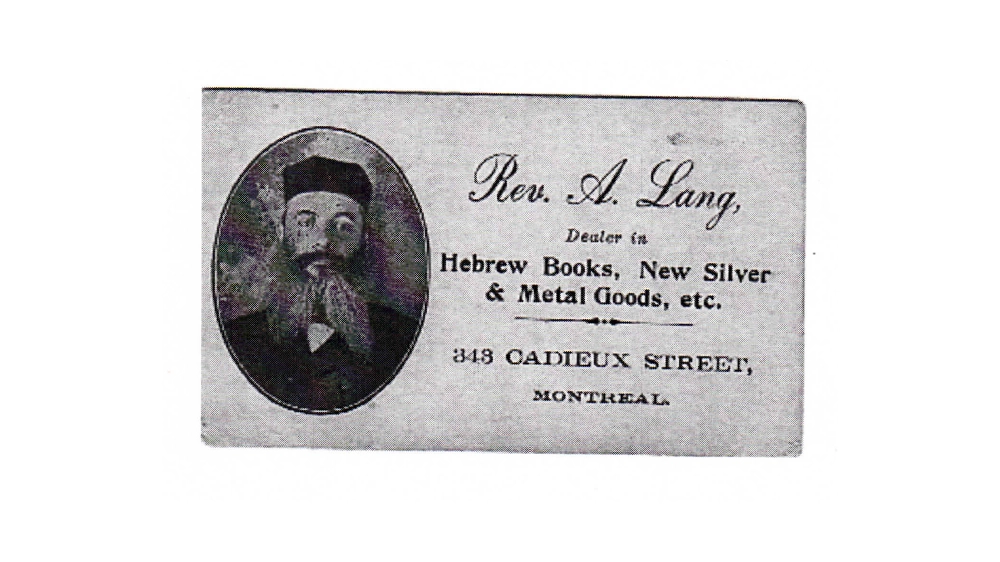
My grandfather followed his father-in-law to Montreal, so that's how he ended up in Montreal, and Abraham Lang was the, let's say, a cantor in Montreal, and he also ran a store, a religious store, on Cadieux Street, which has been renamed since then, so you don't find, if you look up Cadieux, it may be a little bit of difficulty finding it, but, so that was his business card, and after he died, his wife ran the store for a while, and my grandfather became president of his synagogue, and I'm not quite sure which one that was, but he was, my father remembers, uh, remembered, obviously, people come in to ask him for advice all the time. He also became the secretary of the Hebrew Sick Benefit. Now, there are various places like this, the Polish Hebrew, but this was the main Hebrew Sick Benefit Association in Montreal, and they were, it was sort of a cradle-to-grave type of thing before Medicare, and um, they, uh, handled you at birth, through all sicknesses, and then buried you, you know, say everything, uh, and he was treasurer of that for many years, so that this was a souvenir program from the time when he retired.
He had 38 years devoted to continuing services. The first time in the history of our 47 years of existence has it happened that a financial secretary has left office voluntarily, so presumably he, there was no funny business, and they were very satisfied with it. The only thing I really know from my father is that my father was totally in awe of him, uh, because in my father's point of view, that my grandfather was so important, because I'm the president of the synagogue, and every people coming to advice, that he felt he could never match up to him, and my father ended up taking the business that my mother's father had, which was what they called a customer peddler.
I don't know if you have any idea what that is. Um, there were a number of stores in Montreal, Browns, Montreal Outfitting, Canadian Outfitters, and so on, um, and these people, uh, helped out the poor people in the city, like Point St. Charles. I, once or twice, I went with my father to seek his customers, and, um, they, uh, you know, days before credit cards or anything else, poor people really had difficulty buying things, so they were providing a very important service.
They would, um, send people to these particular stores that they dealt with, and, um, you know, the prices that they saw were marked up somewhat, they, so they paid money largely on the difference between, uh, what they would have to pay for and what these people paid, and then the people paid, um, my father would go every week and collect money from them, um, and he, one thing about it is if, at least in my father's case, if, uh, people didn't have money one particular week, it was okay, as long as they were paying on a fairly regular basis, it was okay, so that also helped when you were poor because you could have weeks that various things happened, you know, you had to buy food, you didn't have money to pay, and, uh, that was okay, you know, just, so, uh, it was a very important service for poor, poor people, which as credit cards became available and so on, gradually disappeared. Uh, there were two categories of people, like my father, one was people who were independent like he was, and they worked through, from Browns and Montreal Outfitting, but there was also another group who were actually, uh, basically employed by the companies, like Canadian Outfitting was quite different, the people who worked there were effectively employees of Canadian Outfitting, and so, um, they didn't have the independence that my father had. I don't, you know, my grandfather died, you know, before I was born, my grandmother, I vaguely remember because she was about, I was about five when she died, so I just remember being on her lap pretty much, and my sister would have knew things because she's mentioned to me, but I, I didn't, uh, I, my mother's parents, I knew to some extent, uh, um, I remember, uh, one point having some honey cake, and somebody had claimed that my grandfather had baked it, which is quite possible since he taught my grandmother how to cook, um, and he used to give me a dime allowance every week.
(5:16 - 6:12)
Now, in those days, you could buy two comic books for a dime, so that was very significant. Prices were quite different at that time, so, uh, that was very good. He died when I was about nine, my grandmother was, she was at my bar mitzvah, she was about, I was about 15 or so, 14, 15 when she died.
I remember her as a very lovely lady, we, uh, used to go to their house on Côte St. Catherine, and, um, there was, behind it, there were a lot of trees all, all along, they're not there anymore, but we used to like to go in and wander in those trees and so on, and, uh, so, you know, we would be fed something, and then we'd be expected to leave so the parents could be by themselves and have fun.
Disclaimer
Please note that the views and opinions expressed in these recordings are those of the interviewee alone and do not necessarily reflect the positions of the Montreal Jewish Museum, its staff, or its Board of Directors. These recordings are presented as personal recollections for historical and educational purposes. Individual accounts reflect the interviewee's personal perspective and lived experience, and have not been independently verified for factual accuracy.
These transcriptions and translations have been produced using automated transcription and translation tools, followed by human review. Despite this process, inaccuracies may remain. If you identify an error, please contact research@imjm.ca with the page link and your suggested correction.