
Listen to this Oral History
Description
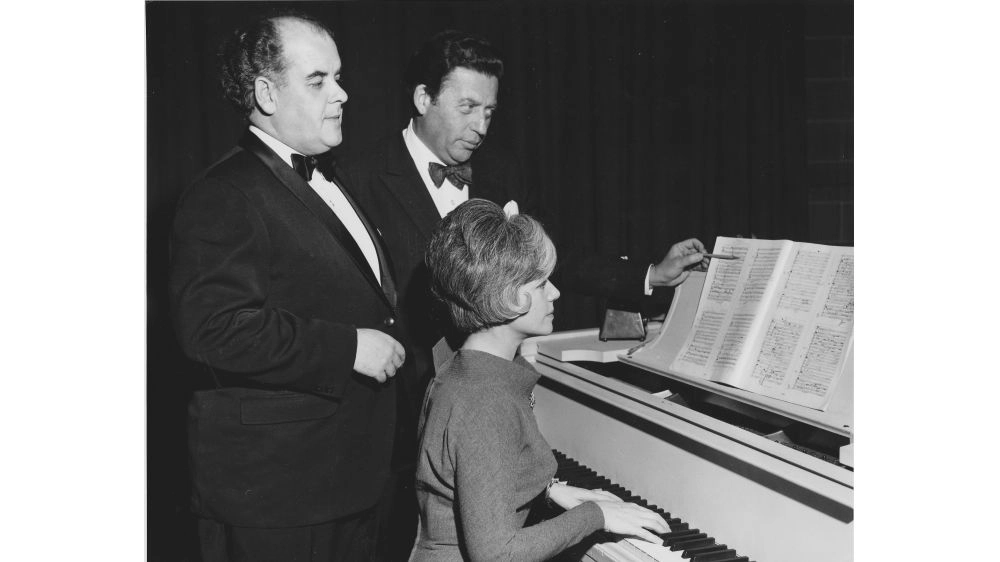
Listen to Rebecca Stotland explore the impact music has had on her life. From childhood, to 50 years of conducting the Laurentian Choir, to raising her children, grandchildren, and great-grandchildren – music has always been at the centre.Transcription
(0:00 - 1:22)
I was born in Belarus. I came to Montreal in 1923. We settled in Ottawa because our sponsors, my mother's sister and her husband, were living in Ottawa.
They were already in business, and they sponsored us, and we came to Ottawa. And then my father, who was a musician, got a job in Montreal at the Jewish People's School as a music teacher. So we moved to Montreal, and thus began my father's career in music in Montreal.
And then he became the choir master of the B'nai Jacob Synagogue on Fairmount Street, and was choir master and cantor there for probably his lifetime, I would think, 35, 40 years. The first thing I ever remember is music, because the choir used to rehearse at home, and four-part harmonies in four different rooms, and all I remember is music, really. If you ask me what my life was like, it was wonderful.
(1:22 - 3:26)
My home was the center of all activity for cousins and aunts and uncles who came from Russia. And all I remember, really, is my mother singing all the time, cleaning the house with her head in a bandana because she was dusting the ceilings, but she was singing. Oh, my mother used to sing “In the Meadow Stands a Little Birch Tree”, which is a Russian folk song.
You know, In the meadow stands a little birch tree, in the meadow stands a little birch tree, loo-lee-loo, little birch tree. And of course, it was sung as a lullaby very often. And I mean, you know, music is so much a part of me, and I've been singing all my life.
Well, when I got married, I was married at an early age, and then, I don't know how it came about, but I was asked to join the Laurentian Chapter of B'nai B'rith. How old was I when I started the choir? Twenty-four. So, I joined the Laurentian Chapter of B'nai B'rith, and they used to have, every year when new members came in, they would have an initiation ceremony.
So, I think two years into being a member, I suggested, well, you know, maybe we should put together a little choir and do a welcome show. And sure enough, before I turned around, I had 42 young women from the chapter said, I want to sing, I want to sing. And that was the beginning of the Laurentian Choir, which sang for 50 years in Ottawa, in Toronto, in Montreal, in Israel, you name it. We had a jolly good time.
(3:26 - 4:29)
It was a folk choir. We sang folk songs from around the world.
We also were a backup choir for the very, very well-known Alan Mills, who was a very well-respected folk singer, and we were his backup choir. We had a concert every year, which very happily was always sold out. We performed at the Jésus Hall.
We performed for charity events. One performance will never, never, never leave my mind. It was wintertime, Montreal, snow up to your eyeballs, and the choir was scheduled to sing at the Sailors Institute.
(4:29 - 6:16)
Well, we being the Laurentian Choir, never missed a performance. And we got to the Sailors Institute, and needless to say, nobody could get there except one sailor who was sitting in the audience. I think he was in his cups.
And the opening song that we were singing was, “What do you do with a drunken sailor?” Well, that is epic, something we will never forget. Nobody ever forgot that. But the choir made it. The sailors didn't. We had a lot of fun. Every performance was something different.
42 young women who grew old together. I think it was the strongest sisterhood imaginable. I think everyone cared for each other with an immense passion and caring. And we really loved each other, and that's what made the choir so outstanding. It was such a cohesive group, and each one cared for the other as much as they cared for themselves, really. Every woman in the choir felt that she had gained a tremendous amount of what? I don't even know, but of camaraderie, of love, of respect, of understanding.
(6:16 - 7:21)
And I think that every woman in the choir enjoyed appearing on the stage. We performed in Toronto for B'nai B'rith. We performed in Ottawa.
I don't remember whom we performed for there. And then 12 women from the choir became part of Les Chanteurs du Québec, which went to Israel to participate in Zimriyah. Zimria was a gathering of choirs from all over the world.
It was like really the Olympics of choir singing. And I thought there must have been 30 choirs easily. And Les Chanteurs du Québec, of which 12 of the Laurentian chapter singers were the nucleus, also held a contest across Canada for young singers, musicians, and we ended up being 84 singers called Les Chanteurs du Québec.
(7:21 - 8:38)
And that's the group that went. We rehearsed at the music camp in Québec for a week, and then we got on a plane and off we went to Israel and sang for a month across the country. Oh my God, we were stationed at kibbutzim.
And this kibbutz that we came to one night near Tel Aviv had German Jews who had escaped the Holocaust. And we were all billeted in different little houses. And the four priests were billeted in the German-speaking quarter of the kibbutz.
And they came running to me and said, Rebecca, how do we behave in this kibbutz, in this house with these German Jews? I said, just be yourself. I'm sure that they will have absolutely no problem with you. They were a little concerned about how they should behave.
(8:43 - 9:50)
And for us, the 12 Jewish women who were with the group, it was also a learning experience, because at one point after I used to do the rehearsing with the choir, and a very young French-Canadian girl came to me and said, Rebecca, c'est vrai, vous êtes juif? And I said, oui, je suis juif. And she said, j'ai jamais vu un juif dans ma vie. She said, I've never seen a Jew in my life.
I said, mais qu'est-ce que c'est ça? Est-ce que je suis différente? Est-ce que je suis tellement différente? Toute différente? Oh, no, no, Rebecca, vous êtes comme nous autres. Vous êtes la même chose. Vous êtes la même comme nous autres.
Je sais pas. Voilà, un juif. C'est ça? So there was, I think the choir learned.
One of the priests fell in love with a girl, and he wasn't supposed to. So the month that we were together, it created all kinds of problems. One priest thought he would leave the priesthood for the love of this girl. You have no idea what started happening.
(9:50 - 10:56)
The Laurentian Choir lasted 50 years. It ended after 50 years because members were getting ill.
We had our last, we had a cast party every June, and it came down to the point where out of the 42 members, original members, we now were about 12. And then we had the 50th anniversary of the chapter for which the choir was formed. And after that, there was just not any call for performances.
I mean, we were 50 years old as a choir, and that's old. And it just, the few of us that were left still, I'm still in touch with a few of the girls, as we call them. But that was it.
After 50 years, it was time to hang up the baton.
(10:56 - 12:40)
I raised my children by taking them to performances, theater, ballet, opera, choir, Broadway shows. They love music. They listen. They buy tapes, recordings, whatever. But none of them, I had a daughter who passed away.
They all sing. They're all very much musically inclined, but none of them have taken any kind of step towards working in the music industry. I have five great-grandchildren who are very nice little people who are definitely getting the full treatment of music from me.
We went to see the Potted Potter the other night, all of us, and the little one, my seven-year-old, was, I think he fell out of his skin. He was so taken with the production. It was wonderful.
But, you know, Jacob, who's my 11-year-old, goes to symphony with me, to theater. They all go to certain. We went to Matilda together, and the little one looked around and said, Oh, Becky, that was so exciting.
He loved it. The Lion King, you name it. I take them to everything.
Listen, I've got to get the audience ready when I die. Who's going to go? They have to go, you know. So I'm training them.
(12:40 - 13:06)
I think music in the family was, next to having to eat, music was the most important thing. I simply want to say that I think music will probably be the biggest part of me until I'm no longer here, and hopefully my great-grandchildren will enjoy music the way I did.
Disclaimer
Please note that the views and opinions expressed in these recordings are those of the interviewee alone and do not necessarily reflect the positions of the Montreal Jewish Museum, its staff, or its Board of Directors. These recordings are presented as personal recollections for historical and educational purposes. Individual accounts reflect the interviewee's personal perspective and lived experience, and have not been independently verified for factual accuracy.
These transcriptions and translations have been produced using automated transcription and translation tools, followed by human review. Despite this process, inaccuracies may remain. If you identify an error, please contact research@imjm.ca with the page link and your suggested correction.