
Listen to this Oral History
Description
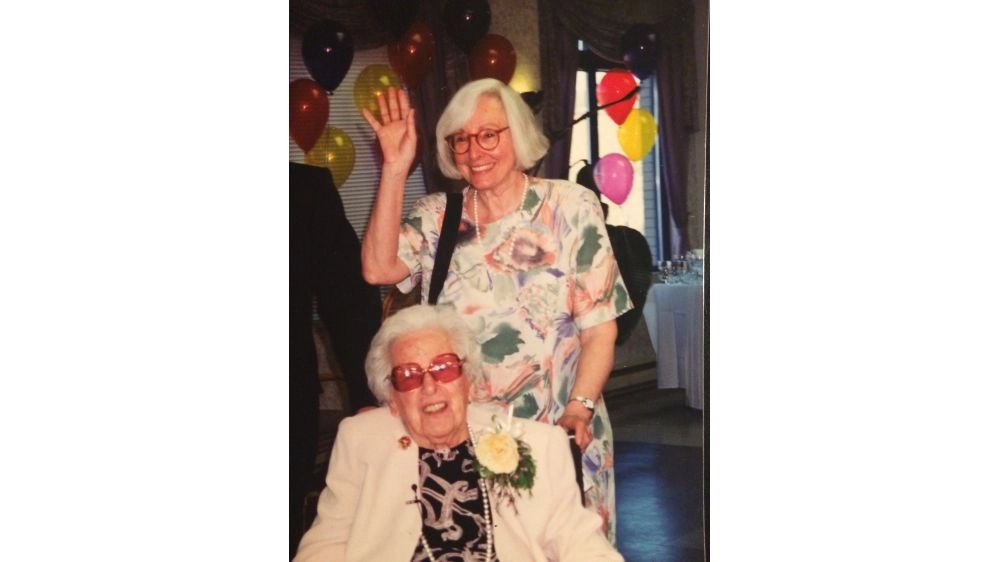
Listen to Elaine Waddington discuss her parents' leadership in the Montreal Jewish community, including their role in resettling WWII refugees and the value they placed on education.
Transcript
(0:00 - 1:46)
My parents were a bit unusual in that they grew up in North America and not in Eastern Europe, but their parents came from Eastern Europe. My father landed in Portland, Maine in 1893. He was the youngest of nine children.
His name was Benjamin Robinson, but it wasn't Robinson, you can imagine. And there's a legend about this, that when he landed, his father landed with his family and the immigration man asked, what is your name? And he said, Yecht. And the immigration man said, you can't live in America with a name like that.
So he said, well, what's your name? He said, Robinson. Okay. So he was lucky because he had six brothers and two sisters.
The brothers were all, of course, older than he and some were already grown up and able to work. The youngest one, not my father, sold newspapers on the streets of Portland when he was five years old. But my father also did that a little, but his siblings helped him and he ended up going to Harvard.
(1:49 - 10:35)
And he went to Harvard and he graduated in 1915. And he had older brothers in Montreal. They ran a pawn shop on Craig Street.
You've heard of Craig Street? No? Well, it's way downtown. And so he, when he graduated Harvard, he wanted to take law. So he came to Montreal, partly because the Americans were about to enter the war.
So he went to McGill. And this is where he met my mother. And I'll tell you her history later.
But he graduated McGill Law School. And he, he didn't know any French, right? He was from, so he had to learn French. You can't practice law in Quebec without speaking French.
So he interned at a man named, a senator named Athanase David, who was also a lawyer. And he learned there. And he did learn French quite well.
He had an awful accent, but he could actually write proper French and speak proper French. It just didn't sound very French. Anyway, so he and my mother got engaged, but he would not marry her until he could support her in the manner to which neither of them were accustomed.
So now I have to go back and tell you my mother's story. My mother's family was from Russia, like my father's family. And when her mother had three boys, and at that point her husband went to Canada and tried to save up enough money to send for his family.
And he was a peddler in rural Quebec. So he learned French. And in a few years he was able to send for his family.
And they arrived in Quebec in around 1892, thereabouts. Yeah. And they settled first in a place named Gentilly.
And my mother was born there and her younger sister. In the meantime, the husband was peddling around Quebec. And in Rigaud, it's between Montreal and Ottawa, the owner of the general store died, and they needed somebody to run the general store.
So they asked my grandfather. So he got his family to move to Rigaud. It was three boys and two girls by then.
And he ran the general store. And that's where my mother grew up. And there were no public schools at that time.
So she and her sister went to a convent French school. It wasn't French though, it was Irish nuns. And so she learned French and English together.
And so did my aunt at the same time. My uncles who were older, were never totally comfortable in English. They were used to French.
Because by the time they had settled, they were teenagers. In fact, they had to go to work in Montreal because they needed some kind of work. And my grandmother was raising these girls.
And her husband, my grandfather was killed in a train accident when my mother was four, and my aunt was two. And so my grandmother raised whoever was left of the three boys and her two daughters, and ran the general store by herself. And then the boys, as I say, moved eventually to Montreal and mother and her sister were teenagers.
And they started going out with the French Canadian boys. So my grandmother couldn't put up with that. So she moved to Montreal.
And my mother and aunt had to finish high school in one of the French convents here, the one at the corner of Atwater and Sherbrooke, Sacre-Coeur, I don’t remember. And then my aunt became an artist. And my mother went to McGill.
And they were quite advanced for immigrant children. First of all, their native language was French and English. And most of the immigrant families at that time had just arrived.
And their children learned English, but the parents had trouble. And it was a very small community of Jews who were, well, my father was a lawyer, so able to make some money, and who lived in Westmount. So there were very few of those.
In my class in high school, there were six Jewish girls. They separated boys and girls in those days in high schools and in public schools. I never had boys in my class till I was at McGill.
So we had an advantage, but it didn't really matter because all the children of these immigrants were strong believers in education. And they did go to university, a lot of them. There were a lot of, quite a few Jewish students.
Even they had a quote, not a quota, but you had to get 10% more if you were Jewish to get into McGill. Jewish children had to get 70% or 75%, and Christian children 65%. So guess who did very well at university.
So anyway, my father and mother, my mother took teaching. She went to McDonald College, and she learned to be a French specialist in the Protestant schools. And she became the French teacher for the three Protestant schools in Westmount.
And she was the first Jewish teacher to get a job in the Westmount school board. We didn't have any Jewish teachers. Anyway, we went to Roslyn and Westmount High, my two brothers and I, and we continued the tradition of education.
So my father became a lawyer. And he had a law firm down on St. James Street, excuse me, St. Jacques called Robinson and Shapiro. Joe Shapiro was his partner.
And my mother taught at the Westmount schools for, as I said, they were engaged for eight years. My mother and father were engaged for eight years while he established his practice. And she continued teaching for that time.
(10:36 - 11:56)
And once you got married, you were not allowed to be a teacher. Teachers had to be single or widowed or something, because that's a job for a man to raise his family. So she, of course, had to quit her job when she married, but they were more or less in a hurry to have a family.
So they were married in 1925 or 24. No, I was born in 24. So I guess they were married in 23.
Anyway, pretty soon after they married, they had me. I was born in 24. My brother David was born in 27, and my brother Jonathan in 29, 1929.
We went to Roslyn School and Westmount. I'll go along with my parents. My parents became very active in the Jewish community as time went on. And then the refugees, the German refugees from Europe started to come.
(11:57 - 12:43)
And my father got very involved with helping them. And he was president of the Jewish Immigrant Aid Society, which helped to get them settled and stuff. And my mother was also very active with that.
And she eventually became president of the National Council of Jewish Women. So they were both pretty outstanding in the community. And my father was later made a judge and he was a judge until he retired, but he died in his late 70s of a heart attack.
(12:44 - 13:29)
There's a famous quote, somebody said, none is too many. I don't know if you've ever heard that, but that was the attitude. But these people were going to be killed.
But they did manage. A lot of rich refugees from Germany came on their own from Europe and they were able to get in. But one of the big problems they had was after the war started, a lot of Jewish families in Germany saw where things were going and they sent their sons to England to be educated.
(13:30 - 15:09)
And then the war started and the boys were all interned as enemy aliens. They were Germans. There was one camp in Sherbrooke.
They sent these boys to Canada, to internment camps. And there was one camp in Sherbrooke and there's one in a place called Ile au Noix, and I'm not quite sure where that was. But anyway, there were a whole bunch of teenage Jewish boys from Germany.
And the Jewish community here, with my parents both involved as leaders of this, get them out one at a time and sponsored by a Jewish family. And they did. A lot of them became very famous.
There was a pianist, Helmut Blume, who was the head of the music faculty at McGill. There was John Newmark, who was a pianist. They were highly educated in the first place and they were very interested in engineering and science.
And one of them ended up in Princeton, the Institute for Advanced Study. They were really super accomplished young men. And I had dates with them and it was very educational for me to meet these people of much more cosmopolitan backgrounds.
(15:09 - 16:53)
So very often after they got out of camp, they came to our house for supper or something and I would meet them. And then whoever their sponsors were would come to pick them up. So I met some very interesting young men that way.
And my aunt and uncle took in one of the boys. His name was Friedel Schiffman and he loved singing Schubert. And he taught me some, one of the songs, which I still know.
And he was very religious. I wasn't, we weren't religious at all. We were not religious.
My parents were very active in the community. They went to a shul, high holidays, that's it. But they did send us to Sunday school at the shul.
So we learned Jewish history and customs and ceremonies, none of which we observed, but we know what they were. So in fact, I used to lie to some people at school that somebody asked me if I went to junior congregation. I didn't even know what that was.
And I said, yes. My mother and father were very active with the refugees. So they were pretty distinguished in the community.
I am not. But I am, I am a librarian. And I have a master's in biochemistry.
(16:54 - 17:22)
And I found out I wasn't very happy doing lab work, but they kept sending me to the library to look up medical articles. And I could understand them because I understood biochemistry. So I went back and took a degree at library school at McGill.
And for 30 years, I worked as a medical librarian at the Women's Pavilion at the Royal Victoria Hospital. So that's what I did.
Disclaimer
Please note that the views and opinions expressed in these recordings are those of the interviewee alone and do not necessarily reflect the positions of the Montreal Jewish Museum, its staff, or its Board of Directors. These recordings are presented as personal recollections for historical and educational purposes. Individual accounts reflect the interviewee's personal perspective and lived experience, and have not been independently verified for factual accuracy.
These transcriptions and translations have been produced using automated transcription and translation tools, followed by human review. Despite this process, inaccuracies may remain. If you identify an error, please contact research@imjm.ca with the page link and your suggested correction.