
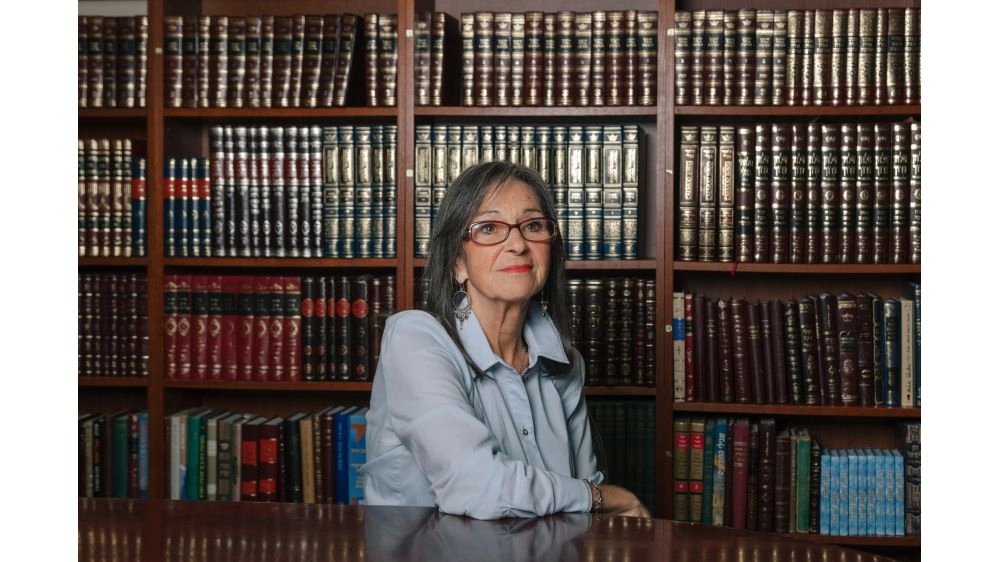
Listen to this Oral History
Description
Listen to Rose Simon Schwartz discuss her memories from her childhood in Cairo, Egypt, from the harmonious early years to the changes and harassment that she and her family experienced after 1956.Transcription
(0:00 - 0:18)
I was born in Cairo, Egypt in 1950. I remember, I remember Jews and Christians and Muslims living in harmony. I was playing with my neighbor on the third floor with the kids that were Muslims.
(0:20 - 4:19)
I would go there, they would come to our house. I remember neighbors across the street who were Greek, Greek Christians, not Jews. We were very close friends. So I remember this togetherness that we felt. It was very, it was a harmonious type of life. We lived together in harmony, we talked together, we were invited to each other. So that was, was a good life.
What made us move to Montreal? The Jews were no longer accepted in Egypt for many years prior, since 1956 and sometime 1948, since the creation of the state of Israel. And we were harassed.
The Jewish population was harassed by the government. We felt we did not belong anymore. We felt threatened.
They did take a lot of men to jail for absolutely no reason. And my parents had two young children, myself and my brother, and we were afraid for our lives. We were afraid.
There was no future for us anyway. So this is what made us decide to, okay, it's time to go. If you go back in history, the Jews were part of Egypt.
They were, they contributed tremendously to the economy, to the arts. In Egypt, they, big, big, big stores, big businessmen were Jews. And we lived very, very happily together with the Muslim and Christian population.
There was no difference. We were part of their, we were part of Egypt. And then until things started to deteriorate just before 1948.
But before that, life was very, very comfortable, was very easy. We had access to everything, all services, with no exception. So it was not, it was not through, throughout the centuries.
Now, don't forget that Egypt also brought in a lot of people from Europe, mainly from Eastern Europe, because it was very prosperous. Beginning of the 19th century, it was very prosperous. So that brought in a lot of people from Europe, a lot of Jews from Europe that came because the life was, was comfortable.
The life was easy. There was enough jobs for everybody. There was no discrimination whatsoever.
So really, the turn off the, our history in Egypt was around 1948. My father was working in a bank, and he was the director of foreign investments. And he had a very good job.
And he was working there ever since he finished his studies, he was very well received, he was very well looked up to. And then from one day to the next, they said, Okay, you're not going to be the director anymore, you have to train somebody else. And this somebody else was a local Arab, who had no education, no knowledge whatsoever of the banking system.
And my father was reduced from his high position to teach this man what to do. And he lost his, I mean, he still worked at the bank, but he lost his position, he became a regular employee. So that was a very, very hard blow.
(4:19 - 6:16)
So now from my not immediate family, in 1956, my mother's sister, her family lived in Egypt as well. One tactic that they had is that to harass you, they would knock at your door in the middle of the night, they would go in and turn all the lights off. And just, you know, look around, ask, What are your names? Okay, fine.
So this is one way they were harassing. So one one night, they knocked at my aunt's door, and they asked my my uncle to follow them. And he followed them, and he was put to prison.
And they said to my aunt that she will see him in two weeks at the Alexandria port, where he will be on a ship out of the country. And if they wanted to be with him, they had to leave in two weeks. So what was his, what was his big, big, big to do was that just about a couple of weeks prior to that, there was a man knocking at the door and saying, you know, I would like to move to Israel.
Can you help me? Can you give me some money? And my uncle being my uncle, Jew being a Jew, he would always help him and say, Okay, here's some money. And he would come back, you know, a little few days later, you know, my family really needs a little bit of food. And we really want to move to Israel.
So he would give and this person was put by the government. He was a spy for the government. And that's how they that's why they arrested my uncle, saying that he's a Zionist.
And being a Zionist was big taboo in Egypt, of course, at the time. And he was helping people go to Israel. And that's why they took him to prison.
(6:16 - 7:38)
My aunt had three children underage, including a baby, six month old baby, and she had to just get rid of everything or leave most of the stuff behind in two weeks, pack up and go. She went to the to the Alexandria port. And she still did not know if she would find her husband because very, very often they would just kill them, they would not release them.
And thank God lucky for them. He was on that ship, and they managed to to leave. So these are just a couple of stories to to show the type of atmosphere we were faced.
So Jewish families were afraid if, God forbid, the door would the door somebody would knock at the door right away, they would think prison that we think bad news. So these are some of the things that we had to live through. Because this is when I started to hear.
Before that, there was a lot of talk, but I don't really remember I was a small child. But by the time I was 10. I remember, you have to be careful. I remember not talking about being Jew. I remember not talking politics outside of the house. I remember people walking and turning around to see was following them. That I remember too.
(7:38 - 9:15)
It happened over a few years, over a few years, but concentrated over 1956. Although I was fairly young, I do have some vivid experience, vivid memories of some of the things one of them hearing my parents talk every day.
So who's leaving? Did you hear? Oh, this one is leaving. This one has got this paper they're applying. So every day there was a new family that we knew a new neighbor, a new family that we knew who was leaving.
So this really caused some anxiety because all of a sudden for you know, for a small child, it's it's very difficult to to absorb. And what I remember also is not being able to listen to foreign news on the radio. So what we had to do is just gather around the little radio and listen to hear what was going on in Israel, what was going on in Europe, but we were not allowed to.
So we did that with a lot of caution. That also is pretty traumatic that you know, you don't have that freedom. I remember the sirens going on when there was the war, you know, with 1956.
We heard the sirens and we had to close all the lights and keep the lights off. I remember seeing police walking by and being very, very scared. Why are they walking by? Are they going to arrest someone? These I knew.
(9:15 - 11:04)
In school, I didn't feel any discrimination. I went to a French lycée in Egypt and for myself personally, I know some other students felt discrimination. I did not feel any discrimination.
I still had my friends. Some of them were Arabs, Muslim Arabs, some of them were Christians, some of them were Jews. So there it was okay.
The only thing that bothered me is that everything had to be taught in in Arabic, even if it was a French lycee. So I had a lot of difficulty with that because I hadn't really learned Arabic from the first grade, but it was, it was acceptable. It wasn't really all that traumatic, but it was uncomfortable.
These are my memories. I remember my, I remember the tension, you know, you feel the tension as a child, you feel the family tension. And I remember the tension. My father, he would really, my father was a very, very peaceful, calm, quiet person, and who tried not to show his fears, but I could feel it. I could feel the fear. I could feel my father had responsibility of six people.
His parents lived with us and we were four, my brother, myself, my parents. So he had the responsibility of six people. He was the only one.
He was the only breadwinner. So leaving, the thought of leaving a country to go to the unknown was pretty traumatic and I felt it, yes. You could not talk, you could not say you're Jewish in public.
(11:04 - 11:33)
You could not wear the kippah, that's for sure. There were services being held at synagogues. That was not a problem, but you could not talk about Israel.
You could not talk about the situation. You could not talk about the Jewish situation, definitely. You had to hide, almost hide, because like my father always used to say, the walls have ears.
(11:34 - 11:45)
And there are people that were spies everywhere, amongst your neighbors, among your best friends. So we really had to be very, very careful as Jews as to what we said.
Disclaimer
Please note that the views and opinions expressed in these recordings are those of the interviewee alone and do not necessarily reflect the positions of the Montreal Jewish Museum, its staff, or its Board of Directors. These recordings are presented as personal recollections for historical and educational purposes. Individual accounts reflect the interviewee's personal perspective and lived experience, and have not been independently verified for factual accuracy.
These transcriptions and translations have been produced using automated transcription and translation tools, followed by human review. Despite this process, inaccuracies may remain. If you identify an error, please contact research@imjm.ca with the page link and your suggested correction.