
Listen to this Oral History
Description
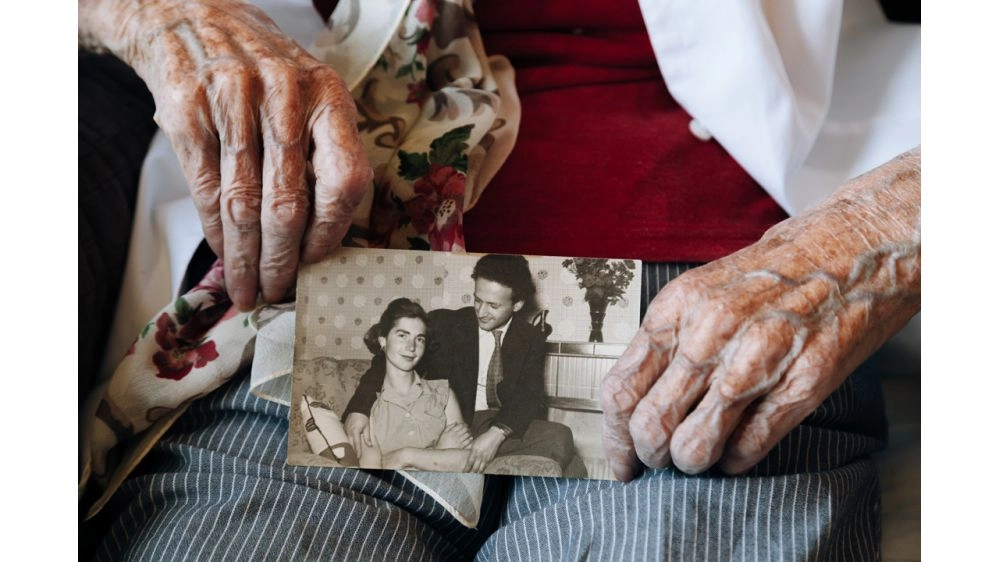
In a poignant oral history, Régine Miller recounts how she was able to survive WWII in Belgium by going into hiding for four years, living with several Catholic families. She would then move to Montreal (via London), where she raised her children, Sonia Zylberberg being one of them. In this interview Sonia Zylberberg also discusses some of her own memories growing up in Montreal, including her memories of going to Brown Derby on Van Horne. This oral history is in both English and French and was conducted as part of Yuula Benivolski's project, The Ocean Between Us.Transcript
(0:00 - 0:33)
[In French] We came here from England, from London. I was 4 years old; obviously, my mother was an adult, but we came here—my mother, my father, my brother, and me. I was born in Belgium, then I moved to England after the war, because the only family I had left was an uncle who lived in London.
(0:35 - 1:01)
[In French] So I immigrated from Belgium in 1946, after the war. And I lived with my uncle for two years. At first, it was hell.
(1:02 - 1:28)
[In French] When you don’t know the language, people think you’re stupid. So I learned quickly. I learned English—I learned it well—and I even kept a vocabulary journal to deepen my knowledge of the language.
(1:31 - 2:08)
[In French] Well, then I got married there; I met this guy—another refugee—they called us all refugees—and he was another refugee. I was 18 when we got married; I met him when I was 16. And that’s how I ended up there.
(2:09 - 2:27)
[In French] Money-wise, we couldn’t afford the rent. There was nowhere to go—no apartment, nothing. 1946.
(2:29 - 2:53)
[In French] And we bought a place; we’d been promised help from my uncle. When the time came for him to help me—to help us with money—he said no. So we really couldn’t afford the rent.
(2:54 - 3:10)
[In French] And that’s how we decided. At that point, we became British subjects. “Naturalized,” they call it—naturalized.
(3:14 - 3:24)
[In French] So back then, we had the choice to go anywhere in the British Empire. The Commonwealth. Yes, the Commonwealth.
(3:25 - 3:37)
[In French] Why Canada? Why not? No, there were reasons. For my mom and dad. For my mom, it was mainly Quebec, because of the French language.
(3:39 - 3:55)
[In French] And as for my father, he wanted my brother and me to go to a Jewish school—one that wasn’t religious or Zionist. Well, there aren’t many of those. But in Canada, they existed.
(3:55 - 4:50)
[In English] The Jewish Peretz school was non-zionist, non-religious, more of a focus on Yiddish and culture than on Hebrew and religion. But I think the school basically had the same attitude, so certainly from home. A very leftist, open, unprejudiced, universal, international, attitude. Of the teacher. She terrorized me. I used to go home sick, right, all the time, because I was so scared of her. She was my teacher in grade 1, she was awful, very scary.
(4:51 - 7:10)
You know Montreal culture is what I remember growing up, not Jewish culture. Right? We went to European stuff, you know that was more, I lived with my mother and that was much more what we were interested in, was for instance when Expo happened, right, and all of the sudden there were ballets and concerts and stuff from all over the world. And we went to a lot of it.
It was heaven. Yeah, so that was more I guess what we felt connected to, was that. And the French side to some extent also. Also because I had a strong attachment to a lady who remained in Belgium, and no religion, that was our religion. But the food, that never varied. From the beginning my mother used to make, well I remember her drawing out the dough so that it should be thick enough to make verenikas.
Oh my god, she made her own? Or something, because I remember that. So verenikas are the kind of dumplings, stuffed with meat usually, right? Maybe she didn’t make verenikas, but those kinds of dumplings, yeah. She made noodles, that’s it. And anybody who was Jewish had to make an applecake or cheesecake, and you could not be Jewish without it.
(7:11 - 7:28)
Where we went mostly was to the Brown Derby. It was on Van Horne, in the Van Horne Shopping Centre there at Victoria. Brown Derby was, we never went to the Snowden Deli. I didn't know about the Snowden Deli.
(7:28 - 8:06)
We went to the Brown Derby always. That served that kind of Eastern European Jewish food. We ate all the time.
We wanted something Jewish. We ate it out, yeah. A few things you made, soup.
You made the soup, but you didn't make your own noodles. Soup, yes. But mostly that's it.
When we wanted Jewish, we bought it. So, I mean, yeah, I can say I'm an immigrant, but I came when I was four. I don't remember very much, if anything, before that.
(8:06 - 8:14)
So basically, I think I am, through and through, Canadian. So it's all familiar. But for you, you came as an adult.
(8:14 - 8:27)
Do you think of yourself as an immigrant still? Yes. Refugee. I feel for them.
(8:28 - 8:39)
Yeah. I know how it feels. So I am aware of the difficulties.
(8:41 - 9:04)
The main thing is the language. Maria, I have a lady, who comes, not, but when you get it, not here's Maria. I understand how she, she is from Mexico.
(9:08 - 9:23)
It doesn't matter how long she stays. She will have her accent and her history, that's okay. You have to keep it, you must not forget it.
(9:25 - 9:51)
When I was in hiding, I was with Catholic people. I knew all the prayers by heart. My father came to work in the mines, in Charleroi, but not in Brussels.
(9:52 - 10:02)
Charleroi. Everybody knew. Nobody knew. How could we?
(10:04 - 10:33)
But my mother wanted my father to leave because the Germans came, they would take the men. And he, I'm sorry, I have to tell this story. It's important.
(10:34 - 10:52)
He said, I want to die in my own bed, because we didn't. So, nobody knew. The horrors, we didn't know anything.
(10:54 - 11:22)
We somehow vaguely we knew what was going on in Poland. My grandparents, that's where they were. But, look, nobody could possibly the extent of that hatred.
(11:23 - 11:46)
But it wasn't just the Germans. The whole world was against us when I was in the country. Everybody was nice because they didn't know I was Jewish.
(11:48 - 12:00)
This is when she was in hiding. So she was placed in hiding with a Catholic family with a different identity. It was part of the resistance.
(12:02 - 12:11)
Solidarité juive. She was part of it. Yeah, she was a friend of my mother's parents.
(12:12 - 12:27)
She was also a communist, and her job was to place the children. So, she's the person who actually placed my mother and then came back to get her afterwards.
How long were you in hiding for? Four years. 1942-46? Yes.
(12:31 - 12:48)
Did you get along with your Catholic family? With the last one, yes. The others, not so much.
(12:50 - 12:58)
She knows this stuff. But the last one, yes. They wanted to adopt me.
(12:58 - 13:14)
Yeah, and my mother went back to see them after the war and they were very nice people. They had a farm. Yes, with cows.
(13:14 - 14:04)
That you milked, right? One of them I milked. I still know. You still know how to milk a cow? They didn't have children of their own. They wanted to adopt me, but that's when my uncle turned up, and rather than being left one little orphan there, I chose to go to my uncle.
(14:05 - 14:15)
I thought I would find a family. Yeah, not so much, but there you go. It was awful.
(14:16 - 14:31)
The worst two years of my life I spent in this house. My mother was 14 and didn't know if she had any family left. I thought my father would come back. In my mind, the whole time that I was hiding, mon père va revenir. Mon papa, il va revenir. Ce n'était pas possible autrement.
(14:59 - 15:12)
It took many years for me to accept. [in French] They’re not coming back. No one is coming back.
(15:15 - 15:35)
[in French] But in Belgium, there’s a committee for deportees. The children of deportees. There’s an organization and there’s a museum.
(15:36 - 15:45)
[in French] A museum about deportees and deportations. Amaline. That was the committee.
(15:49 - 16:26)
[in French That’s where they sent people from. By train, straight to Auschwitz.
How did you end up in England? How did I end up in England? I had hopes.
(16:27 - 16:37)
[in French] I thought I’d found a family. It wasn’t… They were false hopes.
Disclaimer
Please note that the views and opinions expressed in these recordings are those of the interviewee alone and do not necessarily reflect the positions of the Montreal Jewish Museum, its staff, or its Board of Directors. These recordings are presented as personal recollections for historical and educational purposes. Individual accounts reflect the interviewee's personal perspective and lived experience, and have not been independently verified for factual accuracy.
These transcriptions and translations have been produced using automated transcription and translation tools, followed by human review. Despite this process, inaccuracies may remain. If you identify an error, please contact research@imjm.ca with the page link and your suggested correction.