
Listen to this Oral History
Description
Listen to Alice Lehrer recount her mother's story, from her childhood in Holland and last-minute escape to Canada in 1939, to the challenges of her readjustment to life in Montreal and her success in finding a Dutch community in her new home. This oral history was conducted as part of Yuula Benivolski's project, The Ocean Between Us.Transcript
(0:00 - 0:44)
I was born in Montreal at the Jewish General Hospital in 1947. My father was born here in 1917. His parents came from Russia or Ukraine and my mother was born in Scheveningen, Holland, which is a suburb of The Hague, and she was born in 1922.
My mother grew up in Holland, but the family was German-Dutch, like a lot of the family was. My grandfather was originally German and moved to Holland, so a lot of the family was born. She was the youngest of six children.
(0:47 - 1:27)
My grandmother, on a shopping trip with my mother in Germany in 1938, had a stroke and died in Germany, and it was around the time of Kristallnacht. So my mother recalled that she was brought to a Jewish hospital from the hotel and died in that hospital. My mother recalls that there were some young Jewish doctors asking her father to come back with them across the border, like into Holland.
(1:28 - 3:41)
So, you know, that was traumatic for her. Her brothers at that time were in the family business, which was the diamond business. They were already in North America and they kept urging my grandfather to leave with my mother and her sister who was left, who was still with her in Holland.
My grandfather wasn't leaving so fast, and so finally, right after his wife died, my grandmother, he moved the family to Antwerp, to Belgium. Their relatives in Germany, my mother's cousins, who was just about 14, they were experiencing trauma in their town in Germany. Raids at night and Jewish children being rounded up and parents being rounded up.
So in my mother's cousin's accounting, he said he was lucky that they had an uncle who was my grandfather in Belgium. So they all moved to Antwerp. At that point, it was my mother's uncle and her three cousins, the uncle and his wife and her cousin.
Her uncle's daughter and her parents, my mother's uncle and aunt, got a visa to go, got out through Cuba. They got a visa to go to Cuba and eventually ended up in the States. Her older cousin, Shlomo, was sent, he qualified and he was sent to Israel on youth Aliyah and he landed on a kibbutz that he remembers Henrietta Szold visiting because there were a lot of young adults who were being brought and helping establish these kibbutzes.
(3:43 - 5:44)
Then there was a younger brother, a nine-year-old, Eric, and he was, no one could get a visa for him. At that point, my mother, her sister and my grandfather's visa came through because her brothers here hired a lawyer in Montreal who sponsored them. So they got on a boat and they came in their finest and with the piano and the silver and everything.
But little Eric, no one could get a visa for him. So he moved to a family in the same town, family friends, another family. That family and Eric perished in Auschwitz and the whole family always went silent when it talked about, when the memory of a younger brother came up, everyone would just go silent, no one could talk about it.
When I just saw his name in Amsterdam on this board, I walked away and the first time I felt like, I started feeling like what she went through, what the parents went through. It was the idea of Sophie's Choice and that, having to say goodbye to this nine-year-old. I have an eight-year-old granddaughter, maybe that's why it became so real because I couldn't imagine.
How come my mother's aunt didn't say, you take our daughter and I'm going to stay with the little boy. But who could say that, I wouldn't have done, I would have done that. It takes tremendous courage either way.
(5:46 - 12:41)
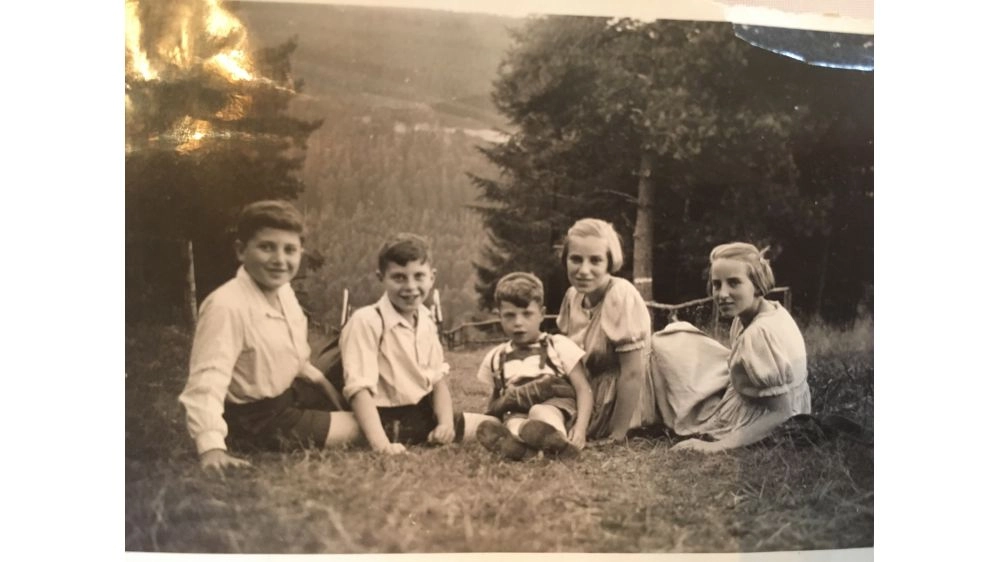
So that was a story when I went on the March of the Living, I took this picture with me and I saw his name in Auschwitz too. And then when I got to Israel, I met up with Shlomo and I said, look I just went through the March of the Living in Birkenau and I saw his name and this is the picture I took. And he sort of grabbed it from me and I thought maybe he had seen it, but anyway he didn't, he made a copy right away.
He didn't say much, he didn't say anything. So that was the story. So my mother and her sister and her father got on this boat, the SS Australian, and arrived in June 1939 and just got out.
And she credits her brothers here for saving their life. So what I was saying too is that my mother didn't go to a camp, she wasn't in a concentration camp, but she was like one of these people who's like collateral damage, you know, like she suffered a lot from her displacement. She felt like her childhood came crashing down and I'm sure it was a lot to do with the death of her mother too and the trauma of like Kristallnacht and what was going on in Germany and having to leave and even coming through, you know, Holland and Belgium and all that trauma.
And so she lived a privileged life there, she came here and had a very privileged life. She met my father soon after and he was successful and she didn't suffer that way, but she always suffered, you know, she suffered sort of emotionally from this lost childhood, lost ideal kind of life. And also from the notion of having lived in a very interesting, deeply cultural, historical places and coming here and the contrast really was pretty strong for her.
So that's the thing, I look at these pictures and I see like this, like as if nothing was happening and she never, I think she must have been very protected, so she never experienced or I don't think she even hid it from us, but how protected could she have been? I mean she was 16 or it's just as if they were living in a bubble. Like I don't get, I never got the feeling that they were afraid, you know, the only thing, it's interesting that my mother never spoke about what she came from, but I remember as a young child like living in, my father built our house, it was a beautiful bungalow and my windows were higher up and I remember having these thoughts of like I had to hide because the Germans were coming down our street. Now where did I get that from? So I must have, I don't know, overheard maybe when she was with the family or, I mean we weren't exposed to that many news stations, you know, there was, TV was new, it was like Howdy Doody and, you know, it was nothing, it was no proliferation of news like it is, there is now, but I had that fear, so I was conscious that there was something very bad that had happened and fear that it would happen here.
I have no idea how I got that. I don't know, I, did she end up liking it? I think she ended up appreciating, you know, Montreal and Canada. I don't, I don't know, she always wanted to go back to Europe, she, they traveled to Europe a lot and it was mostly, I'm sure, on my mother's, you know, urging.
She wanted us to know Europe. She found North America rather devoid of history and deep history and deep cultural, you know, beginnings and so she connected with the Dutch community here. Not all of them were refugees or came from, you know, the war, like she just attached to the Dutch community here for a while.
They have Dutch friends and she loved, I think she was the happiest time, I remember were times when her brothers and sisters or cousins who made it out, you know, to the States would come and or they would go to New York and she would go to New York and they would be together and there would be a lot of talk and fun and, you know, like laughing and that. That's when she was happy, when she was sort of, and they would be speaking Dutch, you know, so that's when she was happy. I've always felt like I understood the people.
I understood them, maybe because of my mother and when her family would get together and they would be in our home and I would hear them talking and I sort of was aware of, you know, their culture and their, sort of, you know, where they were coming from. So, I guess I felt like I've always understood the Dutch and I've always felt that I could hear if anyone was Dutch, no matter how long they've been here, I could tell from how they speak that they had a Dutch background. So, history has always been very important to me.
I think it's the same way I've always felt like I need to connect to community. It's like part of that need to connect to where I came from, where we all came from. When I was 40, I started studying Torah on, like, successively deeper levels every year and, you know, I just felt all the time that, you know, everything's there.
I think everything about life is there. I do. I think a lot of ways to happiness, fulfillment is there.
(12:45 - 12:48)
Which is a stretch for some people.
Disclaimer
Please note that the views and opinions expressed in these recordings are those of the interviewee alone and do not necessarily reflect the positions of the Montreal Jewish Museum, its staff, or its Board of Directors. These recordings are presented as personal recollections for historical and educational purposes. Individual accounts reflect the interviewee's personal perspective and lived experience, and have not been independently verified for factual accuracy.
These transcriptions and translations have been produced using automated transcription and translation tools, followed by human review. Despite this process, inaccuracies may remain. If you identify an error, please contact research@imjm.ca with the page link and your suggested correction.