
Listen to this Oral History
Description
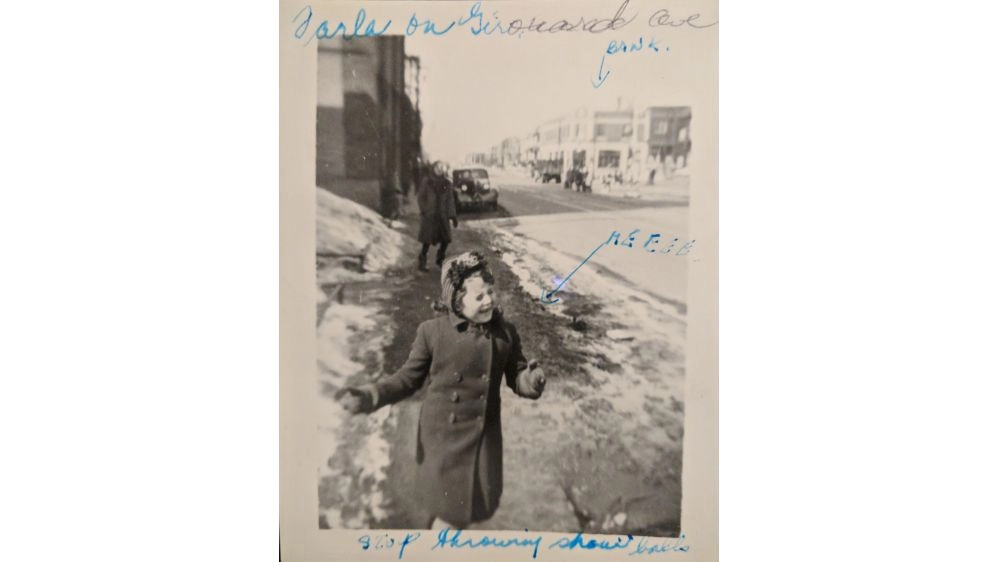
Listen to Farla Cohen recount memories of her mother, an amateur actress, and her father, the owner of a garment factory located in the Vineberg Building. Farla and her brother William Shatner both followed in their parents' footsteps: William became an actor, while Farla owned a textile business.Transcript
(00:00 - 00:52)
My father was born in Austria. Today, it’s Ukraine. So, he was born in a town called Czernowitz, which at the time was Eastern Austria. He came over to Canada around 1910 and he had thirteen sisters and brothers. So, they moved in bits and parts, I think, they didn’t all come over at one time, but they eventually all came. Two of my aunts moved to New York. They got married and moved to New York, I don’t know what point, but probably when they got married, and the rest of the family were here in Montreal.
(00:53 - 01:28)
My father was sort of the breadwinner of the family, not only his nuclear family but his extended family. He worked very hard, developed his business on 4060, I think it is, St. Lawrence, which is on the corner of St. Lawrence and Duluth. He had a manufacturing business: men’s clothing.
(01:29 - 02:16)
I’ll just go a little bit into the family. All these sisters and brothers we used to visit… they mostly lived in Outremont in these duplexes–not duplexes, they were kind of… I don’t know what you’d call them, but they had these big stairways going up. It’s very typical of that area, these winding staircases to get to the third level. We used to go on Sunday mornings to visit aunts and they were busy making kreplach and potato knishes and all their Romanian or whatever–not whatever–dishes; Jewish flavour. And it was wonderful.
(02:17 - 02:47)
My family was very close but my father was busy supporting this one and that one, the cousins, and the uncles. It was quite something, so we always thought of my father as, sort of, the rock. Everyone depended on him. He was an outstanding human being.
(02:48 - 03:36)
My mother was born here–Montreal–and I believe her heritage–her grandparents–were from Vilnius. I’m not one hundred percent sure but that’s what I’ve been told. My mother was one of four children: there were two girls and two boys. But it was a very different family. My father’s family were more European, still with the European flavour, and my mother’s was very North American. We were already integrated and you really couldn’t tell that they were born in another place.
(03:37 - 04:10)
My parents… I actually don’t know where they met, but I guess my mother’s parents saw a very ambitious, serious man for this woman who was very vivacious and… Not flighty, but full of life. Two different people got together and had a marriage, had three kids, and here we are.
(04:11 - 04:23)
I was the youngest in the family, so I was like this little china doll and, you know, I had all these aunts and uncles, everybody made a big fuss over me.
(04:24 - 05:28)
I had an older brother who was quite a bit older, who was very driven with his own career, and who became a huge success. My father wanted him to come into the business because he had no one else and he wanted him to take it over eventually, which is pretty normal, but my brother wouldn’t have anything to do with it. He wasn’t interested because he was an artist and sensed that he was interested in theatre. My brother, sort of, left town, he went to McGill, he ran, directed, produced, and starred in Red White Revue, which was what was going on those days in terms of plays. Then he went off to Ottawa to act and Toronto, and knocked on doors.
(05:29 - 06:10)
Interesting, because there were a few people–and I won’t mention names–who said, “he’s not going to make it,” and, “he won’t have talent.” But he ended up going to New York, he was on Broadway into hit plays, he started doing a lot of TV work, and that took him to Hollywood. He started on different projects and ended up on something very famous called Star Trek and became very famous. His name is William Shatner.
(06:11 - 07:16)
It’s interesting because he had a wonderful relationship with my father… never took a penny from my father to enhance his career. Did it all his own, never took an acting lesson and worked like a trojan. He starred in Stratford, he actually learned the lines– didn’t know he was going to be asked, but… He was asked to replace this actor and he went on stage and did the show without having rehearsal. He knew all the lines. So, that’s the kind of drive I’m talking about. And passion. He never took no for an answer: he just forged ahead, focussed on his work, worked extremely hard, was married, had three wonderful children, and he’s a huge success.
(07:17 - 08:31)
My mother was actually a frustrated actress. My mother taught elocution when she was in her early twenties, which was something unusual in those days, but she never pursued a career in acting because I guess she wanted to have a normal life, and my father was never interested in that life. But, she loved it. And she kind of lived vicariously through my brother. It’s in the genes. He was talented from the time he was a little boy. He was on stage when he was, like, four or five, and he made the audience cry. Up at camp–some Jewish camp–and he was there, and he was acting–I don’t know if he was five or six, whatever, he was a little kid–and the people were crying. He says that when he saw these people crying, he moved them so much that he decided, “well, maybe I’ll do that when I’m older.” The fact is, he had a gift and he wanted it very badly.
(08:32 - 09:40)
My father owned his business. The company was called Admiration Clothes. He used to make men’s clothing, a lovely quality, and he’d sell to a lot– he used to travel a lot by car to towns: to Winigan, to Drummondville. I remember he’d go away overnight, but he sold a lot to stores in Montreal. He employed mostly French people, so there was mostly French conversation. His cutters were French, his secretary was French, and that’s what I remember. In those days, I don’t remember one woman working there. There was not a woman. I was the woman who came into the building.
(09:41 - 10:21)
There was another manufacturer upstairs, Mr. Berman, and I think that the building belonged to him. It was called the Berman Building. Originally, I think it was the Vineberg Building. So the Vineberg family were there, I don’t know if they were there in the building when my father was there, but Mr. Berman owned that building. I used to go up to his factory and see what was doing. He made sweaters and he imported sweaters. There were a lot of women working there, I believe. They were working as sewers but not at a higher level.
(10:22 - 11:44)
Well, we would go there. Saturday morning we’d be in synagogue usually, and after that, he would go to the office to check things out. The secretary would be there sometimes and they were working on Saturday, so I’d get to see the people cutting and making garments. I would sit and talk to the secretary very often. I’d sit in the office and I’d speak French. My father would be, you know, not particularly around us, and I’d be exploring myself the whole building; the whole floor. I mean, his office, his secretary’s office… I’d look at the books, I didn’t understand what was going on but I’d see all these numbers and then I’d go in the back and I’d check all the fabrics and all the cutters and what they were doing. Sometimes my father would have people come in to make them some garments made to order, so he’d be there checking– seeing the work being done. I spent a fair amount going to this factory.
(11:45 - 12:30)
He would take me for lunch. Up the street, there used to be this restaurant called Horne’s and they served all these Jewish foods. I rabbled in the foods. I was, you know, delighted to be with my father. Then very often he’d take me to another factory to buy clothes because he knew some of the other manufacturers. I got, like, my Red Riding– Red River Coat for the season and for school. I’d get some new dresses, I remember, he’d come to see the dresses. It was kind of a nice time.
(12:31 - 12:58)
My father used to make coats and suits. He had, like– in the back of his place he had a big area where he stored all the fabrics and I used to go into the back and feel the fabrics. I remember, you know, the quality of the fabrics. I don’t know how come I knew at that age, but it impressed me. I used to look at the different patterns.
(12:59 - 14:28)
It’s interesting because I always went to school, but after school I decided to go into business. I knew zero about business. I had a flair for business. My company was called Josie Artisanal. I started a textile business, well, which was natural for me because my husband was in the textile business. I saw a pattern one day in New York ‘cause they had a show room in New York and I saw this piece of fabric I thought was so beautiful. I said to my husband, “I’ve got to do something with that!” From there, I took a piece of that fabric and I made a tablecloth out of it. He helped me get people I needed–sewers–and I started with nothing. I made this tablecloth and I went to the Linen Chest. I finished it. It was not easy. I presented it to Linen Chest, and he said to me–the owner, Stanley–“Okay, I’ll buy some,” he said, “but they have to be here in three weeks.” So I said, “No problem,” walked out of there, called my husband, started crying to him on the phone because there’s no way I’m going to get this done! He said, “Don’t worry, we’ll get it done.” And that’s how it started.
(14:29 - 14:56)
I did that for thirteen years. That’s why I was saying before that I used to go feel the fabrics. That meant something to me: the fabrics, the quality. My goal in this business of mine was to make quality. I used fabrics and I was very focussed on making a beautiful end product: something original, which is what I did.
(14:57 - 15:14)
But in business, you have to work so hard to make it. That’s why I really admired my father having to come to a new country, starting a business, I mean, all these immigrants did.
(15:15 - 15:55)
It wasn’t a huge business, but it was an important business. Important in that my father, he was building a business. He was Jewish and he was contributing to the economy, employing French people with respect. I remember a lot of these people who worked in the factory, they seemed to be very happy and he, you know, honoured their language, he learned the language, and he was very conscientious.
(15:56 - 16:14)
So, when I say important, there were a lot of businesses like this. A lot of Jewish people started businesses and built up these businesses. Some bigger, some smaller, but this was a very big part of the Jewish community’s work.
(16:15 - 16:51)
They worked on the building on the inside, I believe, they divided it. They’ve partitioned the hallway. I don’t think that it’s the same than it was. The museum that you’ve opened is just part of where he was. I think when he came into the building, his portion of the building was down on the left side, and that’s where you are. I remember the windows, you know, we were on the ground floor.
(16:52 - 18:21)
So, I would say that, you know, I identify the building with my father. I was quite… elated, is the word… when I was sitting there, when I went to that first lecture. When I drove up, I didn’t know where– I didn’t remember the address. When I was driving there, they told me it was right near Duluth and St. Lawrence, so I thought I’ll just go and I’ll see the address. I parked my car right in front of the building and I thought, “Oh my God! That’s where my father had his factory!” I walked in and I thought, “Oh my gosh! Here I am, sitting in his office!” So it was quite something. The whole thing came flooding back, you know? My father, what he did, the hard work that he must’ve put into this place… The whole thing, you know, his background, his dedication, his honesty. He was very conscientious. It all came back while I was sitting there. So, that building has touches of the Shatner family embedded in the walls.
Disclaimer
Please note that the views and opinions expressed in these recordings are those of the interviewee alone and do not necessarily reflect the positions of the Montreal Jewish Museum, its staff, or its Board of Directors. These recordings are presented as personal recollections for historical and educational purposes. Individual accounts reflect the interviewee's personal perspective and lived experience, and have not been independently verified for factual accuracy.
These transcriptions and translations have been produced using automated transcription and translation tools, followed by human review. Despite this process, inaccuracies may remain. If you identify an error, please contact research@imjm.ca with the page link and your suggested correction.