
Listen to this Oral History
Description
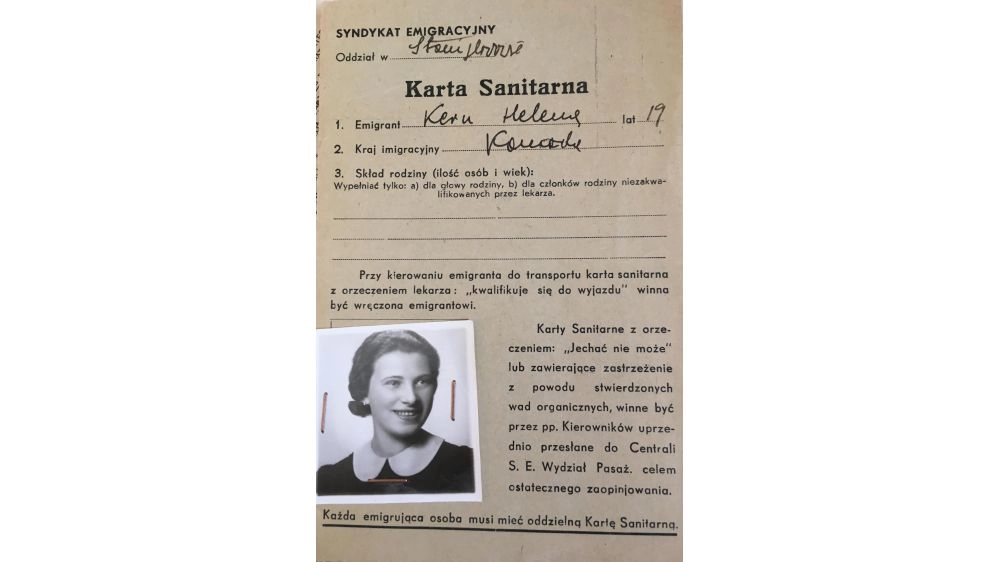
Helen Scharf shares stories about her experiences immigrating to Montreal from Poland as a teenager in 1939, raising a family and running a fur business in Montreal, and many other events from her life.Transcript
(0:00 - 1:19)
Well, it was the uproar with Hitler, which was 1939, and most Jews tried to get out as much and as fast as they can, for wherever they can, and my family tried, and they couldn't get any visa for anybody except me, and so I had left home, and hoping that after a while, I'll be able to bring my family over as well. That didn't happen, because two months after I arrived, the war broke and the Germans invaded Poland in Galicia, which was a very popular Jewish area, and it was in the south of Poland, and it was by the Carpathian Mountains, a sort of village, or shtetl, it was very overwhelming, coming to Montreal, which was a big metropolitan. It was a little bizarre, but I managed quickly to pick up as much English as I could.
(1:21 - 3:36)
I read newspapers, I went to movies, a lot of English movies, asked everybody to speak to me in English, and to correct me when I answered at the moment when I made the error, so that I will remember it, and eventually, I managed, and of course, I was getting used to an entirely new world, a civilized world, to all kinds of foods, and theaters, movies, which were not in my little village, electricity, telephone, radio, all these wonderful things that are taken very much for granted here, or were at that time, too, but it caught on very quickly. It was a village with a lot of Jewish people, but we also had neighbors who were farmers, and they were mostly Polish and Ukrainians, and of course, there was a bit of anti-Semitism, but as children, I mean, we weren't really too aware of it, because we went to school with a mixed group, so we were all school kids, and we didn't realize how much anti-Semitism there was there, but it was always so, and even then, at that time, I couldn't have been aware of it, because everything was so brand new to me, and politics wasn't really my thing at that time. I was just happy to be here, and especially after the war broke out, I felt very fortunate that I made it out, I'm not too happy about leaving everybody there, but such is life.
(3:37 - 4:35)
Yeah, well, you begin with, I was married, belonged to a synagogue immediately, became involved in the synagogue, became involved with the Jewish community, such as the the Jewish Congress, the Federation, and because of being a member of a synagogue, you do get involved a lot with the Jewish community, with all the Jewish organizations, as well as others. The synagogue was Shevet Achim, which was at that time a downtown, and we were members there since 1939, when we were married, and I still am, which now, my synagogue is now amalgamated with the Spanish and Portuguese synagogue, so we're members all of the Spanish and Portuguese now.
(4:35 - 5:19)
Well, I think I am very Jewish, being brought up in a Jewish family, we always had a grandma in the house, and she was always praying and reading the Torah, and of course, we spoke Yiddish at home, and I did attend a Hebrew school when I was at home, as well as I had a teacher come in to teach me proper Yiddish, to read it, to write, so I was well versed with Jewish language, as well as Hebrew.
(5:19 - 7:26)
When I lived here in Montreal, I enjoyed the synagogue very much, because I was involved with the sisterhood, and I was even president for two years of the sisterhood, and my husband was the treasurer for many years in the synagogue, so my involvement was really strong there, and I enjoyed going to services all the time. Also, when I moved to Florida, I had joined a synagogue there, and that was very much to my heart, and I worked hard there. I was a volunteer and enjoyed it.
Now that I'm older, since I came back to Montreal, and I'm not as swift, I don't go to services as often as I would like to. Oh, the sisterhood? Well, we actually worked and had many funds to support the synagogue, so we had all kinds of entertainment to which the public was invited, and this is how we made our money. We had different programs at our meetings, so that was interesting to most people, and it was a very good group.
We put on fashion shows, we had Purim programs, and we had a lot of fun, and we made a lot of money. Bazaars and rummage sales, which were very popular in those days, and so we managed to help the synagogue as much as they could. We furnished a kitchen one year, and it was fun.
(7:28 - 8:18)
I'm delighted to be a woman and do what I could, especially being a woman, to do things in the in the community. Absolutely, yeah, we're capable.
I can say how many I've known. To begin with, of course, Polish, Yiddish, Hebrew, a little German, which I took in high school. I could probably understand a little Russian, because Ukrainian is very similar to Russian. I can make myself understood in that language, and of course, I speak a little English and a little French.
(8:22 - 9:22)
My experience while I was still growing up was great. We had a grandma that we cherished, who was, of course, very good to the grandchildren, and whenever we were scolded by our parents, we would go to grandma, and she always lived with us. She was very sweet, very great, very kind, taught us how, my sister and me, how to knit, how to sew, usually would make toys for us, because we didn't have toy stores to go to, and she would create some kind of a little kitten, or a little mouse, or something out of a little rag, and she mostly looked after us while mom and dad worked, so it was great.
(9:22 - 12:00)
We didn't know that we were poor, of course, because we had whatever we needed, and we didn't know that there were better things that we didn't have, so we didn't miss anything, and it was a great childhood. It's grown a lot. It certainly received many more immigrants, especially after the war, which the Jewish community was very active in, and those people were very welcome here, and I remember we were in the fur business, and I remember that we, as a furriers association, we applied and sponsored many of the refugees that came, and we employed them as well, because the Jewish congress had sent a lot of professional people, such as in the fur trade, or in the clothing and the manufacturing.
They had sent a lot of these people to Europe, and they visited the camps, and they taught a lot of the people that got their immigration papers to come to Canada. They taught them how to sew on a fur machine, or a regular machine, so that when they got to Canada, or other countries as well, they would be able to get a job, and we as a furrier association sponsored many workers, and we took them to our factory when they came here, so that they were able to make a living, and I remember delivering coats to some people's homes, so that the husband and the wife could sit at home, and do the work while the children were still young, so they were able to make some kind of a living, and well, everything was very overwhelming for me, because it was stores with merchandise that I had never seen before, but I got used to it very quickly.
(12:00 - 13:55)
Jewish foods, I guess, stuff that I was brought up with, and it certainly wasn't very fancy, but it was very hardy, and of course, we make do out of everything that we have, and cultivate it at home, you know, everything that grew in the garden, because we didn't have stores that you would go to to buy breads and cakes and stuff, so everything was made at home, and that was just plain hardy stuff.
We used to go to our farmers and get produce from them, we had meat, we had butchers, and of course, it was cautious what observed, because we had a rabbi, and we had a slaughterhouse, I remember, so everything was on the premises, nothing was imported, and it was just plain good, healthy, at that time, what we knew was healthy, and it certainly had no additives and things, as they do now. Oh yes, we had a synagogue, and of course, we all went to synagogue for services, Friday night and Saturday, and for the holidays as well, and then I attended the Hebrew school, so I knew how to read and write in Hebrew, and read from the Siddur and the Mahzor, and we observed, everybody was observant, I mean, there were no theaters, no movies, so we couldn't even cheat.
(13:55 - 15:38)
Israel, and also England, I didn't have a chance to travel extensively, being married, and a business, and children, and then, but Israel was the most exciting thing for me, always a good Zionist, from way back, from home, which we always knew existed, and we knew many young people that managed to travel, and go and live in Israel at that time, and those were the Chalutzim, and I was very happy when I was able to go and visit my land, and if I had had my druthers, I would probably live in Israel.
The Zionist group, as a teenager, which was the Hatzair, and we had a little outings, and little picnics, and whatever, but I was very young, it was just fun, and we always had a blue box in the house, which we knew you had to put money in there, and yeah, that was fun. It's important, because that's about the only thing we can run to, if they chase us out of everywhere. Yeah, so I just hope that there is peace there, eventually.
(15:38 - 17:40)
Okay. Yeah, it's a beautiful country. The following trips, I had gone and served as a volunteer in the Israeli army, which we stayed on the base, and along with young, lovely young men and women that were serving in the army, and we did work, whatever was assigned to us, and we loved every moment of it.
Yeah, it was great fun. Yes, yes, and many Gentiles as well, not just Jewish people, and on these trips, we would, of course, be assigned to work, and we would, the first time I was there, we worked on the Golan Heights. We were taken by bus from our site, and we worked on the Golan Heights, and we assembled the wire bases for the bunks, which were after filled with cement by the soldiers, and so we worked in little groups, about five of us on each one of the units, and we worked with gloves on, and with wires, and hammers, and everything available, and it was great to see work like that, as well as fun.
Well, it was a wonderful experience, and I was helping and supporting my country. Well, I can't say that, because I have lived here for a long time, and that has sustained me pretty well, but next to that, I certainly do. I feel very connected to Israel, yes.
(17:40 - 19:51)
Well, I like music, any kind of music. I was always in a choir. I like jazz.
I like semi-classical music. I love opera. Just give me music, any kind of music, except when they sing words that I do not understand, which is mostly the music of nowadays.
Health and family, and as long as you've got that, I think everything is open to you, but I like reading. I like being with people. I like social life and doing good, helping in every which I can, every which way I can, to family, friends, and the community, and I always have.
Since I arrived to Canada, I belong to many different groups, such as the—I gave blood as a blood donor to the Red Cross. I belong to Pioneer Women Cancer Research. I worked as a volunteer at the Jewish General Hospital.
I am now working at the Cummings Center as a volunteer, except for now when I'm recuperating. I helped out during the United Jewish Appeal every year at that time, at the very beginning, collecting door-to-door. There was no internet at that time, so you had to go and knock on doors.
(19:51 - 20:52)
And get your $25, hopefully, and that was fun. And I volunteered at the synagogue, and I was just a world volunteer. Anyway, there was—they needed me, and still do.
It's upsetting because we had gone through that many years ago, and it just keeps repeating itself, and it seems that the people just don't remember, and don't see it as it is. And it's as if they were walking around with blinders, because every 10, 20 years, the same thing repeats again. So I guess there were no lessons thought.
(20:54 - 21:20)
And, unfortunately, there aren't too many people left that can tell those stories, rather than just read it in books, or see it on film. And it's a little harder to believe, unless you hear it from someone's mouth. C'est la vie.
(21:25 - 21:55)
Well, they just have to be more informed, because a lot of them are walking around with blinders, and they don't realize that these things happening all the time, and it'll eventually happen to those that are just starting in life now. Because if you don't hear, and you don't see, and listen, and understand, it'll appear again.
Disclaimer
Please note that the views and opinions expressed in these recordings are those of the interviewee alone and do not necessarily reflect the positions of the Montreal Jewish Museum, its staff, or its Board of Directors. These recordings are presented as personal recollections for historical and educational purposes. Individual accounts reflect the interviewee's personal perspective and lived experience, and have not been independently verified for factual accuracy.
These transcriptions and translations have been produced using automated transcription and translation tools, followed by human review. Despite this process, inaccuracies may remain. If you identify an error, please contact research@imjm.ca with the page link and your suggested correction.