
Listen to this Oral History
Description
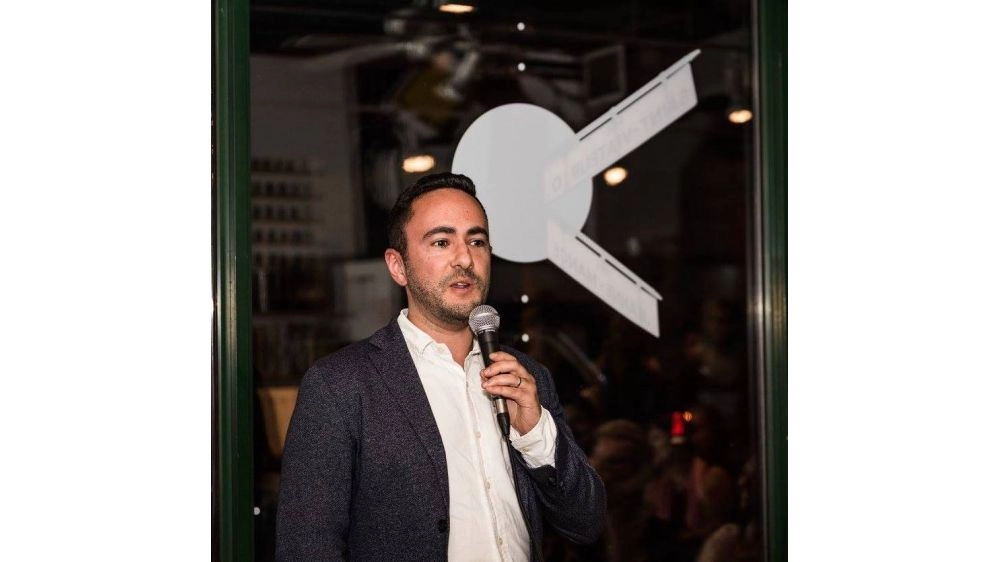
Listen to Joshua Levy tell the hilarious and beautifully profound story about the three times he met Leonard Cohen. This story was recorded at the vernissage for the "Leonard Cohen: Rituals of Absence" exhibit at the Museum of Jewish Montreal.Transcription
(0:00 - 0:13)
So, I'm going to tell you about the three times that I met Leonard. The first time was when I was a teenager and it was through his writing and his music. When I suddenly discovered him in the early 90s as a early teenager.
(0:15 - 0:24)
And of course, I loved his poems and his music and his books. I'm not going to talk about all that because you all know how great he was. You all know how great he was.
(0:25 - 0:42)
But I'll be a little radical and I'll say that I don't think that his writing or his music were the best things that he ever did. I think that there are others, although he's my favorite, I should put, songwriter and author. There are others who've written songs just as good like Bob Dylan or poems even.
(0:42 - 0:55)
But, you know, Bob Dylan was a shmuck or he is a shmuck from all accounts. I think that Leonard Cohen's greatest legacy is himself, the way he lived his life. He lived his life like a poem.
(0:56 - 1:12)
And when I started discovering him, my favorite thing besides all of his written work and his songs were his interviews that he did over the years. And I want you all to go look at them starting in the late 50s. He was just, he chose every word so carefully.
(1:12 - 1:24)
Like he was putting together a bouquet of flowers or trying to deconstruct the bomb. Even when he was just being asked questions. He just lived his life every decade.
(1:24 - 1:38)
He already, if you listen to interviews, he answers questions the same way in the 2000s that he did in the 60s. But he's changed a word here, a word there. And you can see that he's just, he's slowly just adding layers of paints to his life.
(1:38 - 1:45)
He wasn't a one trick pony. As you know, he was Jewish or he was Buddhist. He did Scientology.
(1:45 - 1:51)
He was interested in Christianity. He did every drug under the sun. He was always experimenting.
(1:51 - 2:07)
And yet, unlike all the hippies who, you know, eventually got Wall Street jobs, he stayed the course and he kept working at his craft consistently. So that's the first way I met him. The second time that I met Leonard Cohen was in person, less metaphorical.
(2:09 - 2:24)
We had a few false starts. The first time I physically met him was, physically might have sounded wrong. You know, Suzanne, that was me.
(2:25 - 2:42)
The first time, the first time I met him was actually at the funeral for his very good friend, Irving Layton, another Montreal Jewish poet, legend. And I went, I discovered Irving Layton through Leonard Cohen. And I went to pay my respects to Irving Layton.
(2:42 - 2:51)
And Leonard was there. He was one of the pallbearers and he spoke at the ceremony. And then afterwards, I was putting on my coat to leave and I turned around.
(2:52 - 2:58)
And Leonard was right in front of me. And he was, I realized my horror. He was trying to get by me.
(2:58 - 3:14)
And this man had meant so much to me in so many multitudes and so many ways for so long, was becoming aware of my existence for the first time. And all I represented to him was this physical obstacle. I was like a negative in his life.
(3:14 - 3:26)
So I wanted to say something, but I didn't think it was the best time. So I just got out of the way. And that was how I first saw him.
(3:27 - 3:41)
Then I started working at a company that's actually on this block. And I knew at this point he'd lost almost all his money. And he'd been spending a lot of time in Montreal, I think, to try to get back to his roots and rediscover who he was and lick his wounds.
(3:42 - 3:55)
And I knew he was in the area. So I'd go for walks around during my lunch break. And you know when you're waiting for someone to show up and every single person that walks in the door looks like that person, no matter how off they are for a split second.
(3:55 - 4:03)
So everyone in Montreal, I'm sure some of you, I probably saw and I thought you were Leonard Cohen. Until I actually did see him.
(4:03 - 4:22)
And he was walking on Portugal right to half a block from his house, except it was very cold. And at that moment, he was less a living legend than an old Jewish Montrealer who was a half a block from his house caught in the wind. So I let him go.
(4:22 - 4:32)
I didn't think this was a good moment to say hi. And I've never had a desire to talk to my heroes before. I don't think I would really have anything to say to them that would benefit them.
(4:32 - 4:40)
But for Leonard, it was always different. I just needed to speak to him. So I kept just wandering around and summer came.
(4:41 - 4:59)
And then I saw him sitting in Parc de Portugal, right outside his house. He was sitting. It was a beautiful summer's day.
(4:59 - 5:12)
But now is the time for it was a suitable environment for kibitzing. And across from him on another bench was this gorgeous blonde woman. She was making love to her cigarette.
(5:13 - 5:20)
And she was completely oblivious that Leonard Cohen was sitting near her. And I looked over his shoulder and he had drawn her. He sketched her on his pad.
(5:21 - 5:35)
And he was putting his fingers over her curves very sensually. And in front of him was a an electrical wire draped on the trees. And there were birds on the wire, like a necklace of birds on the wire.
(5:35 - 5:45)
It was I couldn't believe how Leonard Cohen Leonard Cohen was being. It was really something. So I let him have this Leonard Cohen moment.
(5:48 - 6:00)
And then once she got up and walked away, I went up to him and I had to say something. So I said, excuse me, I just, I just need to. I didn't know if I was supposed to say like, I know who you are.
(6:01 - 6:06)
Or just to launch into it. So I just decided to launch into it. Assuming he knew who I was.
(6:06 - 6:14)
And I said, I just wanted to thank you. You know, your work means so much to me. Thank you for being so relentless in your pursuit of the truth.
(6:15 - 6:27)
And for letting all of us look over your shoulder. And he kind of gave me a little wink. And I wish I could tell you that we then had this incredible life shattering conversation that I'll now impart to you.
(6:27 - 6:38)
But you know, we're Montrealers. So for the next 10 minutes, we spoke about the weather. And we spoke about the construction that was going on.
(6:40 - 6:49)
And, and, yeah. But what, I didn't walk away disappointed. Because he looked at me while I was talking with this intensity.
(6:49 - 7:00)
And this focus that I've never felt before or since from anyone. And I thought it was so generous. And you know the expression, a wise man can learn more from the fool than a fool can from the wise man.
(7:01 - 7:11)
I felt like he was sucking in, you know, my entire essence. Whatever was there, he was going to mine. Which is both, you know, made me feel good and terrified at the same time.
(7:11 - 7:24)
But this, the generosity of just the laser focus that he gave to me was really something. And then this, this incredible voice coming from this tiny little man. It felt like I was talking to, you know, an angel.
(7:25 - 7:41)
So that was the second time I met him. The third and final time was the night that it was announced that he died. And it was the day, you know, after the American election that the rest of us, Warren's cousins, found out.
(7:42 - 7:48)
And I was reeling from that news. And I felt like the world was ending. And then I got this message that Leonard Cohen had died.
(7:49 - 7:59)
And I thought, okay, this is proof. I thought of his song, you know, I've seen the future and it's murder. I thought, okay, this guy did not want any part of what's about to happen to the world.
(8:00 - 8:19)
And I was overcome by grief. So what do you do when you, when someone that you love dies is usually get together with the family, usually they're your family or a good friend and you want to be together. But, you know, I, I just had the sense that where I would find people like this was in Parc de Portugal, outside his place.
(8:19 - 8:35)
So I texted my brother and his wife, who loves Leonard just as much as I do. And we went and we bought a candle at the Depanneur, because that was the only thing that was still open. And this was going to be our Yahrzeit candle, which is the Jewish candle you write to commemorate the dead.
(8:35 - 8:44)
And we brought some wine and we went to Parc de Portugal. And there were only a few people there. And there were a couple of candles being lit.
(8:45 - 8:52)
But everyone was crying and singing. And we were singing a song. I brought a book of his poetry and we were taking turns reading from it.
(8:53 - 9:10)
And there were a bunch of people there who knew him quite well. There was an old man who was crying saying that when he had nothing, Leonard had hired him to go through his records in his house for months and months and months and gave him a place to live. And other people who had worked on documentaries on him and friends for 40 years.
(9:11 - 9:18)
But it didn't matter that we didn't really know him. They were still, we were embracing each other. And they could see on our faces that we did know him.
(9:18 - 9:38)
Everyone here is here tonight because we all knew Leonard Cohen through the magic that he put out. And Leonard, like I said before, when he did interviews, he always said the same thing. And since the early 60s, he would be saying when someone called him a poet, he'd say, ah, poetry is a verdict, not an occupation.
(9:39 - 10:01)
Meaning that, you know, who am I to say that I'm a poet? You know, let the people who read my poems decide that. And I have to respectfully disagree with him because a verdict sounds like we're all judges, you know, with our gavels deciding up above, completely not attached from the decision. And I don't think that's the case with Leonard Cohen or any good musician or poet.
(10:01 - 10:14)
Because his stuff, to be less eloquent, you know, it gets under your skin and it changes you. In that sense, it's more of a metamorphosis than a verdict. It's a collaboration between us and him and something new is created.
(10:15 - 10:28)
And I felt like as we were all holding each other, all strangers, and we were singing and talking about it, that the pollen of his life was clinging to us. And I just knew that something beautiful was blooming. Thank you.
Disclaimer
Please note that the views and opinions expressed in these recordings are those of the interviewee alone and do not necessarily reflect the positions of the Montreal Jewish Museum, its staff, or its Board of Directors. These recordings are presented as personal recollections for historical and educational purposes. Individual accounts reflect the interviewee's personal perspective and lived experience, and have not been independently verified for factual accuracy.
These transcriptions and translations have been produced using automated transcription and translation tools, followed by human review. Despite this process, inaccuracies may remain. If you identify an error, please contact research@imjm.ca with the page link and your suggested correction.