
Listen to this Oral History
Description
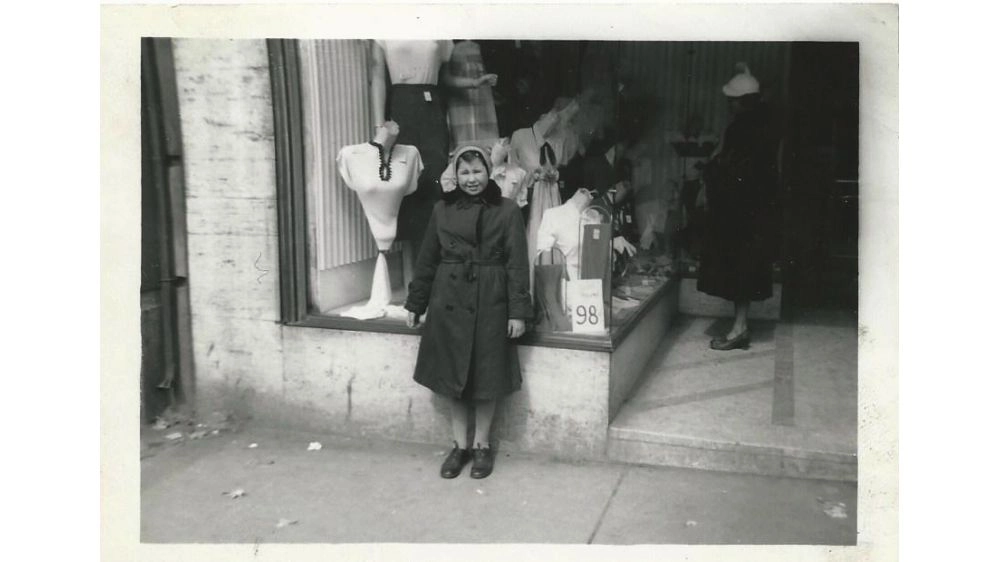
Listen to Carol Katz recount her memories of growing up in the Mile End, with lively tales of food, family, and holidays, as well as hilarious stories from her days at Camp Kvutza and endearing descriptions of her teachers from the Jewish People's School.Transcription
(0:00-0:20)
I was born in 1941 and I grew up on Park Avenue, 5681A, in between Bernard and St. Viateur. Most of the area was Jewish at the time. I, and my friends, went to Jewish people's schools and loved every minute of it, studied Hebrew, Yiddish.
(0:20-0:55)
I remember in those days, especially Rosh Hashanah, we all had new outfits and we would go hand in hand and take up the whole street wishing everybody a Happy New Year. There was a small shul, I think it was the Beis Moshe on the street, where I used to go with my father. Now there was a rialto, it's now the Rialto Theater. It used to be Rialto Hall and that's where I took ballet lessons and tap lessons. And my mother used to go to a butcher on St. Viateur called Gottlieb the Butcher.
(0:55-1:56)
Those days there were no shopping centers, there was no delivery. We had an icebox. There were no fridges. So my mother would go every single day. She'd decide what she's making for supper, then she would go to Gottlieb the Butcher, get her meat, kosher meat of course.
We kept the kosher home and came back and made it. And on, I think it was on Bernard Avenue or maybe St. Viateur Avenue, there was a fish store with barrels of schmaltz herring and we used to go put our hands in and bring home schmaltz herring, which was very salty. I don't know how we ate it. I don't think I could eat that salt today, but our mothers used to send us there. And we also had uniforms in those days, tunics. We wore tunics and white blouses, which was maybe a little easier. We didn't have to worry about what to wear. Also, we were all in the same financial bracket. None of us, none of our fathers really made a lot of money.
(1:56-2:26)
My father worked for Pascal's Hardware Store. First he worked in a factory that closed down, and then he worked for Pascal's Hardware Store, which didn't earn him a very heavy salary, but he earned enough to clothe us and feed us and even enough to send me to have a Jewish education. My grandmother, my mother's mother, actually insisted that I learn some Yiddish and Hebrew, which I did.
(2:26-3:01)
My best friend, Naomi Zik, her father worked, what's called, in a factory, it was called piecemeal. When he worked, he got paid, and then for months he didn't work. But I don't remember being deprived. We didn't have television sets. We didn't have computers. We didn't have any of those. We played outside. And I remember I would bring home, it doesn't matter how many people, to my home. We had a very small three and a half room apartment where the living room was my parents' bedroom, but there was always milk and cookies for anybody who wanted.
(3:01-3:41)
Mrs. Zik, her apple cake was just scrumptious. And then there was Camp Kvutza. And Camp Kvutza then was in St. Faustin. And there were four shack wooden bunks, two for girls, two for boys, no shelves, no bathrooms. We lived out of our trunks. There were outdoor toilets.
You had to walk across the hall. If you had to go in the middle of the night, you went behind the bunk. It was dark. You were scared. We washed our own clothes. There was no laundry.
Some of the counselors had to sleep in tents. And we cleaned the whole place. And we loved it.
(3:41-4:26)
We hired a cook. And we had to, though, each one took a turn working in the, we called it the chadar ochel, the kitchen there. And each one of us took turns helping to cook.
She just cooked. We peeled potatoes. We prepared the vegetables, everything we cleaned up after, we washed dishes. We cleaned up the dining room. We were expected to clean on Fridays. We took all our beds out and swept and swept the bunks and swept the thing. And then Friday night, we had Shabbos. We dressed in white. And we sang Shabbat songs at the flagpole. And then there was visiting day, right? One day, parents came up for visiting day. And we cleaned the whole camp.
(4:26-5:05)
One of my friend's mothers was very, very fussy about cleanliness. And they came up, and she said, Oh my God, the dirt, the dirt, the shmutz. What are you living in? I'm taking her home. She screamed, and she yelled, and we screamed, and we yelled, and we pulled, and she pulled, and she stayed. Then I bring home a trunk of clothes. Ma, this is clean, this is dirty. Oh yeah. So she took the whole thing, but she couldn't figure out what was clean. So she took the whole thing and threw it and washed it by hand. She washed it on a washboard. Those were, I'd say, fun days.
(5:05-6:11)
And I didn't feel our parents struggling. I think they did. But the point is, we were happy in those days. I love my Yiddish and Hebrew studies. As a matter of fact, I'll tell you a little story about that. Mr. Wiseman, who's now gone, Shlomo Wiseman was the principal of the school. And one day, my mother went to him, I only learned this years later, when I was in grade one and said, I'm sorry. I have to pull her out. I just can't afford to pay anymore. And at that time, he said, there's no way you're pulling her out. She's a very good student. You'll pay when you can pay. And that really, really got me. At that time, I also went, there was no high school. And so after grade, we finished in grade seven at that time. And then I went to, I went to Garem Ding High School for two years and Outremont High for the last two years. Then I went to Baron Byng High School. A few of us wanted to study. And every day after school, we went to Jewish people's schools and we had teachers and we studied Yiddish Hebrew.
(6:11-7:07)
Now, those teachers had just come out of the Holocaust. And they really wanted to teach. I don't think they were earning very much. There was Paul Trepman. There was a Mr. Hellman. Shem Shendonsky. Shem Shendonsky. He was a really gentle soul. And I remember one day, he said to us, he said to us, you know, and this was all in Yiddish, he told me, he said, I want to tell you how you should respect all books. He says, you know, I was on a bus and it was pouring rain and there was a book on the ground and people stepped on it. And he said, never do that. All books have to be respected. The things that stayed, it stayed in my mind for years and you can see our home is full of books. I've always loved books. Anyways, we had a real love of reading books.
(7:07-8:20)
We studied Shalom, Shalom Aleichem. We studied all this literature in Yiddish. And there was somebody, I forgot his first name. There was Mr. Bach and there was Mr. Hellman. Mr. Hellman was also one of our teachers and apparently something was bothering him. And one day he said, you know, he said, I was in a camp and he said, and we were divided into two and my wife and daughter were here and I was here and my daughter was your age and she was lost. And those things like really got us you know, we didn't know. And one day, it was before Yom Kippur and he went to the back of the class and he started to sing Kol Nidre. We laughed unfortunately until later we realized what this was all about. You're kids, you're in grade three, grade four, you don't know. Later, I realized what this man, what it meant to him, you know, and then Paul Trepman used to call me Hanala all the time. My Hebrew name is Hana, Hana, Hanala.
(8:20-8:55)
Well, we would be studying and one day he said, Hanala, can you go to the corner and get me an Alka-Seltzer? And we thought this was very funny and I did. And then in reading, reading more about it, the hunger, I thought they must have had stomach problems. We sort of laughed at these things. Wow. So these were my teachers, all, they were all, all dedicated, all really, really wanted to impart some Yiddish to their students.
(8:55-9:27)
So these are the memories. And like I said, I finished, I went back to library school much later when I had children and a husband and I finished in 1989 and Jewish Public Library hired me as their archivist and I was very excited. There were my teachers, Shem Shandunsky and there were Paul Trepman and there were their archives, their writings. I knew them as teachers. It was only later that I began to know them as people.
Disclaimer
Please note that the views and opinions expressed in these recordings are those of the interviewee alone and do not necessarily reflect the positions of the Montreal Jewish Museum, its staff, or its Board of Directors. These recordings are presented as personal recollections for historical and educational purposes. Individual accounts reflect the interviewee's personal perspective and lived experience, and have not been independently verified for factual accuracy.
These transcriptions and translations have been produced using automated transcription and translation tools, followed by human review. Despite this process, inaccuracies may remain. If you identify an error, please contact research@imjm.ca with the page link and your suggested correction.