
Listen to this Oral History
Description
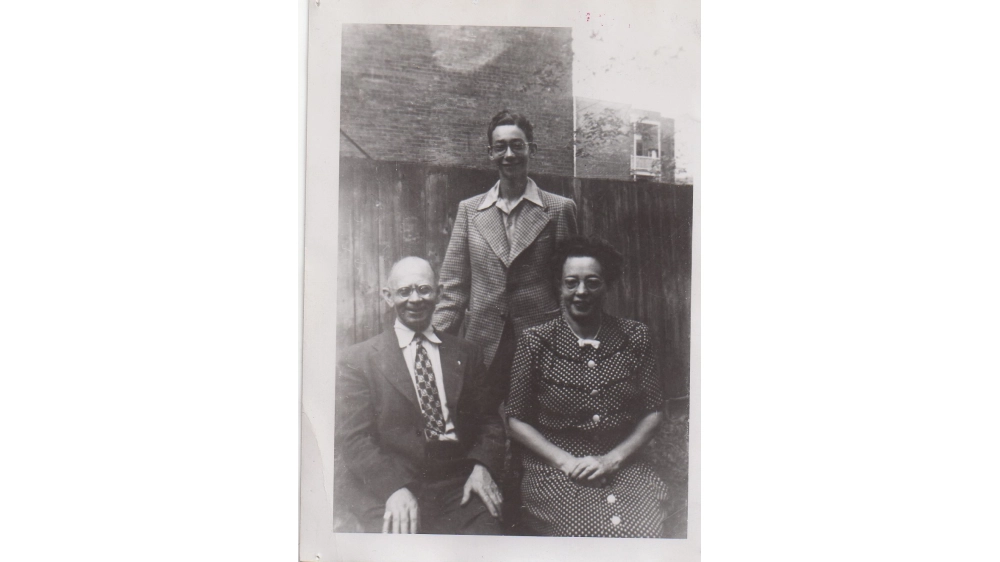
Jack Hoffman shares memories of his mother, Esther Hoffman, and her experiences working as a seamstress, and details of his mother opening up a ladies ready to wear on 5615 Park Avenue.Transcript
(0:00-1:30)
My name is Jack Hoffman. I grew up in Montreal during the 40s. I'm 83 years old. I'm the son of Esther Smolkin Hoffman, who was born in Russia in a small town called Horodetz. And she grew up in a large family, which was the norm at that time, probably about 10-12 siblings. And came over to, was brought over to Canada by some of her siblings who had already come over. And grew up in Buckingham, Quebec, which is in the Outaouais, which is near Ottawa. And a lot of her siblings grew up and worked and had stores, most of them in men's fashions, in the Ottawa Valley. So in Ottawa, Cornwall, Alamond, Smiths Falls, and other places.
Her date of birth is September 18th, 1893. And she passed away October the 11th, 1988. She married, I don't have the date, and my father is Paul John Hoffman.
(1:30-3:55)
And they moved to Montreal. And she was a seamstress in Buckingham. And they did alterations for ladies' clothing. And decided to open up a ladies' ready-to-wear on St. Lawrence. And had the store there for a few years. And then decided to move to Park Avenue, which she felt was a much better area to have. And it was more of an upscale area, if you will. And that area where they had Steinberg's store, the whole area from St. Viateur to Bernard was all filled with stores. And of course, the population around that area was immense.
So, if you take all the areas from going from Mount Royal and going to St. Lawrence and going up to Outremont and going up to Van Horne, it was a huge population area. And as I remember it, she started her business of getting ladies' clothing from a lot of the Jewish ladies' ready-to-wear manufacturers. And there were a lot of them in Montreal.
And I believe that she started off by getting dresses from them, what we would call “on consignment”, and paying them off as she sold them and got more and more new dresses. And so she had the latest fashions at that time in Park Avenue. And for all the women who lived in that area, it was a lot easier for them to go to her store rather than having to go downtown to get the similar fashions. And as well, because her overhead was much lower than those who were at stores downtown, she was able to sell her dresses at a much lower price and was very competitive in that sense.
(3:55-6:06)
Her store carried a lot of wedding gowns. And the reason for that is, of course, because all women need to have a wedding gown at one time or another. So, she had a very extensive selection of wedding gowns. The store was at 5615 Park Avenue, and we lived above the store, which meant that she was on hand pretty much all the time the store was open, which was open until very late hours, usually I think to 10 o'clock at that time. And she had some very good salespeople.
The store had an entrance, and on the side of the entrance were two large windows with mannequins in the windows showing the latest fashions. And when you walked into the store, there were all kinds of racks of ladies' dresses with accessories. And to one side, as you walked in, there were fitting rooms or dressing rooms, and there were also two at the far end of the store. To the left of the dressing room, there was a stairs going upstairs to an area where my father was the bookkeeper and had a small little place where he could do the books and two at the same area just going along to the end of the store to the side. There were seamstresses, several with sewing machines.
And one of the beneficial aspects of that was that women who came in and needed alterations, if they weren't very extensive, they could have them done on the spot, which is a great advantage. And of course, if there were more alterations, they could come back later to pick up and try on the dress.
(6:06-8:03)
The flat above or the living room on top of the store had three bedrooms, a master bedroom and another bedroom in a very small one where I live. There was a large distance. The fact that she lived above the store, as I mentioned, was very good and that she was able to be in charge of the store for pretty much all the time it was open. And the customers really liked to have someone like that serving as well as the others.
At that time, I was going to school. I was in public school, then in high school. And then when I had to make a decision, if I want, what area I want to do, I decided to become a pharmacist. And that was about the time when my mother was thinking about closing the store. She was getting on and she thought that it was a good time for her to retire. Her younger sister, who was married to a gentleman who was involved in the Kik Company, which is like a coke company.
And when he passed away, she asked my mother if we would all move into her large Outremont cottage, not a cottage, but it was a duplex. And my mother decided it was a good time for her to do that as well. She's going to sell the store, there was no need for us to live upstairs. And that's what happened.
(8:03-
And so, instead of going to university pharmacy in Quebec, I decided to go to University of Toronto. I was accepted and I graduated there. And of course, so then I came back to Montreal because my mother decided she didn't want to move to Ottawa yet. And she preferred to stay in Montreal. I started practice here in Montreal.
The store closed, I believe in the mid, mid to late fifties. As I say, she was getting on in age and she decided that she wanted to have some time to enjoy life and maybe do traveling, and she did for several years, go down to Florida.
Disclaimer
Please note that the views and opinions expressed in these recordings are those of the interviewee alone and do not necessarily reflect the positions of the Montreal Jewish Museum, its staff, or its Board of Directors. These recordings are presented as personal recollections for historical and educational purposes. Individual accounts reflect the interviewee's personal perspective and lived experience, and have not been independently verified for factual accuracy.
These transcriptions and translations have been produced using automated transcription and translation tools, followed by human review. Despite this process, inaccuracies may remain. If you identify an error, please contact research@imjm.ca with the page link and your suggested correction.